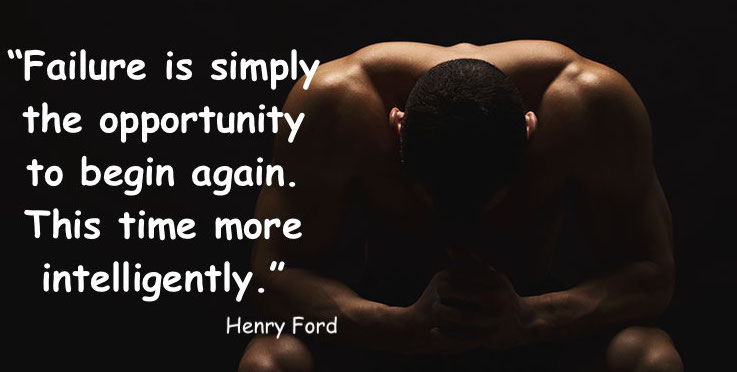
Failure can be a beautiful thing for kids, if only they’d give it a chance

I was a high school teacher for 20 years. I mention this so you’ll know I’ve spent a great deal of time around children. During that time, I met far too many kids who were terrified of failing, which made them unwilling to try anything new. School—high school especially—is where young people should take advantage of extracurricular activities like sports, drama, clubs, music, art, debate, and whatever else they’re offered. But in my experience, few children took advantage of those opportunities.

Because much of my background is in sports and so many of our young people are in need of exercise and socialization, I often encouraged students to pick a sport.

“I don’t know how to do that,” a child would say.

“Not a problem. The coach and other players will help you learn,” I’d counter.

One kid shot back, “No! Our team sucks!”

“Then perhaps you could help them improve.”

There are a number of reasons young people may fear failure. Some children have low self-esteem and little confidence. Sometimes kids are bullied and believe they’re not good enough. And sometimes parental pressure is the problem. All of these issues compel young people to stay in their comfort zone, making it difficult for them to stretch and grow. And, sadly, many become underachievers, who lack the skills to achieve their dreams.

Michael Jordan could have quit when he failed to make the high school varsity team when he was a sophomore, but that failure made him push himself even harder.

Maybe they’d feel better if they understood that even the greatest athletes, artists, and business people suffer from insecurity, at times. The difference is they manage to shake off their fear and push forward, learning as they go.

In my efforts to get my students to try new things, I often used the story of Michael Jordan, who famously didn’t secure a spot on his high school basketball team when he was a sophomore. Jordan was a skinny 5’10’ player who after tryouts was relegated to the junior varsity squad. I’m guessing he was disappointed, but did he quit? No! He worked harder and today is known as the NBA’s greatest player of all time.

Some  of my students understood that failure could be used as a tool for growth. There’s a special place in my heart for the wide receiver who dropped an easy catch a few yards from the endzone, a touchdown that would have won the game. And the kid who struck out swinging with the bases loaded in the final inning. And the one who, with the game on the line, missed the free throw. These children picked themselves up and arrived at practice the next day ready to give it another try. And that is a beautiful thing, don’t you think?

This willingness to step into the spotlight, fail, and learn from one’s mistakes is one of the most valuable skills a child will ever learn, one that is at the very heart of succeeding in life.

Anne Montgomery’s novels can be found wherever books are sold.

Goodreads

Amazon

As the job market changes, get ready to pivot

In a world of rapidly changing technology, job seekers must be ready to monitor and adjust.

When I was a teacher, much of my job was about helping students plan for the future. The idea was to determine where in the business world they might be happy and thrive. The process wasn’t difficult, if I could get a child to answer those three important questions: What do you like to do? What are you good at? What will someone pay you to do?

Over 20 years, I posed those queries to just about every student who walked through my classroom door, but looking back, I think I might have failed them, because I never saw Artificial Intelligence coming.

Like many people, I watched those sci-fi films where robots evolved and threatened human existence. Movies like Stanley Kubrick’s 1968 epic 2001: A Space Odyssey, where Hal, the computer with a human personality, took control with deadly consequences. In the same vein are The Matrix, I Robot, Westworld, and Ex Machina, where humans find themselves second-class citizens in a mechanized world.

While I don’t want to go all doom-and-gloom, the rise of the machines will change our world exponentially, primarily in the area of jobs. It’s estimated that within the next 20 years no humans will be working as travel agents, truck and ride-hailing drivers, bank tellers, sports officials, warehouse personnel, cashiers, and fast-food workers. Publications like newspapers and magazines will be entirely digital, jettisoning the folks who print and deliver periodicals. I even saw a video recently about a three-story building that was being assembled using a 3D printer. Only two men were required at the site to monitor the process, eliminating the need for construction workers.

Astronaut Dave didn’t have much of a chance against Hal the computer in 2001: A Space Odyssey.

You may have noticed that most of these jobs are considered low-skill positions, occupations that don’t require a big investment in education. But high-skilled employment will not go unchallenged. With ChatGPT—an Open AI model that can speak, think, and grow—jobs held by creatives like authors, artists, musicians, screen writers, and video game and graphic designers are also in peril.

So, what do we do now? We can’t stop AI; no stuffing that genie back into the bottle. It’s estimated that by 2030 between 400 to 800 million jobs will be eliminated by automation. As many as 375 million people will have to find new occupations. That means we must teach people to monitor and adjust. There will be no staying in one career for life. We have to learn to pivot and try new things. Be life-long learners, as the job market changes.

Recently, Microsoft co-founder and philanthropist Bill Gates spoke at the commencement cermony at Northern Arizona University where he offered this advice. “Your life isn’t a one-act play. What you do tomorrow, or for the next ten years, does not have to be what you do forever.”

The good news is that even though many jobs will disappear, others will emerge. A good place to start planning your future is the Bureau of Labor Statistics, a governmental agency that keeps tabs on overall job growth, as well as impending growth in individual occupations over the next ten years.

So strap yourself in and be open to a future that will be everchanging.

It should be quite a ride.

Anne Montgomery’s novels can be found wherever books are sold.

Goodreads

Amazon

Amazing things I’ve learned from cooking shows

If you’ve never watched Guy Fieri’s Diners, Drive-ins, and Dives, I highly recommend it.

I watch the news a lot, but sometimes the world’s happenings are hard to bear, so to give myself a little break I periodically switch over to PBS where they have those wonderful programs that make me forget what’s going on.

I’m talking, of course, about cooking shows.

There are perfectly good reasons why I love cooking shows. I worked in the restaurant business in my youth and was married to a chef for a while, so I like to think of myself as a bit of a foody. My sweetie pie also loves to cook—in fact my ex-husband gave him some pointers and once exclaimed that, “Ryan makes the best coq au vin I’ve ever tasted!” I fell in love with cooking shows when Ry introduced me to Diners, Drive-ins and Dives, hosted by chef Guy Fieri, the most un-chef-like chef you’ll ever meet. (Give it a try!)

It’s amazing that people used to think tomatos could kill you. They missed so much yummy goodness.

I bring this up because sometimes I learn fascinating things about food from these shows that have me running to the computer to learn more. Like the fact that Europeans, upon meeting a tomato, decided it was poison. Why you ask? Because only wealthy people could afford these fantastical New World fruits—yes, a tomato is a fruit—and strangely those rich folks started dying after eating what came to be called “poison apples.” Poor people blamed the tomato, when in fact it was the pewter plates that were knocking off the rich because of lead poisoning.

When Catherine de Medici was shipped off to France to marry the king, she made sure to bring artichokes with her, even though women were forbidden to eat them.

Then there’s the artichoke, which most 16th century European women were banned from eating, because the vegetable was believed to make people feel…um… frisky. All the way back in ancient Greek times that prickly plant—called kaktos by the locals— was thought to be an aphrodisiac. And when Italy’s Catherine de Medici was shipped from her home in Italy, where women relished the artichoke, to France where she married King Henry II at the tender age of 14, she exclaimed, “Oh, mio dio!” when she was told that eating her favorite vegetable was a no-no, even though men were free to consume it. However, Catherine was lucky because Henry didn’t seem to mind her constantly scarfing down artichokes. It’s good to be the queen, apparently.

Puffer fish are cute but also poisonous, and yet Japanese people eat them.

Puffer fish are an interesting food, as well. People eat them even though THEY CAN KILL YOU! Before I go on, let me say that I’m a scuba diver and puffer fish are very cute, so I would never eat one. Also, I don’t want to die a miserable death from poisoning. In Japan, however, puffer fish are all the rage. A Japanese friend once explained that even though the fish contains a toxin called tetrodotoxin which can cause paralysis and death, people eat it because the chefs who prepare the delicacy must take a national test and practical examination to be allowed to prepare and serve it. She also explained that eating puffer fish is a manly exercise, where a dude’s masculinity quotient is elevated because he’s so very brave for eating a poison fish. Kind of a mine’s-bigger-than-yours contest.

The point, I guess, is there’s a giant world of interesting food out there and we should learn about it, especially since it’s so much more entertaining than the news.

Anne Montgomery’s novels can be found wherever books are sold.

Goodreads

Amazon

On being invisible

Now 88, brilliant actor Maggie Smith practically dares you to look away.

For most of my adult life, I’ve had the ability to walk into a room full of strangers and strike up a conversation with just about anyone.

Now, at 68, whenever I walk into a room nothing happens.

Nothing!

I’ve become invisible.

And I’m not the only one. Friends—women in my age group—have told me the same thing. No heads turn to greet us. No one smiles from across the room. No one seems to notice us at all.

Studies show that after 49 the attention strangers pay to women plummets.

Israeli-American writer Ayelet Waldman was interviewed as she approached her 50th birthday. “I have a big personality, and I have a certain level of professional competence, and I’m used to being taken seriously professionally,” she said. “And suddenly, it’s like I just vanished from the room. And I have to yell so much louder to be seen. . . I just want to walk down the street and have someone notice that I exist.”

This invisibility can be exhasperating. Recently, I was at an event in San Diego. Dinner and drinks were part of the festivities, which generally leads to myriad conversations. But as I walked among the other guests, looking for some geniality, people turned away. I promise you, I’d bathed and was dressed appropriately, and still…nothing.

Occasionally, some older women do get recognized. Take Martha Stewart’s recent foray into posing in a bathing suit on the cover of Sports Illustrated. At 81, the former queen of homemaking was poured into various swimsuits, artfully draped, and air brushed to perfection. I guess we’re supposed to be impressed that the magazine known for showcasing young, rapier-thin women with big breasts and flat stomachs, gave a nod toward the more mature crowd. Still, I think I’d be more impressed with Stewart’s spread if she’d been allowed to actually look, you know, older. While she claims to have foregone plastic surgery, the photos have clearly been run through photoshop and numerous other magic filters, because there isn’t an 80-year-old alive with that kind of flawless skin. Is the assumption that SI readers would turn away if Stewart actually looked her age? Or, even worse, they’d just ignore the whole endeavor?

I “aged out” of my job as a sportscaster when I was pushing 40, the idea being I was no longer hot enough to appeal to male viewers.

Note that the problem of invisibility is not just about our egos. There are real world implications to aging. In The Atlantic article “The Invisibility of Older Women,” Akiko Busch said, “The invisible woman might be the actor no longer offered roles after her 40th birthday, the 50-year-old woman who can’t land a job interview, or the widow who finds her dinner invitations declining with the absence of her husband.”

I can relate to the 40-year-old actor. When I was pushing 40, I was suddenly unable to find a TV sports reporting job, even though I’d worked for five stations, including ESPN where I’d anchored SportsCenter. The problem? The sports target audience is 18-to-34 year old males, and once a woman exceeds that boundry the idea is men will no longer watch. (Note that while you will see some “older” female sports reporters today, the pendulum remains mostly stuck on the side of youth and beauty.)

So, what can we do? Helen Dennis offered some advice in her Los Angeles Daily News article “How older women can combat feeling invisible or unseen in social situations.”

  1. Be interested & interesting
  2. Use humor
  3. Stay current about world events
  4. Show interest in others; make appropriate conversation
  5. Dress well and age appropriately
  6. Take an interest in people who are younger and older than yourself
  7. Stay curious about life
  8. Respect your life and stay engaged
  9. Engage in conversation with wallflowers
  10. Always speak kindly of others and avoid gossip

While that seems like a lot of effort, women still in the business world need to stay relevent, if they want to climb the work ladder. But for those of us who are retired, maybe all we need is a mental reset. I sometimes think of actors like Jamie Lee Curtis and Kate Winslett, both of whom have battled the Hollywood beauty and age police. Then there’s the brilliant Maggie Smith who has no qulams about showing her age. And the incomperable Frances McDormand who looks straight into the camera barefaced, daring viewers to see her for who she is.

Taking their example, here’s hoping we regular folks can someday walk into a room with the same strength and determination, so we might force those around us to not look away.

Anne Montgomery’s novels can be found wherever books are sold.

Goodreads

Amazon