Allotment Annies: Polygamist wives of war

Was Bud Richardville’s wife an Allotment Annie? It’s quite possible that she was.

During World War II, American servicemen were confronted by many dangers on foreign soil, but they were also at the mercy of some homegrown risks: women who spent their time enticing men to marry them. These women seduced young servicemen—many of whom were naïve and away from home for the first time—into whirlwind marriages, just as they were about to ship out.

It would be discovered later that some of these women, who would be dubbed Allotment Annies, were married to multiple servicemen at the same time. Elvira Taylor is one of the few women to be prosecuted for what was essentially polygamy, after she was found to be married to six sailors at the same time. Taylor might have gotten away with her crime had two of those men not reportedly met in an Australian pub. There they did what men in love do. They took out photos of their wives, and were shocked to discover that they were married to the same woman.

But why would women marry multiple men during a war? The answer is simple: money! Wives of servicemen were issued a weekly allotment of $20, which doesn’t sound like much today, but back in 1945 was equivalent to almost $340. Multiply that by four and Elvira was pulling in $1360 a month. When you consider that the median income in the U.S. at that time was just $1,400 annually, you can see why women were tempted to game the system. On top of the weekly stipend, wives were entitled to a one-time death benefit of $10,000, which works out to about $170,000 today.

I’m now patting myself on the back for doing a little math—not my best subject—but the numbers are important in regard to Allotment Annies, women I will now defend, if only a little. High-paying job opportunities were practically nonexistent for women at that time. Though they toiled in factories and in other sectors for the war effort, I’m sure many realized that when the boys came home, their time in the workforce would end. They’d had a taste of earning and managing their own money, and no doubt many chaffed at going back to being dependent on men for an income.

We will never know just how many women married servicemen for the paychecks and death benefits, but the issue was well-known to the military which produced videos warning men about the practice. Even Hollywood got into the act with the 1945 film noir release of Allotment Wives, a story about an Army investigator who tries to stop a woman from preying on unsuspecting soldiers.

I mention Allotment Annies because over the course of my research for my World War II historical novel Your Forgotten Sons, I became convinced that I’d found one. The book, inspired by a true story, traces the path of Sergeant Bud Richardville who was inducted into the Army in 1943 as the United States prepared for the invasion of Europe. He met a woman named Lorraine—at least that’s what she told him—and they were quickly married before he deployed.

The marriage would cause Bud great pain and confusion, and it wouldn’t be until years later, long after both Bud and Lorraine were dead, that questions about the union were broached. Had Bud married an Allotment Annie? And why is it that records indicated there was never a marriage, even though Lorraine received and cashed his allotment checks? Bud writes about his “wife” constantly in his letters. Clearly he believed he was married to Lorraine, but so apparently were two other men. Whether these marriages overlapped is unclear, but in those days divorce was practically unheard of, so multiple marriages would certainly have been looked upon with suspicion.

One wonders about the mindset of the women who duped unsuspecting servicemen into marriage as they headed off to war. Were they desperate, greedy, or just cruel? It’s unlikely we will ever know.

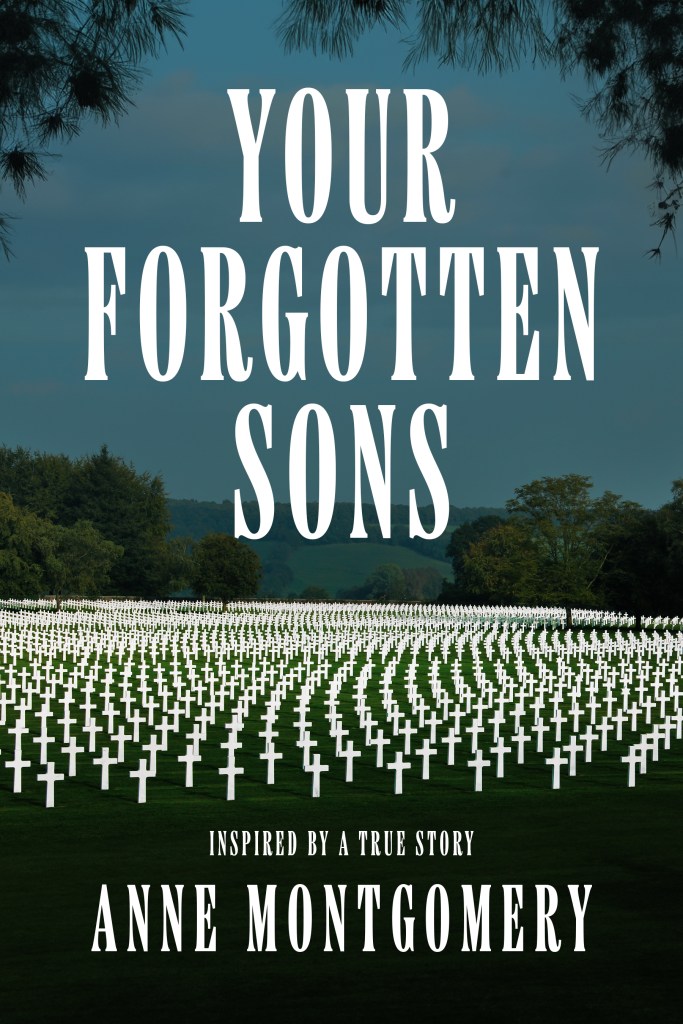
Your Forgotten Sons

Inspired by a true story

Anne Montgomery

Bud Richardville is inducted into the Army as the United States prepares for the invasion of Europe in 1943. A chance comment has Bud assigned to a Graves Registration Company, where his unit is tasked with locating, identifying, and burying the dead. Bud ships out, leaving behind his new wife, Lorraine, a mysterious woman who has stolen his heart but whose secretive nature and shadowy past leave many unanswered questions. When Bud and his men hit the beach at Normandy, they are immediately thrust into the horrors of what working in a graves unit entails. Bud is beaten down by the gruesome demands of his job and losses in his personal life, but then he meets Eva, an optimistic soul who despite the war can see a positive future. Will Eva’s love be enough to save him?

Release Date: June 6, 2024

Pre-Order your copy today

Amazon

Apple Books

Barnes & Nobel

Google Books

Kobo

Review a copy early by going to NetGalley. Sign in here.

Find Anne Montgomery’s novels wherever you buy books.

Goodreads

Amazon

Writing historical fiction can be tricky

I almost got tripped up a few times, when writing about World War II Jeeps.

My new book, Your Forgotten Sons, is a work of historical fiction, a story inspired by Sergeant Joseph “Bud” Richardville who worked in the Graves Registration Service in Europe during World War II.

As many authors know, writing about the past can be tricky. One reason is we tend to look at history through our own modern-day lens. For example, when I was writing about Bud, I often had him riding in a Jeep. Today, Jeeps are ubiquitous on civilian roadways, but the origins of the vehicle are steeped in war.

Scripps Howard WWII reporter Ernie Pyle once said of the Jeep, “It did everything. It went everywhere. Was as faithful as a dog, as strong as a mule, and as agile as a goat. It constantly carried twice what it was designed for and still kept going.”

No doubt current Jeep owners prize the vehicle for many of the same attributes. The problem comes when one sees a Jeep and misses the evolution that led to today’s version. When I first wrote Your Forgotten Sons, I had Bud starting a Jeep with keys and adjusting the rearview mirror. Oops! Jeeps back then started with a pushbutton and the vehicles had no review mirrors.

I also had Bud and his fellow soldiers eating K-rations, but I would learn that he and his peers actually consumed C-rations. What’s the difference? K-rations were heavy, having been designed for static warfare, like the trench battles of World War I. But World War II was a different type of war, with fast-moving trucks and tanks and parachute troops who needed lighter combat rations, because soldiers were constantly on the move.

When I first envisioned Bud, I saw him in a green T-shirt, the iconic color of the Army. Today, Army personnel wear undershirts defined as Tan 499 which has a slight green tint to it, a shade referred to as “coyote”. But in Bud’s time, the plain, white cotton T-shirt was what all male service members sported.

When writing about the World War II era, I had to pay close attention to the facts. Luckily, the time is well documented with videos, and photographs, and eye-witness accounts. But consider writing about periods that go way back in history. My novel Wolf Catcher takes place in both modern times and the 11th century in what would become Arizona. I once wrote a scene where Native people used honey to sweeten their food, which could never have happened, because it was not until the early 1600s that European settlers first brought honey bees to the Americas.

It’s clear, then, that when authors choose to write stories based on history, they need to be meticulous in their research.

I’m working on it.

Your Forgotten Sons

Inspired by a true story

Anne Montgomery

Bud Richardville is inducted into the Army as the United States prepares for the invasion of Europe in 1943. A chance comment has Bud assigned to a Graves Registration Company, where his unit is tasked with locating, identifying, and burying the dead. Bud ships out, leaving behind his new wife, Loryane, a mysterious woman who has stolen his heart but whose secretive nature and shadowy past leave many unanswered questions. When Bud and his men hit the beach at Normandy, they are immediately thrust into the horrors of what working in a graves unit entails. Bud is beaten down by the gruesome demands of his job and losses in his personal life, but then he meets Eva, an optimistic soul who despite the war can see a positive future. Will Eva’s love be enough to save him?

Release Date: June 6, 2024

Pre-Order your copy today

Amazon

Apple Books

Barnes & Nobel

Google Books

Kobo

Review a copy early by going to NetGalley. Sign in here.

Find Anne Montgomery’s novels wherever you buy books.

Goodreads

Amazon

Who was Bud Richardville?

In 1943, Sergeant Bud Richardville left a new wife and headed off to World War II to serve in the Graves Registration Service. But he never came back and questions about his death lingered for 75 years.

Joseph “Bud” Richardville was not very different from the millions of other young men who served in the U.S. military in World War II. He came from rural Indiana, where his family lived in poverty, a hangover from the Great Depression. He knew little about the world outside of Vincennes, but as the inevitability of the coming conflict became clear, Bud moved to Michigan to work in the paper mills, an industry that was essential to the war effort and which kept him stateside until he was drafted in 1943.

When Bud boarded the train for Camp Warren, Wyoming that summer, he was 29 and found himself riding with other soon-to-be soldiers who were mostly kids, many still in their teens, some excited to be away from home for the first time, others quiet, perhaps fearing what was to come.

Once at bootcamp, Bud was assigned to the Graves Registration Service. Family stories indicate that when Bud was young he’d periodically been called upon to help remove the corpses of those who’d fallen from the trains that trundled through his neighborhood, travelers who’d jumped aboard, hoping for a free ride, but who’d slipped and fallen to their deaths. Perhaps he’d mentioned this fact during his induction at Camp Warren and that familiarity with the dead colored the decision to place him in a GRS. Bud would serve in the 606 Graves Registration Company where he and his brethren were tasked with locating, identifying, and burying the dead.

Sgt. Bud Richardville died just after the German’s surrendered in 1945. He lies in the American Cemetery in Épinal, France.

Think about that for a moment, and consider that the gathering of war dead is an undertaking that seems to have been erased from history. Consider all of those war movies where soldiers are mowed down on the beaches of Normandy or are mortally wounded on foreign battlefields, young men, some blown to pieces. But once their deaths are confirmed, the camera moves forward, ignoring the carnage.

It was left to those in the Graves Registration Service to gather up the horrific aftermath of battle in the hope of making some order out of all that death. They did their utmost to retrieve and identify the fallen and design and build the cemeteries that would hold their remains. Today, about 130,000 American war dead are said to be buried on foreign soil, men and women who were laid to rest with the reverence they deserved, because of the dedication of those in the GRS.

The efforts of Bud and his men additionally served another vital purpose: morale. As wave after wave of soldiers hit those Normandy beaches, the dead had to be collected quickly, so as not to traumatize the incoming troops. It is not hyperbole to say that the job of those in the GRS is perhaps one of the most difficult and least appreciated in the history of military service. And it is easy to understand the torment many of these soldiers, including Bud, faced for the rest of their lives.

It is ironic, perhaps, that Bud’s final resting place would be in the American Cemetery in Épinal, France, where he was buried by his brothers who also served in the GRS.

Your Forgotten Sons

Inspired by a true story

Anne Montgomery

Bud Richardville is inducted into the Army as the United States prepares for the invasion of Europe in 1943. A chance comment has Bud assigned to a Graves Registration Company, where his unit is tasked with locating, identifying, and burying the dead. Bud ships out, leaving behind his new wife, Lorraine, a mysterious woman who has stolen his heart but whose secretive nature and shadowy past leave many unanswered questions. When Bud and his men hit the beach at Normandy, they are immediately thrust into the horrors of what working in a graves unit entails. Bud is beaten down by the gruesome demands of his job and losses in his personal life, but then he meets Eva, an optimistic soul who despite the war can see a positive future. Will Eva’s love be enough to save him?

Release Date: June 6, 2024

NextChapter Publishing

Pre-Order your copy today

Amazon

Apple Books

Barnes & Nobel

Google Books

Kobo

Review a copy early by going to NetGalley. Sign in here.

Find Anne Montgomery’s novels wherever you buy books.

Goodreads

Amazon

A surgery turns into a search for the truth

My dear friend Gina Liparato told me about her Uncle Bud who served in World War II and never came home; a man who worked in the Graves Registration Service in Europe and whose strange death puzzled her for decades.

Baltimore, 2019

I’d traveled to Baltimore at the request of a dear friend. She was facing a delicate, possibly life-changing surgery at Johns Hopkins Hospital and asked that I stand in as her healthcare power of attorney.

The night before the operation, Gina, handed me a Ziplock bag. Inside I found a packet of yellowed letters. We’d spoken of Gina’s elusive uncle—her mother’s handsome, rakish brother—on occasion over the years, and of the odd circumstances surrounding his death near the end of World War II.

“No matter what happens to me, I want you to tell Bud’s story,” she said.

I nodded and promised that I would.

The next day, my friend of over three decades tried to comfort me and her soldier husband: three tours, two in Afghanistan, one in Iraq, a navy-blue sweatshirt boasting an Airborne patch, a bracelet saying Remember The Fallen encircling his wrist. Gina’s husband would soon disappear, leaving her in my care, because the hospital and its patients gnawed at his belly, a reminder of dead and dying soldiers he’d been unable to help in another hospital in Iraq.

I kissed Gina goodbye, told her I loved her, and left her alone with her husband.

Hours later, I sat bedside, staring at my friend who looked small and fragile beneath a thin hospital blanket.

“I want to bring him home.” Her eyes were still glassy from the anesthesia.

“Who?” I gazed at Gina, her face etched with pain. The drugs weren’t helping.

“And I want to know what happened?” She winced and closed her eyes.

“Do you want me to call the nurse?”

“No. Bud…” her voice trailed off.

“It’s been a long time, Gina. And we don’t have much to go on.”  I recalled the night before when she’d extracted those fragile letters with almost religious reverence. The epistles were small squares, etched with tight, black script. I’d made the promise in haste, hoping to make Gina feel better, and now wondered if I could keep my word.

She opened her eyes and squirmed, trying to find a comfortable position, but was under doctor’s orders not to move.

“Stay still! Water?” I reached for a plastic cup with a bent white straw, in an effort to do something.

Gina shook her head and stared out the window. I followed her gaze and focused on the clear blue sky and showy fall foliage, brilliant orange and yellow leaves basking in bright sunshine. I searched for something to say. I’d always been the one who, faced with a problem, could tackle a job and get it done, a hangover perhaps from my previous life as a reporter. But how was I to determine what happened to a man who died mysteriously all those years ago?

“I will have some water.”

I reached for the cup and guided the straw between Gina’s chapped lips. When she was done, I placed it back on the stainless-steel tray next to the bed. Then, she closed her eyes and let out a ragged breath.

I hated feeling helpless. Without thinking, I blurted out, “Let’s go get Bud!”

“Really?” She brightened instantly, a glimpse of the Gina I knew before the surgery.

I nodded. “When you’re better.”

And so, we agreed to travel to France, to the graveyard in Épinal where Sergeant Joseph “Bud” Richardville had lain since his death in 1945. Even if Gina spent the rest of her life in a wheelchair, we’d go to France and find out what happened.

But then Covid hit and our plans were derailed. Still, as Gina healed, we invesitgated Bud’s story, utilizing the resources we had. And, when we were done, we finally knew what happened to Bud Richardville. Your Forgotten Sons, which will be realesed on June 6, 2024 in honor of the 80th anniversary of D-Day, tells his story.

Your Forgotten Sons

Inspired by a true story

Anne Montgomery

Bud Richardville is inducted into the Army as the United States prepares for the invasion of Europe in 1943. A chance comment has Bud assigned to a Graves Registration Company, where his unit is tasked with locating, identifying, and burying the dead. Bud ships out, leaving behind his new wife, Lorraine, a mysterious woman who has stolen his heart but whose secretive nature and shadowy past leave many unanswered questions. When Bud and his men hit the beach at Normandy, they are immediately thrust into the horrors of what working in a graves unit entails. Bud is beaten down by the gruesome demands of his job and losses in his personal life, but then he meets Eva, an optimistic soul who despite the war can see a positive future. Will Eva’s love be enough to save him?

Release Date: June 6, 2024

Pre-Order your copy today

Amazon

Apple Books

Barnes & Nobel

Google Books

Kobo

Review a copy early by going to NetGalley. Sign in here.

Find Anne Montgomery’s novels wherever you buy books.

Goodreads

Amazon

Remember when they told us sports were good for us? They lied!

I bet your think sport officials are generally safe from harm, but think again. Sometimes players run right over us.

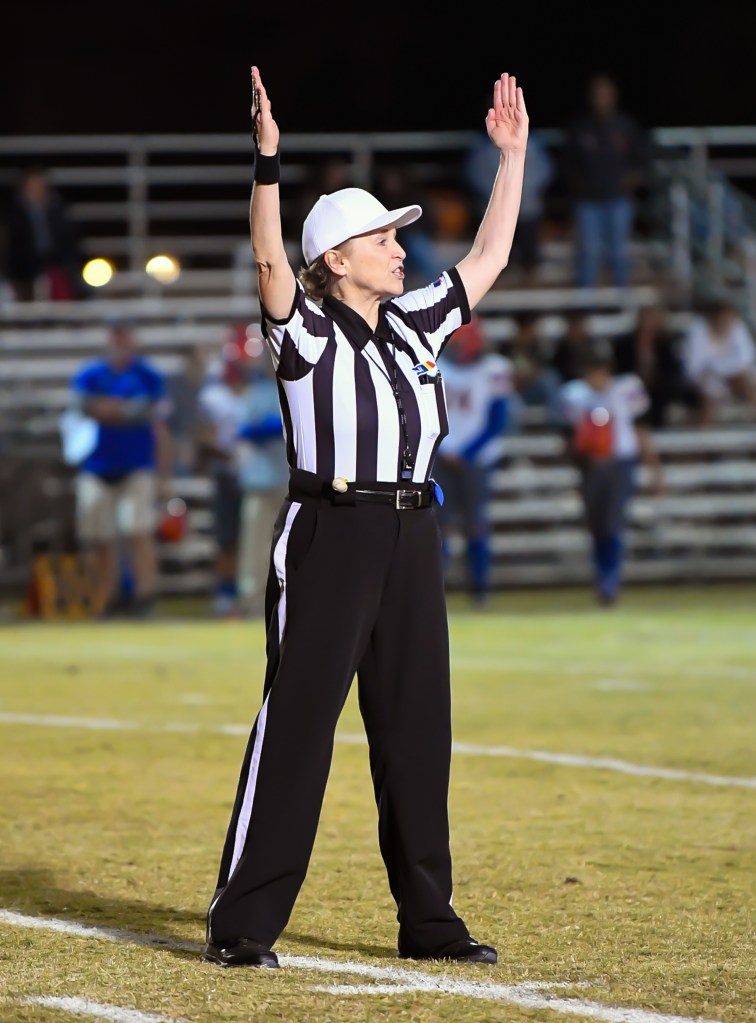
I spent most of my life involved with sports. I started ice skating at five and skiing at eight. I don’t remember learning to swim, but I spent 35 years in lap pools. I was an amateur sports official for four decades, a time during which I called football, baseball, ice hockey, soccer, and basketball games. I’ve ridden horses and hiked the backcountry. I’ve lifted weights and practiced yoga. I’m a scuba diver.

I mention my forays in the sports world, because I feel I’ve been led astray. Remember when they told us sports were good for us? Well, I’m pretty sure they lied.

How do I know? Rotator cuff surgery: twice. A decade of shots filled with gelatinous goo that was routinely inserted into my knees. A compression fracture in my spine. A broken leg. Two fractured arms. Horrendous bruises that had people staring. One woman actually approached me and pointed at my banged-up leg.

“I was hit by a line drive in a baseball game,” I explained.

I’d rather be run over by football players than be hit by a baseball. They hurt!

“You don’t have to lie, honey.” She shook her head. “We’ll get the bastard!”

“No, really. It was a baseball. See the seams?”

The point is, those of us who climbed on the sports wagon believed we would be healthy and happy for all that effort. But even something as seemingly benign as swimming can leave proverbial scars. All that repetitive motion eventually has painful results.

And still, doctors say exercise and sports are good for us. The Web.MD article “Exercise: What’s In It For You?” says, all that sweat and effort can improve our mood, give us more energy, make us more productive, improve our quality of sleep, give us strong bones and muscles, lower our risk of cancer, give us healthy hearts, help control our weight, lead to longer lives, and ease arthritis pain.

At this point, scuba diving is the only sport that hasn’t hurt me much. Then again, I stopped carrying my tanks years ago.

I have to say here that the last one made me laugh, since my aching joints are a direct result of, you guessed it, sports and exercise.

Sometimes, when I’m having a particular sore day, I think back to the times I pushed myself too hard or failed to get out of the way. Back then my choices seemed reasonable. But today all of my painful parts put those decisions in a different light.

There’s nothing much I can do about my damaged joints and muscles and that collection of X-rays, MRIs, and scars, but I did finally admit to myself that given the opportunity and a time-travel capsule, I’d probably do it all again.

Not sure what that says about me, but there you have it.

Coming soon!

Your Forgotten Sons

Inspired by a true story

Anne Montgomery

Bud Richardville is inducted into the Army as the United States prepares for the invasion of Europe in 1943. A chance comment has Bud assigned to a Graves Registration Company, where his unit is tasked with locating, identifying, and burying the dead. Bud ships out, leaving behind his new wife, Lorraine, a mysterious woman who has stolen his heart but whose secretive nature and shadowy past leave many unanswered questions. When Bud and his men hit the beach at Normandy, they are immediately thrust into the horrors of what working in a graves unit entails. Bud is beaten down by the gruesome demands of his job and losses in his personal life, but then he meets Eva, an optimistic soul who despite the war can see a positive future. Will Eva’s love be enough to save him?

Release Date: June 6, 2024

Pre-Order your copy today

Amazon

Apple Books

Barnes & Noble

Google Books

Kobo

Anne Montgomery’s novels can be found wherever books are sold.

Goodreads

Amazon