
My World War II historical fiction novel Your Forgotten Sons is set for release June 6, 2024 in honor of the 80th anniversary of the storming the beaches of Normandy: D-Day. The book was inspired by the true story of a man assigned to the Graves Registration Service.
Joseph “Bud” Richardville was like millions of other young men who grew up in poverty in the shadow of the Great Depression. His family lived in a tiny house next to railroad tracks in Vincennes, Indiana, where his father ruled with a hard hand over his wife and children.
Bud was a poor student who often skipped school and got into trouble. Still he was charming and kind and most found it hard not to like him, with the exception of his father who believed Bud would never be anything but but an embarrassment to the family.
Find below an excerpt from Your Forgotten Sons.
Vincennes, Indiana
1930
Spring in Vincennes had remained cold. Bitterly so. Mickey, wrapped tight in a ragged gray sweater and a pair of cuffed jeans, shivered uncontrollably even when inside the house. Mickey was Bud’s favorite. Her sharp eyes and sometimes irreverence toward adults made the two of them alike, though they were separated by eight years.
Bud crept out of the house an hour before dawn, his breath crystallizing in a huff of white. His coat—a short, cracked, brown-leather jacket that had come by way of the charity ladies at church—wasn’t enough to quell the dry cold that crept onto and under his skin despite the jeans and threadbare sweater. He grabbed the metal bucket that rested beside the uneven front porch and bolted toward the trees.
Ten minutes later, Bud looked down the track and waited. Finally, he felt the rumbling. He’d picked the perfect spot. The train would slow inside town limits, and the small hill would give him the perfect trajectory. The golden light, shining like a small sparkling sun, bounced along the track. Bud crouched in the bushes, not wanting the engineer to see him.
The engine moved past, the tick, tick, tick of the wheels a strangely soothing sound for a massive mechanical vehicle. Bud counted three cars. It was the fourth that was his destination. At the same moment the third car rattled by, Bud launched himself into space. The metal pail banged against the side of the car and, distracted in his effort to keep a grip on the bucket, threw him off balance. His foot slipped on the top edge of the car, and Bud tumbled, though he managed to maintain his hold on the pail, while the other hand clung precariously to the rail atop the car.
“Shit!” Bud mumbled as he grappled his way into the boxcar. When he’d finally lifted himself over the edge, he fell with a thud into the dirty cargo. He took several deep breaths that dissipated in white clouds in the frigid dawn air. Then he stood awkwardly, the uneven freight and the swaying railcar making his footing unstable.
The town was just around the bend. Bud quickly went to work making small piles of coal and lining them up against the side of the boxcar. A few lights glowed ahead, inside the houses on the edge of Vincennes.
He was finished just in time. The first home appeared out of the gloaming. Bud crouched, ready. He scooped the first pile and filled the pail with hard lumps of shiny bituminous coal. Just as the train car approached the dwelling, Bud dumped the coal over the side. Then, he dug into the next pile and flung the contents again. Over and over, he scattered the lumps of stone, knowing his neighbors were in dire need of the heat-producing rock, which many of them couldn’t afford to purchase.
Sweat formed between his broad shoulders and ran in rivulets down his chest. Bud—overly warm now from the exertion—wanted to remove the frayed leather jacket, but the next house approached so quickly, he couldn’t afford to take the time. He worked his way down the inside of the car, dumping coal by every house the train passed. Then his home came into view. Bud dug the edge of the bucket into the loose coal, hauled up the stone, and poured it over the side. He felt like Santa Claus and whooped as the train pulled away from town.
Bud knelt in the coal, the rocks sticking into his knees. He peered into the waning darkness and waited for the best spot to depart the train, which was now leaving Vincennes and picking up speed. After crossing a small trestle, the train rumbled toward the soft grassy area near the river where Bud often went when he skipped school and where he sometimes took girls who’d let him kiss them. He’d have to jump, but he’d done it before and wasn’t worried. Still, the realization of his actions and the knowledge that he would pay for his theft made him wince. He was covered with coal dust. There was no way to hide his crime. Bud tossed the bucket over the side and leapt. He tumbled away from the moving train and rolled in the grass, then stood, brushed off his clothes as best he could, and retrieved the now-empty bucket that had spun down the riverbank.
Later that day, Bud stood with his face pressed against the old oak, the branches of which were so large they’d dropped to the earth and then curved back toward the sky. It took three grown men hand to hand to encircle the massive tree that had stood for close to two hundred years. Bud, striped to the waist, had both arms around the rough trunk.
“What is the matter with you, boy?” His father brought the switch down on his son’s back, slicing through skin, raising an instant welt. “The Bible says thievin’ is wrong.” He whipped his son again. And again.
But Bud never made a sound. It was Mickey who cried on the porch, the bucket of coal by her side, while Momma dabbed her eyes with a hanky.
That evening, Bud’s back smarted. He was unable to sit or lie down comfortably, still he didn’t miss the irony of the fact that the purloined coal now blazed in the black, pot-bellied stove, next to which his father sat, a cigarette dangling from his thin, colorless lips.
Mickey idly played with several hunks of coal. Then, she emitted a gasp. “Look, Bud!” she scrambled from her place on the floor, holding two large pieces of rock.
Bud, sitting rigidly in a high-back wooden chair, smiled at his little sister. “What have you got there, Mick?”
“It’s a flower.” She turned up the two halves of the broken piece of coal, showing a perfect fossil imprinted on both sides.
“I think that’s a fern.” He rubbed her tawny head. “Like the ones that grow out in the woods. Remember those?”
Mickey nodded and hugged the stones to her chest. “They’re beautiful!”
Her father rose from his seat by the stove. “Give me those, girl!”
But Mickey held the fossils tightly in her grip.
Then, her father reached for the pieces of coal, wrenched them from the child’s hands, and hurled them into the fire.

Your Forgotten Sons
Inspired by a true story
Anne Montgomery
Bud Richardville is inducted into the Army as the United States prepares for the invasion of Europe in 1943. A chance comment has Bud assigned to a Graves Registration Company, where his unit is tasked with locating, identifying, and burying the dead. Bud ships out, leaving behind his new wife Lorraine, a mysterious woman who has stolen his heart but whose secretive nature and shadowy past leave many unanswered questions. When Bud and his men hit the beach at Normandy, they are immediately thrust into the horrors of what working in a graves unit entails. Bud is beaten down by the gruesome demands of his job and losses in his personal life, but then he meets Eva, an optimistic soul who despite the war can see a positive future. Will Eva’s love be enough to save him?
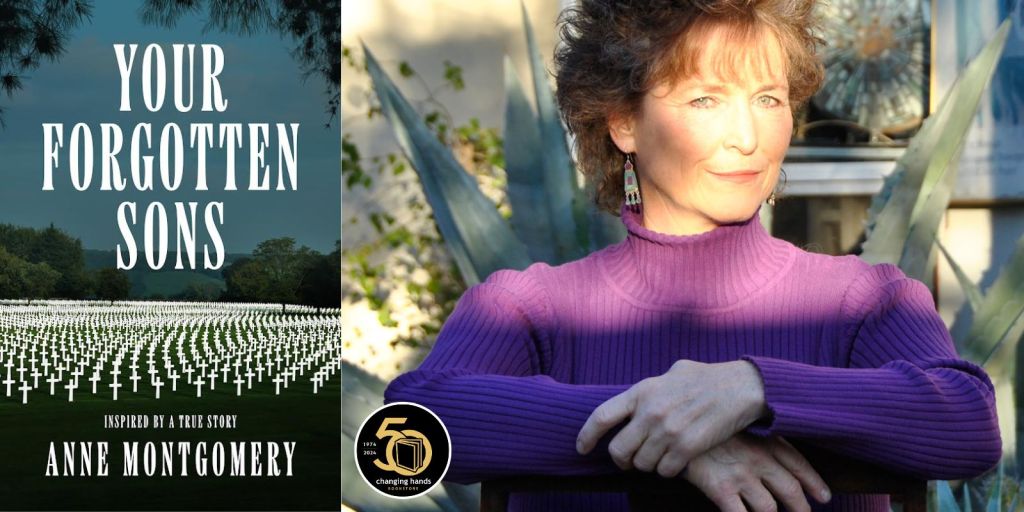
Join us at Changing Hands Bookstore in Phoenix on June 6, 2024, for the lanuch of Your Forgotten Sons. Find out more about the event here.
Pre-Order your copy today
Review a copy early by going to NetGalley. Sign in here.
Anne Montgomery’s novels can be found wherever books are sold.


 Author Anne Montgomery
Love the extract. I have never heard of that clever, risky way to steal coal, a new take on Robin Hood.
LikeLike
And it apparently happened, TS. I got the story from Bud’s surviving relatives. 😉
LikeLiked by 1 person