Designer pets: Let’s stop breeding them

All my dogs, including Sadie and Bella, came from the streets or shelters. And I can’t believe they would have been better pets if they were some special breed and not plain old mutts.

I read the newspaper every day. The actual paper one. (For those who don’t understand, google it.) Note that because I worked in the sports world most of my life, I always begin with the sports section and I’m always dismayed when I turn to the last page, because that’s where the pet ads are. I always flip past these blurbs, because, well, they depress me.

Does anyone really need to spend thousands of dollars on a puppy or kitten? Before I go on, yes, I understand that in certain circumstances dogs with specific capabilities are warranted. Working dogs that can sniff out cancer or alert their owners to an oncoming seizure. Animals that assist the police and rescue workers and ranchers. I get that. But, people, do you really need to obtain the most popular breed of the moment? Is it so important that you have that squatty little French Bulldog to show off?

This is where I’ve annoyed quite a few of you and if we were facing one another you would politely detail all the wonderful characteristics of your designer pet. I’d especially like to talk to those of you who think it’s just fine to breed deformed cats with short little legs. Creatures that can be easily injured by jumping and climbing who have little chance of survival in the outside world, but they are so dang cute in those social media posts we manufacture them anyway.

I am completely baffled by all of this. I have had a dozen dogs over the course of my life and tended to at least 40 cats. Every one of them came from the streets or shelters, abandoned by pet owners  who figured they were disposable or the product of people who felt neutering and spaying are just not that important.

Morgan and Westin, two of the forty cats I’ve tended over the years, were animals no one wanted. I can’t tell you how much joy they gave me.

Last year 5.8 million animals entered shelters nationwide. Though 4.2 million were adopted, 607,000 animals were euthanized. Note this last fact was a kindness. People can blather all they want about no-kill shelters, but eventually animals, especially dogs, gets depressed and there are no other alternatives. Keeping them alive in cages is just cruel.

Imagine, then, if we stopped propagating dogs and cats for their “special” looks and visited those shelters instead. For one thing, if you take your time and look around, you might find the breed you’re looking for since some pet owners are prone to dumping their animals when they’re no longer cute little babies. Large breed doges especially fall into this category. But the best thing you’ll find at the shelter are mixed breeds, those beautiful sometimes awkward-looking creatures who, thanks to the diversity of their genes, are healthier overall than animals who’ve been bred. And please don’t keep focusing on puppies and kittens. Older dogs and cats are less needy and much easier to deal with.

But remember to think twice before making that commitment. Make sure a pet is right for you, because once you take that animal home, it’s yours for the life of the creature. Worried about that new baby? There’s a possibility you might have to move? You’re very busy and might not have the time needed for a pet? You’re struggling with your finances and might not be able to handle veterinary expenses? Please think before bringing that animal home, because there’s nothing sadder than a dog or cat that’s just been locked in a cage, abandoned by its family.

Wolf Catcher

Anne Montgomery

Historical Fiction

In 1939, archeologists uncovered a tomb at the Northern Arizona site called Ridge Ruin. The man, bedecked in fine turquoise jewelry and intricate bead work, was surrounded by wooden swords with handles carved into animal hooves and human hands. The Hopi workers stepped back from the grave, knowing what the Moochiwimi sticks meant. This man, buried nine hundred years earlier, was a magician.

Former television journalist Kate Butler hangs on to her investigative reporting career by writing freelance magazine articles. Her research on The Magician shows he bore some European facial characteristics and physical qualities that made him different from the people who buried him. Her quest to discover The Magician’s origin carries her back to a time when the high desert world was shattered by the birth of a volcano and into the present-day dangers of archeological looting where black market sales of antiquities can lead to murder.

Amazon

Apple Books

Barnes and Noble

Google Books

Rakuten Kobo

Bookstores, libraries, and other booksellers can order copies directly from the Ingram Catalog.

Anne Montgomery’s novels can be found wherever books are sold.

Goodreads

Amazon

Who is creating these posts and more importantly why?

This picture ran with a story about a teacher who had been demoralized by the education system. The article was heartfelt and touching. The picture is fake. So is the story.

Do you ever actually check the Facebook pages of people who create posts you vehemently agree with? It’s so easy to scream. “Yeah! That’s exactly what I think!” and hit the share button, without considering where said clever piece of writing originated and why it was produced in the first place.

I did it myself recently with a story about a woman who spoke about losing the thrill of teaching as she sadly closed the door to her classroom for the last time. The story was well-written, but the fact that Mrs. Robinson, the teacher in question, lacked a first name or place of employment, and there was no identified writer was a tipoff that the piece was a fabrication. Still, the sentiment was spot on, especially when you consider that I spent 20 years teaching. I shared the story with the caveat that I while I understood the problems associated with the piece, I decided to pass it on, because I agreed with the comments within.

And it still bothers me.

Why? First, I was a reporter for about 15 years in both television and print. And like every other reporter out there, I wanted my name in big bold letters on the screen or at the top of my stories. A byline is the reason we’re out there. Our work is not supposed to be anonymous. Let’s face it, reporters—even back in the days before a handful were garnering huge paychecks for injecting their opinions into stories—have always wanted to take credit for their work.

Note that another story circulating recently cited a mother with Down’s syndrome who raised a woman who went on to become an astronaut. Wow! It was hard not to succumb to tears with that one. Still, since there are relatively few astronauts on the planet, it was easy to prove that the events depicted never occurred.  

So the question is why are unknown entities producing stories that are fictitious in order to get us to wantonly share them without thinking first. In the case of the teacher Mrs. Robinson, the Facebook page that appears to have produced it is called Things That Make you Think, a link that currently has 113,000 followers. There is no information about who might be at the helm of this site. All the posts appear to have AI generated photographs like the one above that are designed to draw sympathy from the reader. It’s probably a good bet that the story is also AI generated. The site is asking readers to subscribe, so in this case perhaps the incentive is purely financial. “Your support means the world. It helps us write more stories that heal the heart and stir the soul. Subscribe to “Things That Make You Think” to support our work—and unlock exclusive stories you won’t find anywhere else.”

Then there are the posts where famous people are doing or saying things that catch your eye. Like the one where Payton Manning escorts a boy with autism to his senior prom? Well, you’ve being conned again. This piece and others like it are fabricated. Why? I have no clue.

Here’s the thing. I love fictional stories. Gosh, I’ve written six traditionally published novels. I wouldn’t mind if the site explained that the stories are purely fiction, but the pieces are presented as true and I don’t like being lied to.

Other similar sites are clearly political. Both the right and left splash colorful, all-caps kinds of stories decrying the other side, utilizing often photoshopped and/or AI generated pictures and videos presented to make us angry. Maybe they’re hoping to shock you into handing over your credit card number. Consider Occupy Democrats, a site that back in 2022 was accused of raising $800,000 dollars for its so-called election fund, but donated none of the money to federal candidates and where a big chunk of that money went to one of the two brothers who run the site. Then there’s the Republican Tea Party Facebook page. The problem there is the link, teaparty.org, doesn’t exist, so is the site even affiliated with the political part of the same name? Do it’s 350,000 followers even care?  Their posts mirror those of Occupy Democrats, and while some of the facts included might be true, many times they’re exagerated and hyper-partisan, nothing more than click-bait to get readers enraged.

I just can’t stop wodering why real stories with real people and real facts composed by real writers aren’t enough. Perhaps we’re being intentionally desensitized to the truth, so that someday truth won’t matter.

That scares me.

Maybe it’s time we united and took a stand. If you think truth matters, join me and take a bit more time to read between the lines. Then think twice before hitting that share button.

Wolf Catcher

Anne Montgomery

Historical Fiction

In 1939, archeologists uncovered a tomb at the Northern Arizona site called Ridge Ruin. The man, bedecked in fine turquoise jewelry and intricate bead work, was surrounded by wooden swords with handles carved into animal hooves and human hands. The Hopi workers stepped back from the grave, knowing what the Moochiwimi sticks meant. This man, buried nine hundred years earlier, was a magician.

Former television journalist Kate Butler hangs on to her investigative reporting career by writing freelance magazine articles. Her research on The Magician shows he bore some European facial characteristics and physical qualities that made him different from the people who buried him. Her quest to discover The Magician’s origin carries her back to a time when the high desert world was shattered by the birth of a volcano and into the present-day dangers of archeological looting where black market sales of antiquities can lead to murder.

Amazon

Apple Books

Barnes and Noble

Google Books

Rakuten Kobo

Bookstores, libraries, and other booksellers can order copies directly from the Ingram Catalog.

Anne Montgomery’s novels can be found wherever books are sold.

Goodreads

Amazon

Volcanoes: Symbols of destruction and life

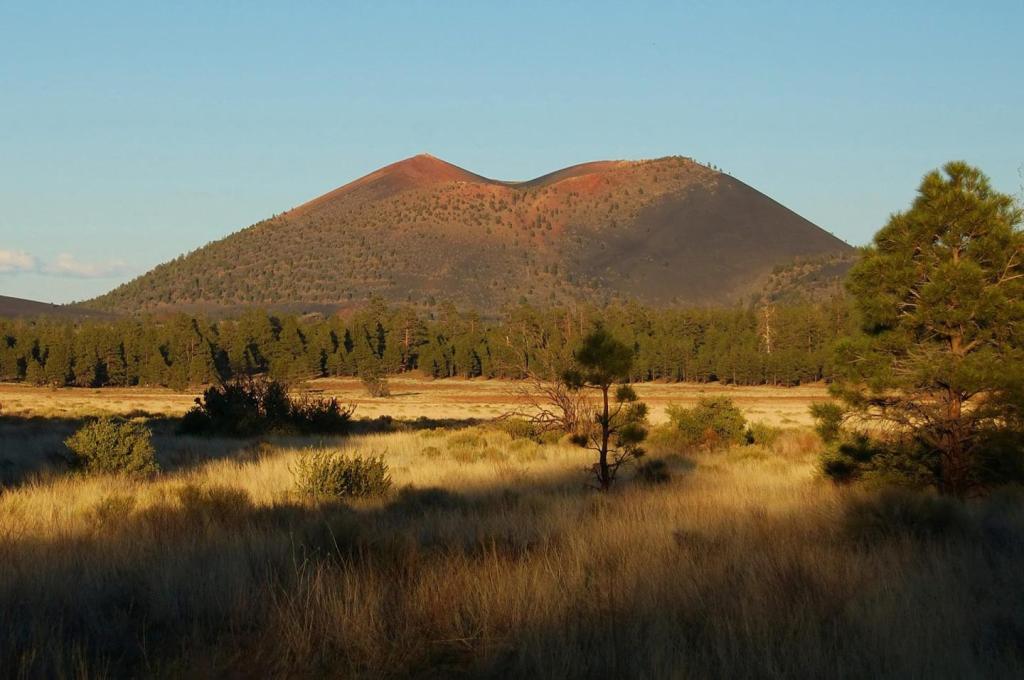
The cinders of Sunset Crater Volcano “glow” because they are infused with iron oxide, which makes the mountain appear to be bathed in a sunset.

While researching my historical-fiction novel Wolf Catcher, which was recently rereleased by Next Chapter Publishing, I found myself immersed in volcanoes. The reason? The Sunset Crater Volcano, which rests outside of Flagstaff, Arizona, and is today a National Monument.

A cinder cone volcano is one of several types all of which form differently. In the case of the Sunset Crater Volcano, scientists believe it began erupting about 900 years ago. Had we been on hand for the big event, we would have noticed the ground shaking on and off in the weeks leading up to the eruption. Then the earth would have split open, emitting steam, and fire, and a cloud of ash that rose five miles into sky. As lightning zigged and zagged above the high desert, ash rained down on 800-square miles of land. After several weeks, or months, the cone grew to about 1,000 feet high, a loosely-packed amalgam of volcanic ash and reddish basalt cinders.

While today we understand the geological forces that birth a volcano, ancient people could only guess about what was happening beneath the earth. Luckily, The Sunset Crater Volcano has a modern-day sister who gives us a look into how witnesses might have assessed the eruption.

Paricutín is a cinder cone volcano just like the one at Sunset Crater. But this volcano, near the west coast of Mexico in the southern half of the country, erupted on and off between 1943 and 1952 in full view of the terrified inhabitants of the area. These documented reactions helped scientists studying the Sunset Crater Volcano discern how the Native Americans who peopled the high plateau may have reacted upon witnessing the event.

Here I will let some of the characters from Wolf Catcher explain.

“They were the same kind of volcanoes, right?” Cooper asked.

Marty nodded. “They are both cinder cones and they both gave the people ample warning that something was happening. No one in Paricutín died as a direct result of the eruption, and from what they’ve discovered so far, probably no one died here either. But let’s backtrack a little. It’s easy to know what happened at Paricutín. We have eyewitnesses. We know exactly when the eruption occurred. But at Sunset Crater, for a long time, there was no foolproof way to determine when the big event happened.”

“Is there now?” Kate asked.

“Well, that depends on who you talk to. I can tell you this. Before a Sinagua pithouse was discovered buried in the cinders, scientists had no idea the volcano was so young. They were able to date the pithouse using tree-rings and the pottery they found, and concluded that the eruption happened sometime in the late eleventh century. The ash from Sunset Crater fell over an area of nearly eight hundred square miles. In some places, just an inch, in others, it was fifteen feet deep. Just to give you a good idea of what that means, four inches of ash, especially if it’s wet, is enough to collapse a modern-day roof.”

“So, if you were caught up in the ash fall you were dead?” Cooper said.

“Theoretically, but as I explained, we haven’t found any bodies. And if we use the Paricutín model, we assume the people escaped in time. What we also know is that in Mexico the people were sure there was an angry god under the ground. In fact, they erected a row of big white Christian crosses in front of the lava flow to protect their villages from the creature.”

“Did it help?” Kate smiled.

Marty laughed. “I’m afraid the crosses did no good at all. Five villages were damaged, some destroyed, by the lava and ash.

It’s not much of a stretch to assume the ancestors of the Hopi who occupied the area around Sunset Carter Volcano may have, like the people at Paricutín, believed angry gods were at work and that some appeasement was in order.

What we do know is that the ash fall proved a benefit to those villages situated in just the right places, locations that received a few inches of ash, enough to fortify the soil and grow crops, while others lost their homes completely when many feet of ash destroyed the productivity of their land. Those forced from their homes might have fought desperately with those who benefitted from the eruption in order to survive.

Then there were those who were lured to the area in search of religious understanding. Who was the god? Why was he angry? What could the people do to pacify him? The Sunset Carter Volcano might have become a place of sacred pilgrimage.

It is into this fractured landscape that the man I call Wolf Catcher arrived.

Wolf Catcher

Anne Montgomery

Historical Fiction

In 1939, archeologists uncovered a tomb at the Northern Arizona site called Ridge Ruin. The man, bedecked in fine turquoise jewelry and intricate bead work, was surrounded by wooden swords with handles carved into animal hooves and human hands. The Hopi workers stepped back from the grave, knowing what the Moochiwimi sticks meant. This man, buried nine hundred years earlier, was a magician.

Former television journalist Kate Butler hangs on to her investigative reporting career by writing freelance magazine articles. Her research on The Magician shows he bore some European facial characteristics and physical qualities that made him different from the people who buried him. Her quest to discover The Magician’s origin carries her back to a time when the high desert world was shattered by the birth of a volcano and into the present-day dangers of archeological looting where black market sales of antiquities can lead to murder.

Amazon

Apple Books

Barnes and Noble

Google Books

Rakuten Kobo

Bookstores, libraries, and other booksellers can order copies directly from the Ingram Catalog.

Anne Montgomery’s novels can be found wherever books are sold.

Goodreads

Amazon

Archaeological looting, a crime that hurts us all

One of the themes in my historical fiction novel Wolf Catcher, which was just rereleased by Next Chapter Publishing, is the problem of archaeological looting. Of course, this issue isn’t new. Humans have been rifling through ancient sites for thousands of years, mostly plundering burials for financial gain. But, before my reporting job took me to Arizona, I had little knowledge of the issue.

The state is vast, with a lasting history of the Native Americans who have populated this land for thousands of years. In the late 1800s grave robbing, especially in the western U.S., became the norm. The idea that the Native American culture was dying gave looters the ridiculous idea that stealing pottery, jewelry, and other funerary objects was perfectly fine, so the wonton destruction of ancient sites—looters have been known to employee backhoes and other large equipment to rip through pueblo dwellings and burials—is sadly common in the American Southwest.

While archaeological looting today is a crime, the law is very hard to enforce. Here I will let some of the characters in Wolf Catcher explain.

“How can this happen?” Kate asked.

Cooper placed his arm around her shoulders, all the levity and earnest excitement that had permeated their time at the site having evaporated into the chilled air. A thick bank of dark clouds blocked out the sun. “I have an idea that the problem of catching pothunters has to do with manpower, am I right?”

George spoke as he scanned the ground for evidence of looting. “Manpower is a great deal of the problem. First, the question is who is responsible for a specific site? A ruin could be on land controlled by National Park officers, Bureau of Land Management investigators, tribal authorities, U.S. Forest Service rangers, Bureau of Indian Affairs agents, or state investigators.”

“It sounds to me like you have too many people involved, not too few,” Kate said as she too searched the ground for clues.

“Consider this,” George said. “The BIA, which watches over about five hundred seventy tribes nationwide, currently has just one investigator assigned to looting. Here in Arizona, just two investigators cover looting on trust lands. That area covers nine million acres. BLM officers cover more than a million acres each.”

“The other problem is the sheer number of ruins,” Rebecca explained. “In Arizona, we have catalogued more than a hundred thousand sites, but most of them haven’t been inventoried, so we don’t even know what’s in them. How, then, can we know what’s missing?”

So manpower and vast areas of rugged wilderness make catching looters difficult. But prosecuting them is even more of a problem. The way the laws are written, those caught looting can play dumb and act as if they had no idea they were breaking the law. Often, they get off with little more than a warning.

Not only do we need to install harsher penalties for archaeological looting, we need to change the way we think about it. Looting is a crime against all of us, because once you’ve removed an artifact from its resting place, you’ve destroyed its sense of time and place. Our ability to understand its historical significance is then lost forever.

What can we do? Be very careful when you consider acquiring an ancient object. Even if it comes from a tony Scottsdale shop, ask about its provenance: Where and when was it harvested and by whom? And, when you’re out hiking, stop and think about picking up that pretty pottery shard or arrowhead. It’s best to admire the object then walk away.

Wolf Catcher

Anne Montgomery

Historical Fiction

Next Chapter Publishing

Released August 4, 2025

The past and present collide when a tenacious reporter seeks information on an eleventh century magician…and uncovers more than she bargained for.

In 1939, archaeologists uncovered a 900-year-old tomb at the Northern Arizona site called Ridge Ruin. The man, bedecked in fine turquoise jewelry and intricate bead work, was surrounded by hundreds of extraordinary funerary objects, including wooden swords with handles carved into animal hooves and human hands. The Hopi workers stepped back from the grave, knowing what the Moochiwimi sticks meant. This man was a magician.

Sixty-five years later, investigative reporter Kate Butler discovers evidence that The Magician looked notably different from those who buried him. Her quest to discover The Magician’s origin carries her back to a time when the high desert world was shattered by the birth of a volcano and into the present-day dangers of archaeological looting where black market sales of antiquities can lead to murder.

Amazon

Apple Books

Barnes and Noble

Google Books

Rakuten Kobo

Bookstores, libraries, and other booksellers can order copies directly from the Ingram Catalog.

Praise for Wolf Catcher

“Blending archaeology and Native American mythology, “Wolf Catcher” by novelist Anne Montgomery is an original, exceptionally well written, and compelling work of historical fiction…” – Midwest Book Review

“The author’s ability to interweave the past and the present was masterful. The characters were complex and interesting, especially with the underlying theme of rethinking the history of worldly human migration … A real page turner and I am wondering when the movie is going to be made!” – Alicia Williams Goodreads

“The story is very well-paced, reaching a page-turning, action-packed climax to the end. This story has all the elements of a great suspense drama centered around a historical mystery.” – Heidi Slowinski Author

“I was deeply and thoroughly embroiled in this imaginative novel… (that) melds seamlessly much of fact with fiction. Totally recommended! “ – V. Williams Vine Voice

“What a journey! What a story! A truly epic tale that grabs you by a throat and moves your soul. Highly recommend for the readers of all age groups.” – Marina Sardarova Author

“Boy, didn’t this one grip me quickly and keep me glued to the pages! Loved the cliff-hanging chapter endings. Well researched, well-plotted and paced…Trust me, you’ll love it. Totally recommended and out now!” – Rosepoint Publishing

“Once again the author has created a beautiful story with a powerful message. She took a piece of history and brought it to life. I just can’t say enough good things about Wolf Catcher.” – Megan Salcido Wildwood Reads

Anne Montgomery’s novels can be found wherever books are sold.

Goodreads

Amazon