A surgery turns into a search for the truth

My dear friend Gina Liparato told me about her Uncle Bud who served in World War II and never came home; a man who worked in the Graves Registration Service in Europe and whose strange death puzzled her for decades.

Baltimore, 2019

I’d traveled to Baltimore at the request of a dear friend. She was facing a delicate, possibly life-changing surgery at Johns Hopkins Hospital and asked that I stand in as her healthcare power of attorney.

The night before the operation, Gina, handed me a Ziplock bag. Inside I found a packet of yellowed letters. We’d spoken of Gina’s elusive uncle—her mother’s handsome, rakish brother—on occasion over the years, and of the odd circumstances surrounding his death near the end of World War II.

“No matter what happens to me, I want you to tell Bud’s story,” she said.

I nodded and promised that I would.

The next day, my friend of over three decades tried to comfort me and her soldier husband: three tours, two in Afghanistan, one in Iraq, a navy-blue sweatshirt boasting an Airborne patch, a bracelet saying Remember The Fallen encircling his wrist. Gina’s husband would soon disappear, leaving her in my care, because the hospital and its patients gnawed at his belly, a reminder of dead and dying soldiers he’d been unable to help in another hospital in Iraq.

I kissed Gina goodbye, told her I loved her, and left her alone with her husband.

Hours later, I sat bedside, staring at my friend who looked small and fragile beneath a thin hospital blanket.

“I want to bring him home.” Her eyes were still glassy from the anesthesia.

“Who?” I gazed at Gina, her face etched with pain. The drugs weren’t helping.

“And I want to know what happened?” She winced and closed her eyes.

“Do you want me to call the nurse?”

“No. Bud…” her voice trailed off.

“It’s been a long time, Gina. And we don’t have much to go on.”  I recalled the night before when she’d extracted those fragile letters with almost religious reverence. The epistles were small squares, etched with tight, black script. I’d made the promise in haste, hoping to make Gina feel better, and now wondered if I could keep my word.

She opened her eyes and squirmed, trying to find a comfortable position, but was under doctor’s orders not to move.

“Stay still! Water?” I reached for a plastic cup with a bent white straw, in an effort to do something.

Gina shook her head and stared out the window. I followed her gaze and focused on the clear blue sky and showy fall foliage, brilliant orange and yellow leaves basking in bright sunshine. I searched for something to say. I’d always been the one who, faced with a problem, could tackle a job and get it done, a hangover perhaps from my previous life as a reporter. But how was I to determine what happened to a man who died mysteriously all those years ago?

“I will have some water.”

I reached for the cup and guided the straw between Gina’s chapped lips. When she was done, I placed it back on the stainless-steel tray next to the bed. Then, she closed her eyes and let out a ragged breath.

I hated feeling helpless. Without thinking, I blurted out, “Let’s go get Bud!”

“Really?” She brightened instantly, a glimpse of the Gina I knew before the surgery.

I nodded. “When you’re better.”

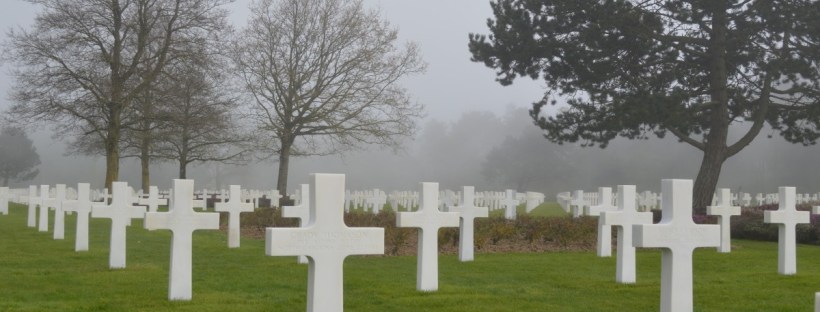
And so, we agreed to travel to France, to the graveyard in Épinal where Sergeant Joseph “Bud” Richardville had lain since his death in 1945. Even if Gina spent the rest of her life in a wheelchair, we’d go to France and find out what happened.

But then Covid hit and our plans were derailed. Still, as Gina healed, we invesitgated Bud’s story, utilizing the resources we had. And, when we were done, we finally knew what happened to Bud Richardville. Your Forgotten Sons, which will be realesed on June 6, 2024 in honor of the 80th anniversary of D-Day, tells his story.

Your Forgotten Sons

Inspired by a true story

Anne Montgomery

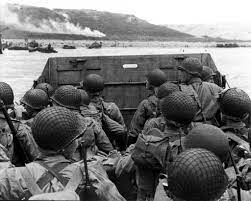
Bud Richardville is inducted into the Army as the United States prepares for the invasion of Europe in 1943. A chance comment has Bud assigned to a Graves Registration Company, where his unit is tasked with locating, identifying, and burying the dead. Bud ships out, leaving behind his new wife, Lorraine, a mysterious woman who has stolen his heart but whose secretive nature and shadowy past leave many unanswered questions. When Bud and his men hit the beach at Normandy, they are immediately thrust into the horrors of what working in a graves unit entails. Bud is beaten down by the gruesome demands of his job and losses in his personal life, but then he meets Eva, an optimistic soul who despite the war can see a positive future. Will Eva’s love be enough to save him?

Release Date: June 6, 2024

Pre-Order your copy today

Amazon

Apple Books

Barnes & Nobel

Google Books

Kobo

Review a copy early by going to NetGalley. Sign in here.

Find Anne Montgomery’s novels wherever you buy books.

Goodreads

Amazon

Remember when they told us sports were good for us? They lied!

I bet your think sport officials are generally safe from harm, but think again. Sometimes players run right over us.

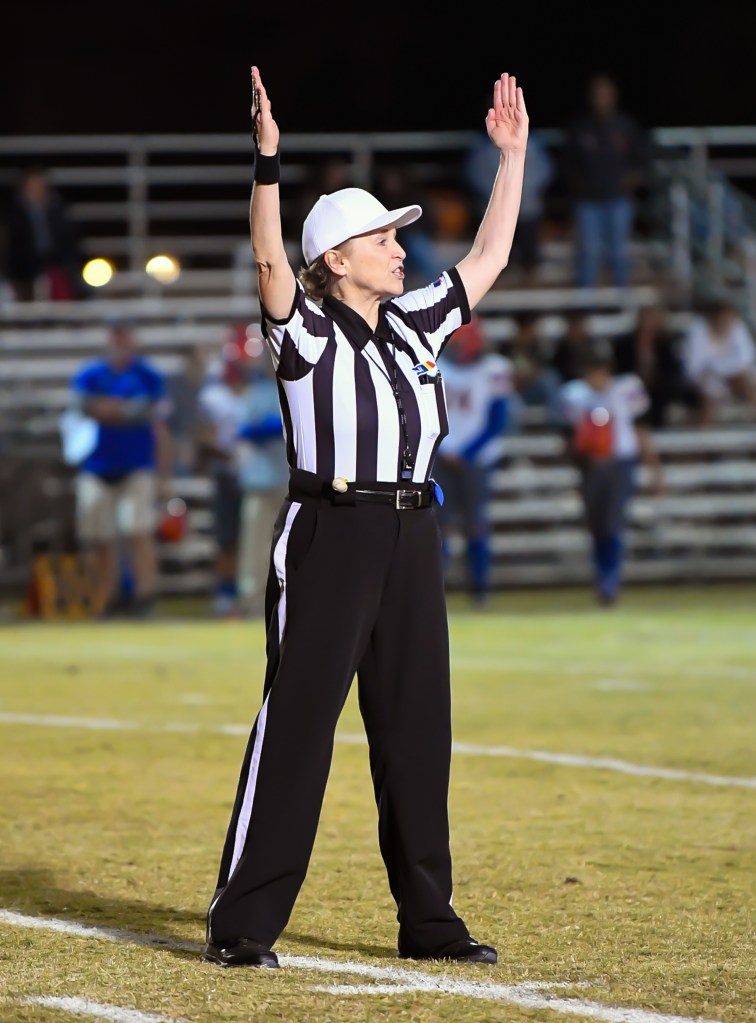
I spent most of my life involved with sports. I started ice skating at five and skiing at eight. I don’t remember learning to swim, but I spent 35 years in lap pools. I was an amateur sports official for four decades, a time during which I called football, baseball, ice hockey, soccer, and basketball games. I’ve ridden horses and hiked the backcountry. I’ve lifted weights and practiced yoga. I’m a scuba diver.

I mention my forays in the sports world, because I feel I’ve been led astray. Remember when they told us sports were good for us? Well, I’m pretty sure they lied.

How do I know? Rotator cuff surgery: twice. A decade of shots filled with gelatinous goo that was routinely inserted into my knees. A compression fracture in my spine. A broken leg. Two fractured arms. Horrendous bruises that had people staring. One woman actually approached me and pointed at my banged-up leg.

“I was hit by a line drive in a baseball game,” I explained.

I’d rather be run over by football players than be hit by a baseball. They hurt!

“You don’t have to lie, honey.” She shook her head. “We’ll get the bastard!”

“No, really. It was a baseball. See the seams?”

The point is, those of us who climbed on the sports wagon believed we would be healthy and happy for all that effort. But even something as seemingly benign as swimming can leave proverbial scars. All that repetitive motion eventually has painful results.

And still, doctors say exercise and sports are good for us. The Web.MD article “Exercise: What’s In It For You?” says, all that sweat and effort can improve our mood, give us more energy, make us more productive, improve our quality of sleep, give us strong bones and muscles, lower our risk of cancer, give us healthy hearts, help control our weight, lead to longer lives, and ease arthritis pain.

At this point, scuba diving is the only sport that hasn’t hurt me much. Then again, I stopped carrying my tanks years ago.

I have to say here that the last one made me laugh, since my aching joints are a direct result of, you guessed it, sports and exercise.

Sometimes, when I’m having a particular sore day, I think back to the times I pushed myself too hard or failed to get out of the way. Back then my choices seemed reasonable. But today all of my painful parts put those decisions in a different light.

There’s nothing much I can do about my damaged joints and muscles and that collection of X-rays, MRIs, and scars, but I did finally admit to myself that given the opportunity and a time-travel capsule, I’d probably do it all again.

Not sure what that says about me, but there you have it.

Coming soon!

Your Forgotten Sons

Inspired by a true story

Anne Montgomery

Bud Richardville is inducted into the Army as the United States prepares for the invasion of Europe in 1943. A chance comment has Bud assigned to a Graves Registration Company, where his unit is tasked with locating, identifying, and burying the dead. Bud ships out, leaving behind his new wife, Lorraine, a mysterious woman who has stolen his heart but whose secretive nature and shadowy past leave many unanswered questions. When Bud and his men hit the beach at Normandy, they are immediately thrust into the horrors of what working in a graves unit entails. Bud is beaten down by the gruesome demands of his job and losses in his personal life, but then he meets Eva, an optimistic soul who despite the war can see a positive future. Will Eva’s love be enough to save him?

Release Date: June 6, 2024

Pre-Order your copy today

Amazon

Apple Books

Barnes & Noble

Google Books

Kobo

Anne Montgomery’s novels can be found wherever books are sold.

Goodreads

Amazon

5 Stars for Your Forgotten Sons

To those of you who are NetGalley fans, I’m happy to announce that my new World War II historical fiction novel, Your Forgotten Sons, is now available on the site. And I’m thrilled that the first 5-Star review has posted. Find excerpts below.

“This was a riveting, quick read that focuses on the true experiences of one man, Bud Richardville of Indiana…Bud’s unit is mobile, following the advances of the front-line troops. They land in Normandy only 8 hours after the first assault, to begin their grim duty of collecting, identifying, and burying the dead…This book is well worth reading, not only because it highlights areas of WW II not usually covered but also because it shines a spotlight on the need for mental healthcare for veterans of all wars. I highly recommend this book to all historical fiction lovers.”

You can read the rest of the review here. My thanks to NetGalley’s Lisa Gentry for being the first to review Your Forgotten Sons. If you’d like to become a NetGalley reviewer, go to https://www.netgalley.com/catalog/book/327844.

Coming soon!

Your Forgotten Sons

Inspired by a true story

Anne Montgomery

Bud Richardville is inducted into the Army as the United States prepares for the invasion of Europe in 1943. A chance comment has Bud assigned to a Graves Registration Company, where his unit is tasked with locating, identifying, and burying the dead. Bud ships out, leaving behind his new wife, Lorraine, a mysterious woman who has stolen his heart but whose secretive nature and shadowy past leave many unanswered questions. When Bud and his men hit the beach at Normandy, they are immediately thrust into the horrors of what working in a graves unit entails. Bud is beaten down by the gruesome demands of his job and losses in his personal life, but then he meets Eva, an optimistic soul who despite the war can see a positive future. Will Eva’s love be enough to save him?

Release Date: June 6, 2024

Pre-Order your copy today

Amazon

Apple Books

Barnes & Nobel

Google Books

Kobo

Anne Montgomery’s novels can be found wherever books are sold.

Goodreads

Amazon

On being a biohazard

When I got Covid and subsequently broke my leg a few years back, I was labled a biohazard.

Covid hit me hard in 2021. Hallucinations haunted me, especially the one where I was being attacked by words, which, à la Serena Williams, I batted away. But the more I repelled those words, the faster they came at me. The experience was akin to being inside a video game.

Later, I passed out and awoke with a severely broken leg, one that had to be surgically repaired and which kept me hobbling around for about eight months. I mention this because when I was hospitalized the fact that I still had Covid was problematic. The sign outside my room said Biohazard in big letters, underneath of which was my name, as well as those of the other Covid patients on the floor.

As a former sports official, an avocation I practiced for forty years, I’d been called a lot of unpleasant things, still Biohazard was a something new and rather sinister sounding. The medical staff coming in and out of my room in coveralls, hoods, and goggles lent an ominous tone, so as you can imagine I was happy when they released me to recover from the virus and wait for surgery at home.

Recently, I dealt with a similar issue. I have what is disturbingly called a degenerative spine, the result of too many falls and hits and lots of repetitive motion. So, my surgeon sent me off to the imaging people, where a nice lady stuck a needle in my arm and deposited a bit of radioactive material into my bloodstream. If the idea is making you squeamish, note that I was a bit queasy about the idea as well.

“Will I glow?” I asked the technician.

 She smiled. “Maybe some sparkles.”

I waited several hours for the radioactive stuff to do its job, then I had to stay completely still for about a half an hour. The scanning machines hummed quietly, as they rolled over and around me. It wasn’t unpleasant, though my nose itched and I wasn’t allowed to scratch it. Still, in the grand scheme it was pretty painless.

When it was over, I asked if I could see the results and what I saw was strangely beautiful. My spine was lit up in purple and turquoise and a bright yellow patch burst from my cervical spine.

“That’s the bad part,” I said pointing at the stary spot.

“I can see that,” she said.

The scans will go to the neurosurgeon, who will decipher all that light and decided how to fix me. I tried to understand what he might see, but like many body scans there was a Rorschach-test quality to the pictures that I couldn’t decode.

I thanked the woman for her help, and before I left she said, “Don’t hold any babies for a few hours. And don’t sit next to any pregnant women.”

I squinted.

“And you probably shouldn’t go to the airport. TSA might stop you.”

“I’m leaking radiation?”

She smiled.

Biohazard indeed.

Your Forgotten Sons

Inspired by a true story

Anne Montgomery

Bud Richardville is inducted into the Army as the United States prepares for the invasion of Europe in 1943. A chance comment has Bud assigned to a Graves Registration Company, where his unit is tasked with locating, identifying, and burying the dead. Bud ships out, leaving behind his new wife, Lorraine, a mysterious woman who has stolen his heart but whose secretive nature and shadowy past leave many unanswered questions. When Bud and his men hit the beach at Normandy, they are immediately thrust into the horrors of what working in a graves unit entails. Bud is beaten down by the gruesome demands of his job and losses in his personal life, but then he meets Eva, an optimistic soul who despite the war can see a positive future. Will Eva’s love be enough to save him?

Release Date: June 6, 2024

Pre-Order your copy today

Amazon

Apple Books

Barnes & Nobel

Google Books

Kobo

Anne Montgomery’s novels can be found wherever books are sold.

Goodreads

Amazon

The news is making me choose

I learned in the news that my hot tea might kill me, but I won’t give it up.

Since I’m a former reporter, the fact that I read the newspaper daily and watch the news on TV should not come as much of a surprise. However, I’m at a point where I’m not sure how much more I can take.

Not too long ago, I read an article telling me that drinking hot tea could cause esophageal cancer. Since I am as dedicated to my daily pot of tea—brewed the old-fashioned way with tea leaves—as any hardcore coffee drinker is to their beverage of choice, the story freaked me out.

The idea put forth was that really hot beverages could alter the nature of the cells in the throat and leave them susceptible to changes that might be a precursor to cancer. The article pointed out that the World Health Organization recommends not drinking anything hotter than 149 degrees, which had me staring at my pretty, eggshell-thin teacup—No, I don’t drink from a mug. I am not a barbarian!— where luscious steam was rising into the air. I put the cup on the saucer to cool. But, later, the tea just didn’t taste right.

It was suggested that I insert a meat thermometer into my tea, but, geez, that would ruin the whole gentility vibe, don’t you think? And the big thermometer would just fall out of my dainty little cup. I considered giving up my non-alcoholic beverage of choice, but the loss of the ceremony itself would just be too depressing

And now, there’s a new horror we must face. It turns out that  picking one’s nose can cause Alzheimer’s. According the National Institutes of Health, “(W)e suggest that nose-picking increases the transfer of pathogenic microorganisms from the hand into the nose changing the nasal microbiome from a symbiotic to a pathogenic type, with possible consequences of a chronic low-level brain infection via the olfactory system…”

And that, they say, can lead to both dementia and Alzheimer’s. Now, I’m not the least bit worried, because I have never, EVER, engaged in that kind of excavation. I’m just sharing the scary news in case you have.

I’m not sure how many more of these stories I can take. I still feel uncomfortable when standing before the deli counter, ordering turkey and ham and bacon. I’m guessing you might already know that the processes used to make our yummy lunch and breakfast meats create cancer-causing substances. And yet there I am pointing out those coldcuts to the guy behind the counter, then hiding the packages beneath all the healthy fruits and vegetables in my cart, lest some know-it-all stare at me with derision.

I’m guessing stories like this will continue to appear, still I must be honest. There are certain things I can’t do without: chocolate, tea, cheese, wine, and bread. So with the idea that something’s going to kill me, I’ll leave it at that.

Bon appétit!

Your Forgotten Sons

Inspired by a true story

Anne Montgomery

Release Date: June 6, 2024

Bud Richardville is inducted into the Army as the United States prepares for the invasion of Europe in 1943. A chance comment has Bud assigned to the Graves Registration Service where his unit is tasked with locating, identifying, and burying the dead. Bud ships out, leaving behind his new wife, Lorraine, a mysterious woman who has stolen his heart but whose secretive nature and shadowy past leave many unanswered questions. When Bud and his men hit the beach at Normandy, they are immediately thrust into the horrors of what working in a graves unit entails. Bud is beaten down by the gruesome demands of his job and losses in his personal life, but then he meets Eva, an optimistic soul who despite the war can see a positive future. Will Eva’s love be enough to save him?

Pre-Order your copy today

Amazon

Apple Books

Barnes & Nobel

Google Books

Kobo

Anne Montgomery’s novels can be found wherever books are sold.

Goodreads

Amazon

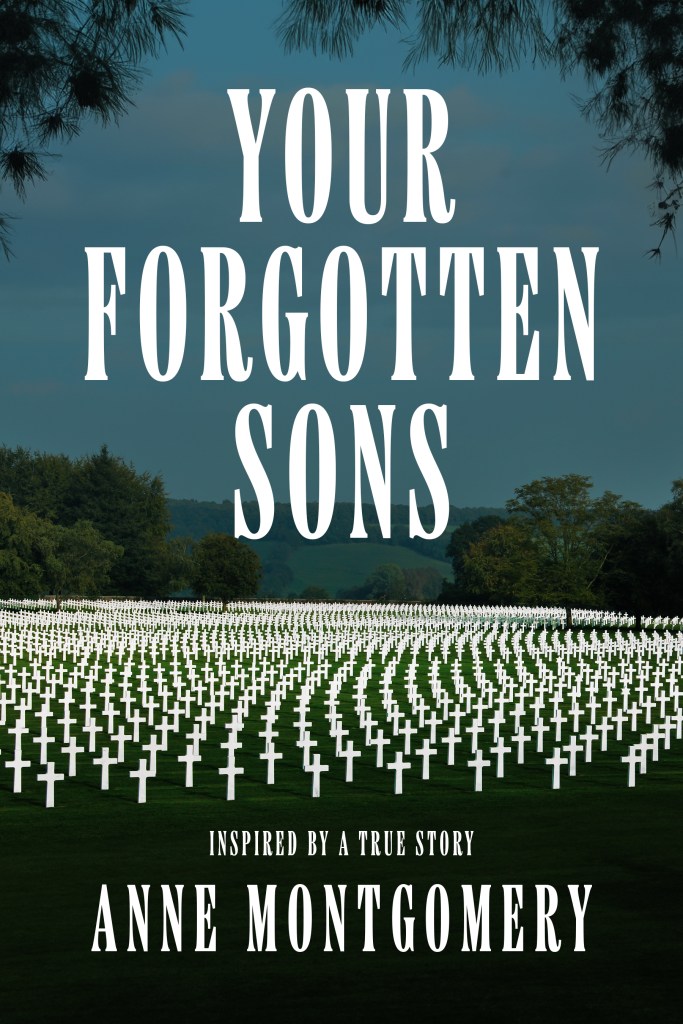
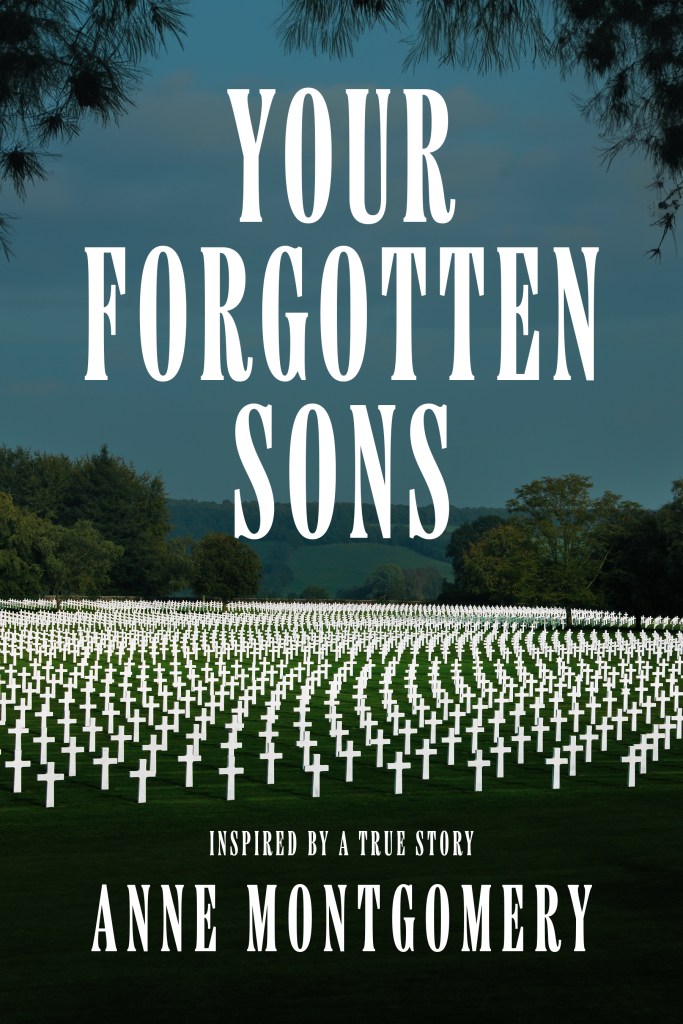
Cover Reveal: Your Forgotten Sons

On June 6th, 2024, the 80th anniversary of D-Day, my new historical fiction novel will be released. Your Forgotten Sons details the life of Sergeant Joseph “Bud” Richardville who was drafted into the Graves Registration Service as the Allies prepared for the invasion of Europe.

Bud’s story came to me via a packet of letters in a Ziplock bag, correspondences that were lovingly preserved by his family members and entrusted to me in the hope that I would tell Bud’s story and that of the men with whom he served.

And now I have.

I want to thank the artsists at Next Chapter Publishing for producing such a lovely and poignant cover.

Your Forgotten Sons

Inspired by a true story

Bud Richardville is inducted into the Army as the United States prepares for the invasion of Europe in 1943. A chance comment has Bud assigned to the Graves Registration Service where his unit is tasked with locating, identifying, and burying the dead. Bud ships out, leaving behind his new wife, Lorraine, a mysterious woman who has stolen his heart but whose secretive nature and shadowy past leave many unanswered questions. When Bud and his men hit the beach at Normandy, they are immediately thrust into the horrors of what working in a graves unit entails. Bud is beaten down by the gruesome demands of his job and losses in his personal life, but then he meets Eva, an optimistic soul who despite the war can see a positive future. Will Eva’s love be enough to save him?

Pre-Order your copy today

Amazon

Apple Books

Barnes & Nobel

Google Books

Kobo

Anne Montgomery’s novels can be found wherever books are sold.

Goodreads

Amazon

Fashion fax pas: 2024

When I was in TV, it mattered what I wore. Today, not so much.

It might surprise those who know me that I didn’t always spend my days in shorts and T-shirts. (Of course, when the temperature plunges below 80 degrees, I swap out those shorts for some pants and that T for a sweatshirt. Living in the desert tends to make one a wimp in the cold.) The point is that I am not a frilly kind of girl.

However, several decades back, when I plied my trade in front of a TV camera as a sportscaster, it did matter what I wore, so much so that I was periodically examined by consultants whose job it was to hate my clothes, hair, makeup, and jewelry, so they could rid me of my bad taste and solidify the need for their opinions on my sartorial choices.

I mention this because, while the idea of dressing up today gives me hives, I do have a clue about what styles look good and which do not. So I will now elaborate on current trends that, well, I just don’t understand.

In my opinion, plaid belongs on kilts not suits.

Take the baggy shirt that has just a small bit tucked in in front. What’s the point there? Why not just wear a shorter shirt, or a button down that’s open in the front, or a jacket, or a good old-fashioned cardigan?

“That’s to give one a sense of curves,” a saleswomen patiently explained when I questioned the look in a dressing room. “You know, to show off one’s waist.”

As someone who has never had much of a waist—I tend to go straight down, a condition my mother pointed out when I was about 14, when she exclaimed, “You’re built just like your father!” A rather confusing remark for an adolescent girl, but I digress.

Tucking in the front of a shirt would never give me a waist, but it did point out yet another strange fashion trend: pants with prominent belt loops but no belt. Everywhere one looks today there are men and women rocking beltless belt loops. Despite my lack of a waist, I used to like belts. Especially western-style, black-and-silver belts, but that accoutrement has vanished. I read belts are making a comeback, but the general public seems not to have caught on yet, leaving me to wonder just how people are holding up their pants.

Ladies, can we at least go for a little more fabric?

And speaking of pants, how is it that “mom” jeans are all the rage. Just a few years back, those navel-hugging pants opened one up to mockery. But now, young women are sashaying about in those high-waisted, straight-legged jeans like they just invented them.

Then there are shorts, which I’ve pilloried before. I almost lost my mind on a hunt for shorts after finding nothing but miniscule ones, often with frayed edges and intentional rips, material that couldn’t possibly cover an average bum, and which women in their fifties and sixties are wearing. (Sorry, ladies, but the visions of you from behind are permanently burned into my retinas.)

This was what hot French guys wore in the 17th century, so I guess I shouldn’t throw stones at today’s sortorial choices.

And women’s fashion aren’t the only ones that have me wondering. What’s with all the men wearing brown shoes with blue suits? Watch any TV news show and just about every guy is combining colors that should not be mixed. And when did plaid suits become all the rage? As an Irish-American girl who grew up in kilts, I feel that is wear plaid belongs. All those tartan suits are giving me a headache.

I could go on, pointing out the ridiculous lengths to which false eyelashes and fingernails have gone, but I guess there have always been strange fashion trends. I’m still trying to wrap my head around those 17th century “hot” guys who favored long flowing powdered wigs, white stockings, knee britches, and funny little shoes. (For some strange reason I’ve tried to envision Jason Mamoa in such attire, but I can’t seem to get it right, and perhaps that’s for the best.)

All that said, fashions will keep changing if for no other reason than designers need to keep selling stuff. So all of you, have at it.

Now, where are my shorts and T-shirt?

Anne Montgomery’s novels can be found wherever books are sold.
Goodreads

Amazon

Parents: Please rethink those school-year vacations

Vacations are fun, but if you’re planning to take your kids out of school for one, you might want to reconsider.

A story on the news the other day had me reaching for heavy objects to throw at the TV. The reporter was interviewing two sets of parents, both of whom thought it was just peachy to remove their kids from school to take family vacations.

I wanted to scream!

Now, before I express my concerns, please note that I understand taking a few days off in the event of a death or family illness, but the idea of dragging the kids to Disney World or Six Flags for some family fun—which is what the parents were suggesting—when the kids should be in school is just plain dumb.

Both mothers explained that since prices at the theme parks drop after summer, taking their offspring out of school should be perfectly fine. One even suggested that keeping children on a school schedule is too difficult, one that leads to their little darlings becoming bored. “Kids just going to school and home and back and forth gets really repetitive.”

So you know where my allegiance lies and in the interest of full disclosure note that I spent 20 years running a classroom. And I sometimes faced students who casually informed  me that they would be gone for a week or two because of a party or wedding. I knew what the extended absence meant for them and me. Said child would fall behind and it would be my job to catch them up.

If the student in question was on top of their studies and they agreed to take work with them on vacation, often the damage would be negligible. But, more often than not, the student would already be behind, mostly because of already missing too many school days, which is the natural outcome when school isn’t considered a priority. When adults make education secondary to vacations, children get the point loud and clear.

When you take your child out of school for a family vacation, it’s the teacher who has to get them caught up on the work they missed.

Here’s where I hear folks saying, “Parents know what’s best for their kids!” But I can’t help but opine that it’s the parents who are bored and are projecting their feelings onto their children.

School is a time to grow and discover what we’re good at, which hopefully leads to a career we enjoy. The daily schedule also prepares young people for life in the business world. Or at least it should. I recall my daughter with a sour look on her face when she discovered that when one has a fulltime job there are generally no summer vacations. Or fall, winter, and spring breaks.

“That’s not fair,” she said with a pout.

Sigh…

The thing is…children see what adults do and copy their behavior. If the parents instill the idea that school is of secondary importance to a fun vacation or family party, the kids will grow up with that attitude.

So, parents, please give that family fling at Disneyland a second thought if it’s during the school year. If not for your child for their teacher. Because, as I mentioned, it’s those of us who helm a classroom who have to scramble to pick up the pieces of your child’s education when you trot them off to ride roller coasters instead of being in school.

Anne Montgomery’s novels can be found wherever books are sold.

Goodreads

Amazon

The mystery plant

Somehow, this mystery plant survived the recent hellish temeperatures here in the desert. If you know what it is, let me know.

Calling all gardeners! I need your help!

But first, an explanation. Some of you may know that those of us who reside in the Sonoran Desert recently survived a miserable summer and fall where temperatures soared and rain was non-existent. The thermometer bubbled up to at least 110 degrees 54 days, at one point topping out at 119. We went five straight months without a drop of rain.

I’ve resided in Phoenix, Arizona over 30 years and have never lived through such a dismal time. People only went outside when absolutely necessary. One could get third-degree burns from a seatbelt. Birds and even insects vanished. Our hearty desert plants that are practically indestructible were dying all over. Trees turned brown and dropped their leaves, leaving skeletal branches against unrelenting, cloudless skies. Even our signature giant—the saguaro cactus—toppled over, dead from the heat.

My son Troy helps in the garden, but there was no way to keep our plants alive in the blistering heat.

I planted my spring garden before the worst hit. Vegetable gardening in the desert is always a tricky task, but I’ve been doing it a long time and understand the pitfalls, still I wasn’t ready for the unrelenting heat. No matter how much I watered, everything eventually withered and died. I kept going out to assess the damage, but all I did was get depressed. I’d show you pictures, but then I’d have to put up that warning: “Some viewers might find these images disturbing.”

We have two planting seasons here in the desert, the second comes the first week of October, but as I’d planned to travel for five weeks around that time, and it was still inordinately hot, I abandoned my plans, figuring there was no way my 26-year-old son Troy would water the little plants enough to keep them alive.

When I returned from my travels, the temperature had dropped enough for me to consider at least popping some greens in the dirt, so I asked Troy to pull a big turquoise planter from the garden up onto the patio. And there it was. A plant I didn’t recognize. The container had been sown with a packet of sunflower seeds, but, along with everything else in the garden, it had been abandoned, so the seedlings never appeared.

When I’m lucky, my garden is bountiful, but with last summer’s heat, everything died.

Still, somehow, this green plant—clearly no sunflower—had survived. I have no idea what it is, but as I stood over the pot ready to rip it out and plant some spinach and red-leaf lettuce, I paused. Tiny white flowers winked at me. When I considered tossing it in the compost heap, I realized that the tough little bugger deserved better, like maybe a Viking funeral.

I left the mystery plant in the pot, saving the lettuce for another time. And now, it’s taking over, thriving without any help from me.

As I will be traveling again soon, the garden remains deserted. But this strange plant seems happy. If anyone knows what it is, let me know. But even if it’s just an everyday weed, I think it deserves a chance, considering all it’s managed to overcome. Don’t you?

Find Anne Montgomery’s novels wherever you buy books.

Goodreads

Amazon

AI Editor: Part deux

I named my AI editor Hal Jr. and I think he did a pretty good job.

A while back, I wrote about an experiment I agree to. My publisher asked if I’d like to try a new kind of editor. I have a book coming out in June—a historical fiction, World War II novel inspired by a true story called Your Forgotten Sons—and the idea was that I would work with an editor of the “artificial intelligence” variety.

I thought about that for a while, and when my publisher said I could switch to a human editor if I was unhappy with the results, in the interest of not being called old and technology averse, I agreed.

I recently sent the completed manuscript back, so here’s what I’ve learned about working with an AI editor, who I dubbed Hal Jr. First, since we authors have long been working remotely with our editors, the process didn’t feel all that strange. I received my document full of those red lines leading to comments I needed to consider. My job was to accept Hal Jr.’s fixes or not.

Almost universally, I said yes. He did a great job finding all those grammatical boo-boos I’ve made most of my life. You’d think that after writing nine books and having five published, not to mention my years working as a print reporter, that I would have figured out to spell compound words by now. But, no! Hal Jr. gently pointed out that corkscrew and curveball were single words, terms that have meant a great deal in my life and which one might think I would have no trouble spelling.

Then there were the homophones, which for those who don’t recall elementary school English are words that are pronounced alike but that differ in spelling and meaning. I have a serious issue with those, and Hal Jr. had his red pen out to illustrate my deficiencies: alter and altar, aisle and isle, and, rather embarrassingly, your and you’re.

I am also grateful that Hal Jr. sometimes identified words I misused, ones that were similar to what I wanted, but clearly wrong: resemble and reassemble, barley and barely, shuddered and shuttered, cheeks and checks.

And Hal Jr. did a damn good job at picking up those missing quotation marks and other errant punctuation, especially all those outdated commas. As a girl who grew up in a home where we debated comma use at the dinner table, I can tell you that the wee squiggle is no longer used as much as it once was. It’s all about clarity and flow, so I let Hal Jr. lead the way in the comma department.  

My AI editor and I then ran into one big argument. He kept correcting things that I thought were right. Turns out there was an issue with which English we were using. Hal Jr., it appears, is British and I’m American. Who knew there were so many disparate spellings between us: pummeled or pummelled, apologize or aplologise, humor or humour, ad nauseum. He and I agreed to disagree, and the American versions won out.

All in all, I think Hal Jr. did a great job, so much so that I wish he and I could maybe have a beer to celebrate the completion of the manuscript. I’m not sure if AIs drink beer, but if I had to guess, I’d say Hal Jr. would drink his warm, yet another difference between we Americans and Brits.

The manuscript is now out of my hands, so I hope it’s perfect, but I know that’s probably impossible. But should you find any errors please feel free to blame Hal Jr.

Anne Montgomery’s novels can be found wherever books are sold.

Goodreads

Amazon