Our dirty little internet secrets

It’s hard not to get absorbed by the things we see on the Internet.

We’ve all seen it. The moment when you approach someone who’s absorbed in their phone or laptop, and when they notice you’re watching, they instantly shut down their device.

“What are you doing? I asked my sweetie pie.

“Nothing.” While Ryan looked a bit sheepish, I didn’t press. Though I was curious.

Later I would discover what had him so fascinated, and for those of you thinking that something nefarious was afoot, hoping perhaps for a whiff of titillating scandal, you might be disappointed.

I think we all can become mesmerized by what we encounter daily on the Internet. Consider YouTube, for example, where music videos are king. The ultimate earworm ditty “Baby Shark Dance” had over 10 billion views in 2022. When I put on my math cap, which is old and tattered and has never worked very well—note that Ryan helped with the math, so blame him if it’s wrong—I came up with the following: The song is two minutes and 17 seconds long. When I did my best cyphering, I determined that humans worldwide spent roughly 44,000 years listening to that annoying little tune, which had me wondering what worrisome societal issues we might have solved over that time, had we not been dancing around singing, “Baby shark, doo-doo, doo-doo, doo-doo.”

You’re probably now wondering what had my sweetie pie so entranced? I couldn’t have been more surprised when I caught my big tough guy giggling at cat videos. And it turns out Ryan is not alone. Searches for images and videos about domestic cats top roughly 26 billion annually on YouTube, making the kitty the unofficial mascot of the Internet.

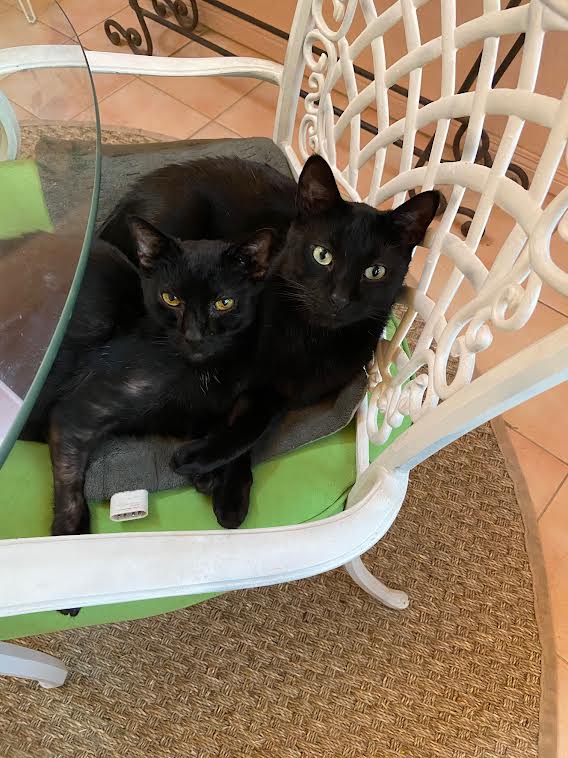
Westin and Morgan taught Ryan to love cats.

Why do cat videos fascinated us? According to the HuffPost article “The Surprising Reason People Love Cat Videos,” by Alex Sobel Fitts, a study of almost 7,000 people determined that the respondents overwhelmingly “felt significantly happier after watching the videos and experienced fewer negative emotions of anxiety, sadness and guilt.”

Which sounds like cats might be medicine…or magic, and I’m certainly not one to argue. I’ve tended to approximately 40 felines over the course of my life and currently share my home with four. However, I know Ryan was not always on the “Cats Rule!” side of the street.

“I thought you didn’t like cats,” I pointed out one evening when our cat Morgan was splayed across Ryan’s chest, purring loudly.

“I only like your cats,” he said stroking Morgan’s head.

Now I know that’s not true. Ryan loves cats as much as I do. Note here that we both also share an abiding affection for canines. (My cattle dog Bella just stared me down and forced me to write that.)

As a life-long rock collector, I find joy in looking at specimens online.

In any case, I can’t really criticize Ryan for his daily foray into the cat-video world, because I have a dirty little secret too.

“What are you looking at?” Ry asked as he peered over my shoulder.

I felt the urge to hide my shame, still I let him see.

He creased his brow. “Rocks?”

I nodded. As a life-long mineral collector, I felt the sudden urge to defend myself for the time I spend cruising rock sites online, but Ry just smiled. And now there is harmony in our home, as neither Ryan nor I have to hide our internet addictions.

Anne Montgomery’s novels can be found wherever books are sold.

Goodreads

Amazon

The Tiberius Show: Father and son working together

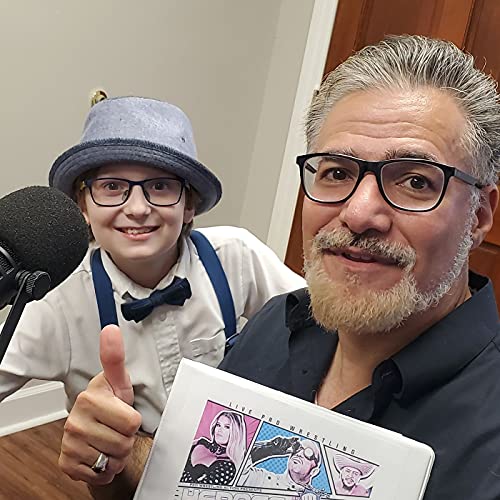
Tiberius and his father Joseph work together to produce The Tiberius Show podcast.

I’ve been on a quest of late to work with all different types of podcasters, and recently I had the opportunity to meet Tiberius. His journey began when he was seven. You can read the following explanation on The Tiberius Show home page.

“After watching a movie called The Greatest Showman,  he wanted to be an announcer,” Tiberius’ father Joseph explains.  “(I) was building a recording studio for a client and while testing the equipment Tiberius would not stop playing with the mics.  He kept announcing everyone that entered the house and acting like he was interviewing people.  Kinda like a mini radio show.  So after a while he decided he wanted to do just that.”

I was invited to be a guest on the program and was impressed with how professional the operation was. Joseph serves as producer, director, and engineer. Tiberius is the host. As you can imagine, the whole endevour takes a lot of preparation. Today, Tiberius is 12 and the thrill of interviewing people hasn’t worn off. When we met, he wore a short-brimmed fedora with matching bowtie and suspenders, an ohmage to his favorite interviewer, Larry King.

Tiberius is mostly interested in discussing jobs. He’s interviewed many guests, including a film composer, chemistry teacher, tax expert, video game designer, antique seller, DJ, and digital marketing professional. In my case, we talked about sports reporting and sports officiating.

There are also special segments of the podcast, including Math Corners and Heart of a Lion. When I found out there would be math involved—a subject in which I am hopelessly lost—I was a bit concerned, which I explained to Joseph.

“Don’t worry,” he said. “Just tell Tiberius you need some help with it.”

And boy was I glad he told me that, because as Tiberius described the math word problem that involved various numbers of colored pens, my mind shot back to elementary school where I always shuttered at the thought that the teacher might call on me. Luckily, Tiberius had my back, and he explained the answer so that even I could understand.

The whole show was fun and bubbly with Tiberius performing like an excited ringmaster. But then, at the end of the show, Tiberius turned serious. It was time for Heart of a Lion, the segment of the program where he discusses the importance Leadership, Integrity, Obedience, and Nobility.

The solemn turn is understandable, when you consider the reason Joseph puts so much time and effort into the program. “I got Covid,” he explained. “I was in the hospital for a few months, and I kept wondering what my epitaph would be. What would they say about me when I was gone?”

Joseph thought about that a lot. Finally, as he lay there critically ill, he knew what he hoped those words to be. “I wanted them to say I was a good dad.”

After being on the show and watching father and son work together, all I can say is, Joseph, that’s exactly what you are. A good dad.

If you’d like to listen to my conversation with Tiberius, you can find it here.

Anne Montgomery’s novels can be found wherever books are sold.

Goodreads

Amazon

A glorious 50th reunion

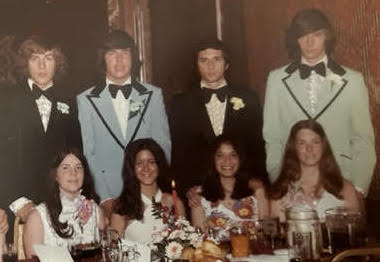
Left to right: Shelly, Jill, Denise, and me at our senior prom in 1973.

For months I’ve been looking forward to my 50th high school reunion. Note that typing those words is, um…difficult. When one is young, old people muttering how fast time flies is something we tend to ignore. But decades later, when my 96-year-old mother looked at me and said, “I never thought it would go so fast,” I finally understood. That comment sent a chill down my spine and cemented the idea that the older we get the quicker that life clock ticks.

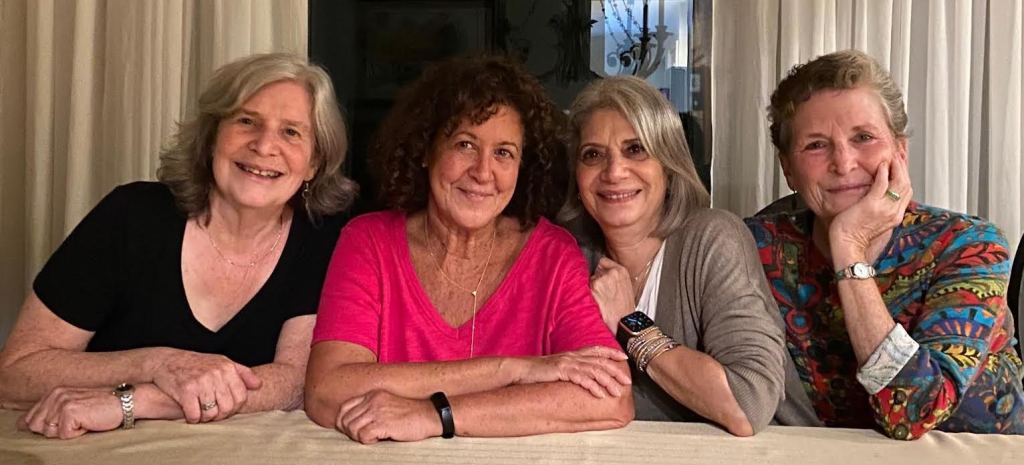
There were a lot of people I wanted to see, but mostly it was my three best friends: Jill Paskow, Shelly Sherman, and Denise Carra, all of whom I met in elementary school. We marched through junior high and high school in lockstep, but after graduation we went to colleges in different states and ended up spread across the country.

I left Livingston, New Jersey in 1973. My friends scattered. Marriages happened. Babies were born. Close friends and family members died. But despite the years that divided us from our youth, the memories of our time together as kids remain vivid: South Mountain Arena where we ice skated, camping on Eagle Island in the Adirondacks, those meetings of the Bridge Club where we talked endlessly about boys and secretly read Everything You Always Wanted To Know About Sex (But Were Afraid To Ask), and holiday celebrations with Denise’s huge Italian family, where her Sicilian grandmother, Noni, who spoke no English, would pat us on our cheeks, apparently assuming we were all her grandchildren.

When I boarded the plane in Phoenix, Arizona, one that took me back to Northern New Jersey, I hadn’t been in that part of the country for over a decade, nor had I had much interaction with my high school pals, aside from the occasional email or Facebook posts.

My visit made me wish we’d spent more time with one another over the years, but I can’t fix that now. All I can do is rejoice in the fact that I got to visit my friends: Shelly, Jill, Denise, and many others.

And it was glorious.

Anne Montgomery’s novels can be found wherever books are sold.

Goodreads

Amazon

Apparently, it’s never a good idea to call a Millennial on the phone

Please don’t call a Millennial! You’ll make them anxious. You should text instead.

I was watching the news the other day and there was a story about what today is proper cellphone etiquette. I have to say, I was as surprised as the two female anchors to learn what is appropriate by current standards.

“It is not okay to call someone on the phone, prior to texting,” said the guest talking-head, who was some kind of media specialist.

I, like the two anchors, said, “What?”

Yep, it seems that Millennials, as well as Gen Xers, are horrified when they receive a phone call without warning. It seems people in these age groups get flustered when they actually have to pick up the phone and mutter “Hello.”

I thought this quite strange, so I put on my old reporter’s cap to see what’s happening, and it turns out the talking-head was spot on. According to the Forbes article, “Millennials Hate Phone Calls, And They Have a Point” by Brianna Wiest, “…phone calls seem invasive because it demands an instant response. In a world where their messages, emails and DMs pile up, they are at least afforded somewhat of a buffer when given time to respond on their own terms.”

Got it! Millennials are afraid to have to make a quick decision, because the idea of having to deal with something immediately is too stressful. That had me wondering where the next generation of air traffic controllers or brain surgeons or any other career that is based on quick thinking might be coming from, but I digress.

Millennials think small talk is awkward, so a text keeps them calm.

And there’s more. The Antsy Labs article “Why Millennials Have a Fear of a Phone Call” by Alex Jeffries, points out that, “While 75% of Millennials say they’re avoiding phone calls because they’re too time consuming, there’s an even bigger reason they don’t like to talk on the phone. It turns out that, according to BankMyCell, 81% of Millennials get apprehension anxiety ‘before summoning the courage to make a call.’”

As a person who spent endless hours on the phone as a teenager without a hint of anxiety, I wonder what these young people are so afraid of. Turns out that on top of the aforementioned avoidance of decision making, they’re panicky that the person on the other end of the phone might disagree with them in some way, the idea of which is apparently appalling.

As a former teacher of 20 years, I worry that perhaps we have failed these young people in some monumental way. They are completely ill-equipped in the niceties of small talk, which they consider “awkward”, so if you want to get in contact a text or email are preferred. That way they don’t have to use that silly old skill called conversation.

Sadly, I now understand when my kids, all now in their 20s, say they are “talking to someone.” This phrase means they are texting another person who they are interested in dating, which is quite the misnomer, as there is zero talking involved. My daughter explained that this is how two people get to know one another. When I suggested coffee or a drink she rolled her eyes.

I know it makes me sound old, but I don’t understand how you can become acquainted with another person with a few lines of text. In my world we look one another in the eye and have a conversation or…pick up the phone and have a chat.

Anne Montgomery’s novels can be found wherever books are sold.

Goodreads

Amazon

My new novel! Your Forgotten Sons

Your Forgotten Sons is the story of Sgt. Bud Richardville, a soldier who served in the Graves Registration Service during World War II and who never returned at the end of the war.

I’m excited to announce that I recently signed a contract for my historical fiction novel Your Forgotten Sons. Next Chapter Publishing, the same company that released my book Wild Horses on the Salt, will publish the novel June 6th, 2024, the 80th anniversary of the storming of the beaches at Normandy: D-Day.

How did I learn about Sgt. Bud Richardville? My dear friend Gina Liparoto was facing a risky spinal surgery, one that could have left her paralyzed from the waist down. Her soldier husband— traumatized by two tours in Afghanistan and one in Iraq—was uncomfortable in hospitals, so I was tasked with being Gina’s healthcare power of attorney.

The evening before the surgery, Gina handed me a Ziplock bag containing fragile, 75-year-old letters from her Uncle Bud, a man who served in the Graves Registration Service and who never returned at the end of the war. Then she made me promise that, no matter what happened to her, I’d tell Bud’s story.

Your Forgotten Sons is a departure for me, as it’s my first book that takes place outside of Arizona. Still, I had the great fortune of studying World War II and its aftermath in depth when I went to school in Luxembourg at Miami University’s branch campus, so when I was asked to write the story, I decided to take it on.

We are currently heading into the editing phase of Your Forgotten Sons, so I have my author’s cap squarely on.

Find below a little about Bud’s story.

Your Forgotten Sons

Inspired by a true story

Anne Montgomery

Next Chapter Publishing

Release Date: June 6, 2024

Historical Fiction

Bud Richardville is inducted into the Army as the United States prepares for the invasion of Europe in 1943. A chance comment has Bud assigned to the Graves Registration Service where his unit is tasked with locating, identifying, and burying the dead. Bud ships out, leaving behind his new wife, Loryane, a mysterious woman who has stolen his heart but whose secretive nature and shadowy past leave many unanswered questions. When Bud and his men hit the beach at Normandy, they are immediately thrust into the horrors of what working in a graves unit entails. Bud is beaten down by the gruesome demands of his job and losses in his personal life, but then he meets Eva, an optimistic soul who despite the war can see a positive future. Will Eva’s love be enough to save him?

Anne Montgomery’s novels can be found wherever books are sold.

Goodreads

Amazon

The joys of home ownership: Maybe not!

I’m guessing most people would like to own a home, but maybe you should reconsider.

There’s been a lot of news lately about young people and their deep-down desire to own a home. I get it. We’ve all been raised on the hankering to have a nice house with a beautiful yard surrounded by the proverbial white picket fence. But, as with all dreams, I thought you should know, there can be a downside to home ownership.

I’m not saying this just because a few months back my air conditioner quit. I can’t say it was entirely unexpected. The old girl had been pumping out cold air for over twenty years, quite the life span for an appliance of that sort, especially when you consider I live in a desert. After she died, some nice men arrived with a crane to replace her. While I gasped as I handed over my credit card to pay that $8,200 bill, I was mollified when I remembered that all those dollars would transfer to travel points. Still, as you might expect, the total stung.

The fridge was 20 years old when it quit while we were on vacation.

Today, since we are still in the midst of the hottest summer on record here in Phoenix—we’ve had 55 days over 110 degrees so far—I have never regretted the expense. However, it’s been all downhill appliance-wise since then.

Recently, we were on vacation when our son Troy called and said the refrigerator had died. Anyone who has dealt with that particular nightmare knows it’s best to be as far from said appliance as possible if it’s been down a while. The thought of sorting through rotting fish and meat and vegetables made me glad I wouldn’t be home for a few days, so that lovely chore was left to the kid. (Thank you, Honey!)

When my sweetie pie and I arrived home a few days later, imagine our surprise when we discovered the dishwasher had quit, as well. So, Ryan and I trudged off to Home Depot and handed off the credit card again, charging a little over $1,500 this time. We lived out of two coolers for a week, before the replacement fridge arrived. But the thing was damaged and had to be returned.

We now have a pretty new dishwasher to replace the one that died while we were away.

“We’ll have to order another one,” said a Home Depot supervisor. “It’ll be delivered in three weeks.”

Ryan was not amused and insisted they provide us with a loaner, which they did. But it’s a wee baby fridge and not much fits inside. Still, at the moment, it’s all we have.

And our appliance woes weren’t over. This morning, as I was preparing brunch for week one of the NFL season, I noticed some water by the backdoor. I wondered where that moist stuff had originated— we hadn’t seen rain here in Phoenix since March 22—and was stumped, until I considered that just inside the sliding glass door was the water heater.

“It’s done,” Ry said after looking through the cobwebs at the appliance that is probably the most ignored in every home. “But the good news is it was only supposed to last seven years. We replaced it 16 years ago.”

I never gave the water heater much thought, until it died

That’s my sweetie pie! Always thinking positively.

I just watched Ry and Troy head off to find a new water heater. The good news is the baby fridge is still cold and the air conditioner is working. On the downside, the dishwasher functions, but it’s not much good without water.

The point, of course, is that all of you hopeful home owners might want to rethink that dream, because sometimes homeownership can be a nightmare.

In all honesty, right now, I’d rather be a renter.

Just sayin’.

Anne Montgomery’s novels can be found wherever books are sold.

Goodreads

Amazon

Criticism isn’t easy to take, but we should consider it a gift

“Don’t judge me!” students would often say when I was a teacher. And that always made me laugh, though not outwardly. I usually wanted to respond, “Well, of course I’m judging you. That’s what they pay me for.”

I don’t know when everyone decided that judgement was a negative thing. And before I go on, please note that I’m not talking about destructive critiques like I hate your new hair style or that dress you bought is really ugly. I’m talking about being evaluated for the work we do and our personal behaviors that might interact negatively with others.

Because of the career paths I chose, I was often criticized loudly and in public. I spent 40 years as an amateur sports official calling football, baseball, ice hockey, soccer, and basketball games where I regularly fended off angry coaches and fans who didn’t like my calls, which sometimes resulted in me needing a police escort to my car. I was also a sportscaster, and whenever I erred on TV, local writers and viewers would have a field day pointing out my stupidity.

Did these attacks hurt my feelings? Of course, they did. But I had to learn to accept the fact that I wasn’t always right, and even though the delivery method was sometimes cruel, I often realized later that those critiquing me had a point. I did make a bad call and I needed to do better.

When I was a sports official, criticism was part of my everyday life.

The fact is we need judgement if we are to grow and become better people. However, most of us bristle when someone tells us we should change.

“Very few people can take criticism graciously,” said Dr. Leon F. Seltzer in his Psychology Today article “Why Criticism is so hard to take”. “ For most of us, being criticized is uncomfortable at best — and de-stabilizing (or even devastating) at worst. The ability to take criticism in stride, it seems, is almost universally elusive.”

If you’re wondering why most of us struggle with criticism, feel free to blame the people who raised you.

“Very few parents are enlightened enough, or sufficiently skilled, to carry out the kind of “loving correction” that doesn’t end up making us hypersensitive—and therefore over-reactive—to criticism,” Seltzer said. “As a result, negative judgments we receive as adults can automatically remind us of the inadequacies we so keenly felt when criticized as a child.”

While we can’t change the past, we can consider ways to improve how we handle judgement. First, don’t take criticism personally, especially if it comes from a boss or peer. Consider the interaction an opportunity, and remember that sometimes we don’t have the full story. Pause and try to understand the other person’s point of view. Focus on what they need from you, and see if you can do something to improve the situation.

It’s also important to realize that all criticism is not created equal. Everyone is periodically faced with comments that are destructive and you should feel free to ignore those taunts. However, embracing constructive criticism, learning from it, and making improvements is one of the best ways to get ahead in the world.

Anne Montgomery’s novels can be found wherever books are sold.

Goodreads

Amazon

Parents, give your kids room to fail

It’s important for children to try, fail, and try again. Parents need to give them room to do that.

I’ve written before about the power of failure. How we learn our best lessons from falling down and lifting ourselves up again. As a teacher of 20 years, I encouraged my students to try new things, even if it meant feeling awkward in front of others. A few took my advice, but many did not.

It’s strange that this fear of failure is sometimes caused by well-meaning parents who seem convinced their job is to protect their child from any form of disappointment. Their kid must be happy and fulfilled every moment of the day. Children must be shielded from frustration and stress and told how great they are on a regular basis.

But what does that teach them? Imagine the 18-year-old, fresh from graduation, who was gently shepherded through school by parents who defended them against teachers who wanted the child to work harder in class, insisted the coach put them in a starting position, and asserted that the drama teacher was a dope for not giving their child the leading roll. Now, when it’s time for the kid to enter college or the business world, they have not learned to deal with criticism or disappointment. They know nothing about taking responsibility for their own actions and trying again. Then they’re lost because they should have been practicing these important lessons all their lives.

Unstructured play where children can work out their own issues is an important tool for growth.

Now, I’m not saying adults shouldn’t stand up for their children when need be. I’m just asking parents to let out the reins a little. Let your child know that failure is just another learning experience, that everyone fails, and you’re proud of them for trying.

Note that this over-protection begins early. For example, many parents often play too strong
a role in organizing children’s playtime. Perhaps if kids are given a little more latitude to interact with other children without adults hovering nearby, kids might be forced to work through difficult or uncomfortable situations themselves. They won’t always get what they want, but when they’re older, they’ll have the basics for dealing with challenging issues, which just might help them develop enough self-esteem to feel comfortable trying new things.

The bottom line is we learn little from success. I challenge you to look back on your life and remember the mistakes that changed the way you did things. With that in mind, give your kids
the freedom to fail. Ask them what they learned. Then encourage them to go back and try again.

It’s the best gift you’ll ever give them.

Anne Montgomery’s novels can be found wherever books are sold.

Goodreads

Amazon

A little tree and second chances

A little bonsai tree reminded me of second chances.

I have a home on the small island of St. Croix in the U.S. Virgin Islands, a place I don’t get to be very often because of family obligations.

That said…I’m a plant person. Ever since I was a little kid and my parents gave me my own small strip of ground behind the garage, I’ve marveled at the way things grow. I planted my first rock garden—rocks being my other love—when I was 12. And the interior of the many of the homes I’ve occupied during my travels through eight states always had plants pretty much everywhere.

I mention this because there are no plants in my home in St. Croix. The logic is simple, really. My sweetie pie and I haven’t been able to stay in our little place on the hillside overlooking Christiansted Harbor for more than a few weeks at a time. Whenever I would look longingly at an orchid in full bloom or some happy, glossy-leafed tropical, he’d say, “It will just die when we leave.” So, I’d gently put it back on the shelf.

Until yesterday.

I was walking through Home Depot, one of the only big-box stores on the island, where we were in the garden center looking for a new hose. Out of habit, I perused the plants and as I rounded one corner I noticed a garbage can filled to the brim. On top of that pile of dead and dying plants was a little bonsai tree in a gray ceramic pot.

I don’t know why I fished it out of the trash, but when I held it up, I noticed some brown leaves, though certainly not enough to indicate the tree was dying. I held the pot in both hands and looked around, wondering why anyone would have thrown the little tree away. Then I carried it over to Ryan. I was surprised when he didn’t remind me that we would be headed back to Phoenix in a few weeks.

I walked over to the customer service counter and was directed to a man named Dane. I explained that the tree had been dumped in the trash and wondered if, under the circumstances, he might lower the $22 sticker price. He looked at me like I was a bit odd, then pulled a black marker from his top pocket and scrawled $6 on the bottom of the pot along with his name.

When I got home, I plucked the brown leaves, checked the moisture level, and then placed the pot on the table on the porch. I must admit here that I haven’t had much luck with bonsai trees in the past, but I’m willing to give it another try. And, when I head home to Phoenix, I’ll leave it with a friend who will tend to it while I’m gone.

The bonsai seems quite happy right now. But it’s funny that sometimes when I look at it I don’t see a tree. I see second chances. I have failed and tried again on many endevours over the years, but I’m not sure I’ve always appreciated the opportunity to give things another go.

Now…I will.

Anne Montgomery’s novels can be found wherever books are sold.

Goodreads

Amazon

Of sunglasses and sports officials

For the first 20 years of my sports officiating career, I wasn’t allowed to wear sunglasses. Then things changed.

Once upon a time, no self-respecting sports official would have been caught dead wearing sunglasses. The reason? “Hey, ump, whadaya, blind?”

The simple idea that an official might be judged as having poor eyesight if they were seen sporting shades kept millions of umpires and referees squinting in the sun.

I know this because I spent 40 years officiating sports: football, baseball, ice hockey, soccer, and basketball to varying degrees, but I spent the vast majority of my officiating career out on fields calling football and baseball games. So perhaps my eye doctor’s response should not have been surprising.

He peered at my eyeballs through his ophthalmoscope. (Just wanted to sound smart there. That’s the round thingy with the little ledge that the eye doctor makes you put your chin on so he can look inside your eyes.) “You need to wear sunglasses,” he said.

“But I can’t!” I whined. “It’s not allowed.”

“What do you mean you can’t?”

“The officiating group I work for says we’re not allowed to wear sunglasses on the field.”

He moved the ophthalmoscope out of the way and sat back. “That’s ridiculous. We live in a desert. Do you want to go blind?”

I shook my head.

“Then tell your boss you want that in writing.”

While I considered that idea, I looked into how sunlight can damage our eyes. According to Web.MD, “One type of UV radiation— UVA rays—harm something in the back of your eye called the macula. It helps you see detail clearly. It’s part of the retina, which sends signals to your brain to translate light into images. The blue and violet parts of the sun’s rays can also hurt your retina.

“The front part of your eye, where your cornea and lens are, can get damaged by another type of UV radiation called UVB rays. The lens of your eye lets in light and works with the cornea to focus it on the retina.”

Sadly, the rule about sunglasses didn’t change until my eyes were already damaged.

I found a whole bunch of bad stuff sunlight can do to your eyes, things like macular degeneration, cataracts, and even eye skin cancer. Sufficiently scared, I asked my boss for a letter explaining why we weren’t allowed to wear sunglasses when officiating. “It’s for my eye doctor,” I said.

He stared at me for a few beats and then a miracle occurred. The policy was dropped and sports officials in Arizona could now wear sunglasses while working games. (I’m still waiting for a thank you from me peers.)

Sadly, the miracle didn’t happen early enough to save my eyes. When I was in my early 50s, I started having trouble seeing baseballs. One evening, while working a men’s league game, I was in the infield when a player ripped a line drive right at me. I couldn’t see the ball and took a shot in the thigh. If you’ve never been hit by a baseball, let me say it hurts. But the nasty bruise on my leg wasn’t the only outcome. I suddenly found myself uncomfortable working in the field, fearful I might get hit in the face. Then I started having trouble seeing footballs on kicks as I would lose the ball in the lights, so off to the doctor I went.

I had cataracts in both eyes. And while many people get the cloudy vision and sparkly glare caused by cataracts, mostly it happens when they’re really old. My parents had them in their eighties. Had I been allowed to wear sunglasses, I too might have gone another 30 years or so with clear vision. Instead, I had surgery on both eyes and can now see a mile or two, but the operation left me needing glasses to read.

Today, it’s common to see sports officials wearing sunglasses. The stigma is gone. That there was ever any concern about appearances seems silly and ironic, because when officials don’t wear sunglasses, they might indeed go blind.

Anne Montgomery’s novels can be found wherever books are sold.

Goodreads

Amazon