Wildwood Reads gives Wolf Catcher 5-Stars

“Once again the author has created a beautiful story with a powerful message. She took a piece of history and brought it to life.”

Megan Salcido

Wildwood Reads

Find the rest of the review here.

The past and present collide when a tenacious reporter seeks information on an eleventh century magician…and uncovers more than she bargained for.

WOLF CATCHER

Anne Montgomery

Historical Fiction/Suspense

TouchPoint Press

February 2, 2022

In 1939, archeologists uncovered a tomb at the Northern Arizona site called Ridge Ruin. The man, bedecked in fine turquoise jewelry and intricate bead work, was surrounded by wooden swords with handles carved into animal hooves and human hands. The Hopi workers stepped back from the grave, knowing what the Moochiwimi sticks meant. This man, buried nine hundred years earlier, was a magician.

Former television journalist Kate Butler hangs on to her investigative reporting career by writing freelance magazine articles. Her research on The Magician shows he bore some European facial characteristics and physical qualities that made him different from the people who buried him. Her quest to discover The Magician’s origin carries her back to a time when the high desert world was shattered by the birth of a volcano and into the present-day dangers of archeological looting where black market sales of antiquities can lead to murder.

REVIEW COPIES OF WOLF CATCHER AVAILABLE UPON REQUEST

Review/interview requests: media@touchpointpress.com

Get your copy where you buy books.

I love rocks, but let’s keep it simple

I have no memory of not being a rocker. Perhaps I was born that way.

I love rocks. I have collected them my whole life. So, when I was asked to pick a science in college, geology was a pretty easy call. I enjoyed learning about how mountains form and marveled at the tectonic plates that move our continents around ever so slowly. I can’t pass a road cut without trying to identify the colorful sedimentary layers and when I stare at the stars I remember being taught about the solar system and how it formed.

I mention this because after I took three geology courses, the thrill wore off. It wasn’t my love of rocks and minerals that waned, it was how complicated geology had become.

Here are a few of my rocks, 400 or so that reside in my living room, just so you know I’m passionate about my collecting.

“Today we’ll be talking about cryptocrystalline structures,” my professor said one day in class. He went on to explain complex things I didn’t understand and no longer remember. What I do recall is that I realized I didn’t care. I loved rocks because they were beautiful or fascinating. Perhaps you now think me shallow, but that rocks were pretty was enough for me from then on.

Today, thanks to the Internet, I’m a member of several Facebook pages for mineral enthusiasts. There are thousands of us out there, so I feel a little
better about my rocking addiction. Every day, I look at photographs of lovely specimens from around the world. But recently, things have gotten problematic again.

Take this post, for example: IMO it is a water-worn cobble of plagioclase porphyry: phenocrysts of bladed plagioclase feldspar in an aphanitic basaltic matrix.”

And this one: Mesolite is a tectosilicate mineral with formula Na₂Ca₂(Al₂Si₃O₁₀)₃·8H₂O. It is a member of the zeolite group and is closely related to natrolite which it also resembles in appearance. Mesolite crystallizes in the orthorhombic system and typically forms fibrous, acicular prismatic crystals or masses.

How can we describe these fluorite crystals? Humm? I think pretty sums it up nicely.

Yikes!

Can’t we just admire beauty without all the scientific mumbo jumbo? One wonders whether the above mineral descriptions are just a bit of braggadocio. Or maybe it’s me. Perhaps, if I’d taken more of those geology classes, I could confidently craft my own long-winded, science-laden description of a clump a beautiful fluorite crystals.

So, do I regret my decision to pass on higher-level geology? Let me think on it.

Doo doo da da doo doo da…

Nope! Pretty works just fine.

The past and present collide when a tenacious reporter seeks information on an eleventh century magician…and uncovers more than she bargained for.

WOLF CATCHER

Anne Montgomery

Historical Fiction/Suspense

TouchPoint Press

February 2, 2022

In 1939, archeologists uncovered a tomb at the Northern Arizona site called Ridge Ruin. The man, bedecked in fine turquoise jewelry and intricate bead work, was surrounded by wooden swords with handles carved into animal hooves and human hands. The Hopi workers stepped back from the grave, knowing what the Moochiwimi sticks meant. This man, buried nine hundred years earlier, was a magician.

Former television journalist Kate Butler hangs on to her investigative reporting career by writing freelance magazine articles. Her research on The Magician shows he bore some European facial characteristics and physical qualities that made him different from the people who buried him. Her quest to discover The Magician’s origin carries her back to a time when the high desert world was shattered by the birth of a volcano and into the present-day dangers of archeological looting where black market sales of antiquities can lead to murder.

REVIEW COPIES OF WOLF CATCHER AVAILABLE UPON REQUEST

Review/interview requests: media@touchpointpress.com

Of islands, birds, and rum

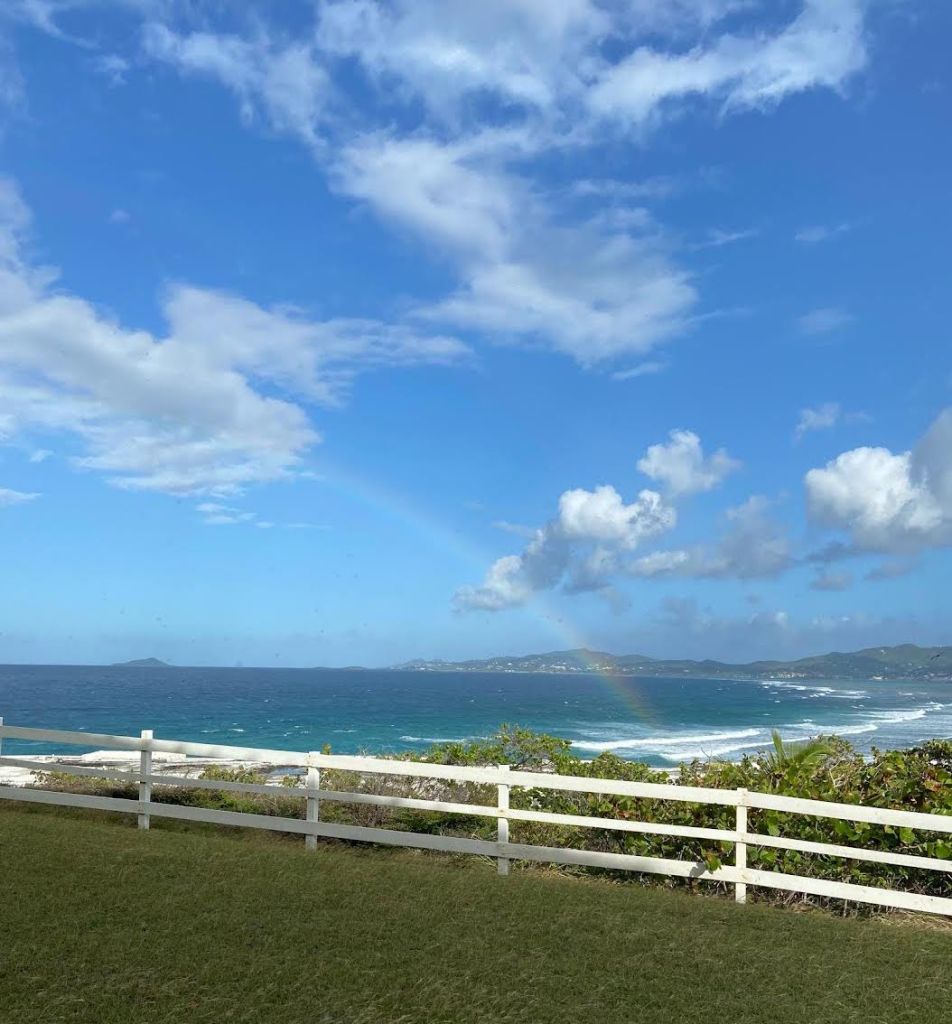
Our backyard in St. Croix gives us front row seats where we watch the sea and the birds that live here.

My sweetie pie and I have a little place in St. Croix.

“Where?” you ask.

Well, she’s one of the US Virgin Islands. St. John, St. Thomas and tiny Water Island—which is mostly uninhabited and remote— are her sisters, but she is the red-headed step child of the group. St. Croix is not flashy and full of nightlife. Travelers don’t come to party. They come to stare at the sea, which, depending on the side of the island you’re on, is peaceful with serene turquoise waters and white sand beaches, or wildly rough and constantly changing, displaying every color of blue you can imagine.

We are exceptionally spoiled because just outside our back porch a vast swath of sea bordered by green mountains and rolling hills entertains us daily: a moving piece of living art.

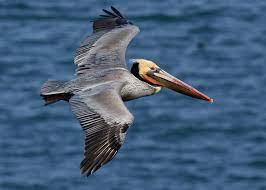
According to the fossil record, pelicans have been around at least 30 million years.

Onto this canvas each day come the birds. We have spent the last three decades living in Arizona’s Sonoran Desert, so these creatures are different from the ones we’re used to. Everyday, a pair of brown pelicans soars overhead before they fold their wings and dive into the foamy white waves, hoping to snare fish to feed their baby who sometimes flies with them.  

Pelicans resemble prehistoric creatures and perhaps for good reason. Their ancestors go back at least 30 million years, according to fossil records, so they’ve done pretty well on the evolutionary scale. The birds developed a throat pouch that expands when they hit the water. About two-and-half gallons of water rushes in and, if they’re lucky, a fish or two, which get scooped up and gobbled down.

Frigates harass other seabirds, get them to throw up their food, then catch the meal in mid-air. Yum!

But they only get to keep the meal as long as the frigate birds aren’t around. While these fleet creatures with scissor tails—named after the powerful French Man-of-War sailing ships— can snatch flying fish, tuna, and herring from the surface, unlike other seabirds they don’t have waterproof feathers. So, rather than risk their plumage in the sea, they often attack other birds to steal a meal. Frigates will harass our friends the pelicans, for example, and get them so frazzeled they will throw up their food. But there’s no waste, I promise, because the frigate bird is there to grab the regurgitated fish, snatching the tasty treat in mid-air. Even cooler perhaps, and far less gross, is the fact that frigate birds can fly for months at a time over the ocean and are able to sleep while doing so. How cool is that?

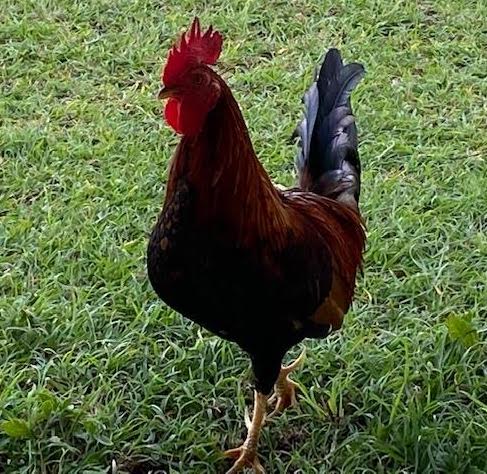
This fine banty rooster visited us daily with his herem, but a hawk has made the chickens move away.

There are also beautiful feral chickens all over St.Croix, birds displaying rust, black, brown, white, and purple-colored feathers, the descendants of chickens that arrived with Europeans five centuries ago. Striking red-combed banty roosters strut about with their harems, plucking bugs and worms from the ground that they ceremoniously give to their hens. The birds are so ubiquitous here that the rooster is the island’s unofficial mascot.

On our last trip, half a dozen chickens would come up to our back porch daily and visit. But this time, not a single one appeared. We wondered why and then spotted an elegant, brown winged bird with a curved beak: a predator that the locals call a chicken hawk. No wonder our feathered friends had fled.

The sea, the sky, the birds, and a spot of Captain Morgan. Life is good!

There are other birds—tiny black ones that flit past so quickly you wonder if you imagined them and swift white birds that fight arial battles with one another— but we haven’t been able to identify them yet. All we know is we’re provided with constant avian entertainment each day, a show that makes Netflix pale in comparison.

I’d tell you more—especially about the six-point, white-tailed buck that stared at us from 15 feet away before slipping over a hillside the other day— but there’s an iced glass of sweet, dark rum waiting for me on the porch.

Ah….

This image has an empty alt attribute; its file name is image.png

The past and present collide when a tenacious reporter seeks information on an eleventh century magician…and uncovers more than she bargained for.

WOLF CATCHER

Anne Montgomery

Historical Fiction/Suspense

TouchPoint Press

February 2, 2022

In 1939, archeologists uncovered a tomb at the Northern Arizona site called Ridge Ruin. The man, bedecked in fine turquoise jewelry and intricate bead work, was surrounded by wooden swords with handles carved into animal hooves and human hands. The Hopi workers stepped back from the grave, knowing what the Moochiwimi sticks meant. This man, buried nine hundred years earlier, was a magician.

Former television journalist Kate Butler hangs on to her investigative reporting career by writing freelance magazine articles. Her research on The Magician shows he bore some European facial characteristics and physical qualities that made him different from the people who buried him. Her quest to discover The Magician’s origin carries her back to a time when the high desert world was shattered by the birth of a volcano and into the present-day dangers of archeological looting where black market sales of antiquities can lead to murder.

REVIEW COPIES OF WOLF CATCHER AVAILABLE UPON REQUEST

Review/interview requests: media@touchpointpress.com

Get your copy where you buy books.

Paper or plastic? Ugh!

People in my household call me Eco Annie. (You know who you are.) The sobriquet comes my way because I take recycling and caring for our planet very seriously.

I was fifteen when the first Earth Day was celebrated, an event coordinated to bring attention to the sorry state of our natural world. Rivers were burning because of the irresponsible dumping of flammable waste, litter clogged our highways, acid rain poured down, damaging forests and water ways and even corroding the steel and concrete on buildings and bridges.

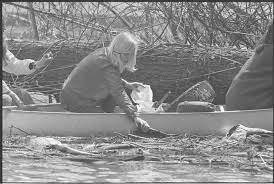
As a kid who grew up at home in the woods, the thought of the massive destruction of the trees and other living creatures upset me. I remember well the day I felt the need to clean the trash from a small stream near my home, and I reveled when the water began to flow free and clear again.

Like this Girl Scout, I too spent an afternoon cleaning the trash from a stream near my home when I was a kid.

The point is, I worry about our world and what we’re doing to it. The fact that fifty years have passed and we have barely moved forward in protecting our planet is just plain depressing. I mention this so you understand why I feel so strongly about recycling and composting and making Earth-friendly choices in regard to the products I buy.

Which brings me to my current gripe. Why, please tell me, do I have to pay more to be the good guy? Case in point: The other day I went to FedEx to ship a package. The man behind the counter immediately sized up the book I was mailing and pulled out a plastic envelope.

“Oh, wait,” I said politely. “Could I have cardboard instead?” He stared at me for a moment, which prompted me to explain. “I’m trying to quit plastic.”

Americans use hundreds of billions of plastic bags each year and they end up everywhere.

Now, before you jump on me, I have done my homework. I do understand that both plastic and paper products have their ecological downsides. But, after much thought, I settled on the idea that paper is the lesser of two evils, since it’s much more likely to decompose, taking only two-to-six weeks in a landfill, while plastic bags need 10 to 20 years to degrade, and they release toxic chemicals in the process. When you consider that Americans alone go through hundreds of billions of them every year, you can see why I worry.

Without comment, the man switched the plastic mailing bag with one made of cardboard. I smiled and felt rather virtuous. Then, I paid and got my receipt. I stared at it for a moment and quickly realized that while plastic bags are free, paper mailers are extra. I stared at the row of numbers and noted the tacked-on cost of just under three bucks.

Doesn’t seem right, does it?

Now, I will admit that producing paper products is more costly than plastic. Still, when doing something for the greater good, should we not get a small nod of appreciation from the universe and not an extra fee?

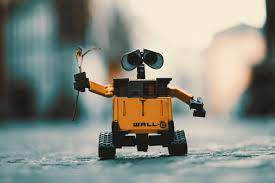
The little robot Wall-E, in the movie of the same name, spent his time cleaning up the mess Earthlings left behind.

That said, let’s face it. The choice between paper and plastic is fraught with all kinds of costs, both financial and environmental. The best answer, of course, is to carry only reusable bags, which I do at places like the grocery store. But that was not an option when I popped my book in the mail that day. (I will give the grocery stores credit, here, as you can recycle your plastic bags at many of them, but I sense few people take advantage of the offer. Perhaps, we can do better.)

I couldn’t help thinking about Wall-E, the sweet little robot trash collector who spent his days trying to clean up an abandoned Earth, the human inhabitants having fled the biological destruction they caused. Maybe, if we were all a little more like Wall-E, we could get the planet back in order. And perhaps somebody brilliant—I know you’re out there—can come up with a product that is sustainable and Earth friendly and…free.

This image has an empty alt attribute; its file name is image.png

The past and present collide when a tenacious reporter seeks information on an eleventh century magician…and uncovers more than she bargained for.

WOLF CATCHER

Anne Montgomery

Historical Fiction/Suspense

TouchPoint Press

February 2, 2022

In 1939, archeologists uncovered a tomb at the Northern Arizona site called Ridge Ruin. The man, bedecked in fine turquoise jewelry and intricate bead work, was surrounded by wooden swords with handles carved into animal hooves and human hands. The Hopi workers stepped back from the grave, knowing what the Moochiwimi sticks meant. This man, buried nine hundred years earlier, was a magician.

Former television journalist Kate Butler hangs on to her investigative reporting career by writing freelance magazine articles. Her research on The Magician shows he bore some European facial characteristics and physical qualities that made him different from the people who buried him. Her quest to discover The Magician’s origin carries her back to a time when the high desert world was shattered by the birth of a volcano and into the present-day dangers of archeological looting where black market sales of antiquities can lead to murder.

REVIEW COPIES OF WOLF CATCHER AVAILABLE UPON REQUEST

Review/interview requests: media@touchpointpress.com

Get your copy where you buy books.

Me? A reading teacher? Don’t be ridiculous

You want me to teaching reading? Don’t be ridiculous!

Sometimes, life can be absurd. Take the day my principal called me into his office.

“There aren’t enough students in your department.”

This I knew as my journalism and communications classes were rather small.

“We can’t pay two teachers if there aren’t enough students.” He clasped his hands together on the desk. Still, I wasn’t worried. After all, I had a degree in communications and I’d been a reporter for almost 15 years in TV and print. My peer in the department did have a background in video editing, though he’d been an English teacher. But, of course, he had seniority.

“You have two choices.”

Uh oh! I got a bad feeling in the pit of my stomach.

“You can move to another school in the district or you can be a reading teacher.”

I leaned back in my chair. “Reading? I can’t teach that!”

He spread his hands. “Then you’ll have to go somewhere else.”

“I have a history cert,” I said hopefully. “I love history!”

“Coaches teach history,” he said as if that statement made sense.

“You don’t understand…”

Dyslexia can cause confusion with numbers and directions, as well as words.

“That’s all I can offer you right now. You’ll have to get a reading certification. That’s about 15 credits, but you can teach on an emergency cert right now.”

“But…”

He stared at me.

“I’m dyslexic.”

“You’ll figure it out.”

I liked my school, despite the Title I issues that identified my students as children who lived below the poverty line. But how could I teach reading?

When I was in elementary school, no one tossed around words like dyslexia. If you couldn’t read well you were just stupid and lazy. I was the offspring of parents who both had college degrees. I watched my dad get his master’s when I was eight and my mother was the only women in our neighborhood who had an education and a job. Every morning they read the now-defunct Newark News at the breakfast table and the New York Times during cocktail hour. The West Essex Tribune was also part of their repertoire. Along with my brother and sister, they both loved to read books.

But, for me, the thought of reading for pleasure seemed absurd. I struggled through fifth grade before my parents actually noticed. A D in Social Studies sounded the alarm bells and my parents placed me in a summer school class called Work and Study Skills. There I learned to take notes and be more organized, though I don’t recall anyone ever saying I was dyslexic, nor being tested for reading problems.

When I was a high school referee, I sometimes, pointed the wrong way on the football field, a problem known as directional dyslexia.

Here’s the thing about dyslexia. It looks different depending on who has it. Like autism, it’s a broad spectrum. Some sufferers will never read well. Others have barely noticeable quirks. I’m of the low-level variety. My spelling sucks. I get easily distracted. I turn certain letters around. (I can’t tell the difference between a lower-case d and b if they’re in an unfamiliar word.) I have trouble when I’m stressed distinguishing right from left, which my crew-mates in football found hilarious when, as the referee, I would signal first down or penalties in the wrong direction. Sometimes, I struggle to put the right shoe on the correct foot. And I’m pretty bad with numbers. I guess I shouldn’t have been shocked when one of my news directors called me into his office to inquire about why I kept reading the sports scores wrong every night on the news. After that, I had to write my scores out in words. Yes, it took a lot of extra time which had me sliding onto the news set seconds before the red camera light blinked on, but at least I had a better chance of getting the scores right.

As you can imagine, I felt like a complete fraud the day I stood in front of a reading class for the first time. My students were mostly freshman who read between the kindergarten and sixth-grade levels. My job was to figure out why and make them ready for high school. Sometimes their issues were physical. They had undiagnosed hearing or vision problems. Sometimes they were kids who didn’t speak English. Others had various learning and emotional disabilities. Many came from homes where there were no books or magazines or pencils or paper and where they never witnessed an adult reading anything.

There’s a big world of books out there and dyslexics need extra help finding the key to all that knowledge.

I began taking classes to get my reading certification, and the day I learned about dyslexia was shocking and wonderful. Wonderful, because there was finally an explanation.

I looked back over the adjustments I’d made to improve my reading skills over the years. When I prepared to head off to college the first time, my older brother’s words rang in my head. “You’re to stupid to go to college,” he said. “I bet you 20 bucks you’ll flunk out the first semester.”

Since I would have rather been hit by a truck than let my brother win, I went to work. Through trial and error, I learned that I could never stay up all night to pass an exam. I had to get a good night’s sleep. I had to study for short periods of time every day, beginning a week before a big test. I couldn’t listen to music or be around noise, or I’d get distracted. I had to take lots of notes and always go to class.

I taught reading for about five years and I often pointed out to my students that I had a reading disability. “If I can do it, so can you,” I’d say.

And then some of them would sit up a little straighter in their seats and nod. Turns out believing you can learn to read is the most important step you can take.

This image has an empty alt attribute; its file name is image.png

The past and present collide when a tenacious reporter seeks information on an eleventh century magician…and uncovers more than she bargained for.

WOLF CATCHER

Anne Montgomery

Historical Fiction/Suspense

TouchPoint Press

February 2, 2022

In 1939, archeologists uncovered a tomb at the Northern Arizona site called Ridge Ruin. The man, bedecked in fine turquoise jewelry and intricate bead work, was surrounded by wooden swords with handles carved into animal hooves and human hands. The Hopi workers stepped back from the grave, knowing what the Moochiwimi sticks meant. This man, buried nine hundred years earlier, was a magician.

Former television journalist Kate Butler hangs on to her investigative reporting career by writing freelance magazine articles. Her research on The Magician shows he bore some European facial characteristics and physical qualities that made him different from the people who buried him. Her quest to discover The Magician’s origin carries her back to a time when the high desert world was shattered by the birth of a volcano and into the present-day dangers of archeological looting where black market sales of antiquities can lead to murder.

REVIEW COPIES OF WOLF CATCHER AVAILABLE UPON REQUEST

Review/interview requests: media@touchpointpress.com

Get your copy where you buy books.

The Castle: “I was gripped from start to end.”

“Anne Montgomery is, in my opinion, a master storyteller…Her writing is at once refreshing, gritty and absorbing and leaves me shocked, concerned for the characters yet satisfied at an amazing novel.”

Katherine Hayward Perez

Just Catherine

Find the rest of the review here.

ANCIENT RUINS, HAUNTED MEMORIES, AND A RUTHLESS CRIMINAL COMBINE WITH A TOUCH OF MYSTIC PRESENCE IN THIS TAUT MYSTERY ABOUT A CRIME WE ALL MUST ADDRESS.

THE CASTLE

Anne Montgomery

TouchPoint Press

Contemporary Women’s Fiction/Suspense

September 13, 2021

Maggie, a National Park Ranger of Native American descent, is back at The Castle—an ancient pueblo carved into a limestone cliff in Arizona’s Verde Valley. Maggie, who suffers from depression, has been through several traumas: the gang rape she suffered while in the Coast Guard, the sudden death of her ten-year-old son, and a suicide attempt.

One evening, she chases a young Native American boy through the park and gasps as he climbs the face of The Castle cliff and disappears into the pueblo. When searchers find no child, Maggie’s friends believe she’s suffering from depression-induced hallucinations.

Maggie has several men in her life. The baker, newcomer Jim Casey, who always greets her with a warm smile and pink boxes filled with sweet delicacies. Brett Collins, a scuba diver who is doing scientific studies in Montezuma Well, a dangerous cylindrical depression that houses strange creatures found nowhere else on Earth. Dave, an amiable waiter with whom she’s had a one-night stand, and her new boss Glen.

One of these men is a serial rapist and Maggie is his next target. In a thrilling and terrifying denouement, Maggie faces her rapist and conquers her worst fears once and for all.

REVIEW COPIES OF THE CASTLE AVAILABLE UPON REQUEST
Contact: media@touchpointpress.com

Get your copy where you buy books.

An open letter to the IOC: Please fix the Games!

The Olympic rings have lost some of their luster.

Dear Folks in Charge of Those Five Colorful Rings,

I’m writing to you because, well, I’m concerned.

Let me start by pointing out that my first dream was to one day step up on that middle podium, a gold-medal around my neck. The national anthem would blare in the background while excited fans showered me with colorful bouquets. That I was a decidedly mediocre ice skater did not deter me in the least. When that dream died, rather early in retrospect, I continued to watch those Olympic competitors with awe and not a little bit of envy.

Now, I feel badly saying this, but your rings have lost some of their luster. I’m hoping you can fix it, so I can continue to be astounded by the breathtaking skills these athletes display.

The first issue is almost too depressing to talk about: cheating! How could you let gold-medal-favored singles skater Kamila Valieva compete after she failed a drug test back in December? The fifteen-year-old Russian was found with a cocktail of performance-enhancing drugs in her system. One was a heart medication that could increase her endurance.

I know what you’re thinking. “Valieva is just a child. It’s not her fault.” While you’re right, we still can’t ignore cheating. That the adults in her sphere had no compunction against doping a child is despicable. The excuse given—that she drank from a water glass her grandfather used after taking trimetazidine—is laughable, and not in a funny way. That the drug can cause lowered blood pressure, vomiting, nausea, indigestion, headaches, and liver dysfunction points out that the girl is being abused. Anybody who participated in her doping needs to be arrested and punished and never allowed near children ever again.

Russian skater Kamila Valieva is just 15, but she and her handlers need to be held accountable for her failed drug test.

And speaking of children…it’s time to put an age limit on all Olympic sports. I can hear a lot of you moaning about how good 14-and-15-year-olds are at flipping through space, but I ask you, if they are mature enough to survive the pressures of the world stage, why do we always see them nervously clutching stuffed animals as they wait for their scores? Answer: They’re just kids.

I have spent much of my life in the sports world, as both a sports reporter and an amateur official in football, baseball, ice hockey, soccer, and basketball. I have seen more helicopter sports parents then I care to remember, and during my time skating I saw quite clearly what their kids were forced to give up. While I was going to high school football games and summer camp and taking music lessons and roaming free in the woods with my dog, these children were prisoners. They skated 365 days a year. They were on strict diets and were tutored so school didn’t get in the way of training. They were like caged animals, constantly under the supervision of adults who hoped to ride their skating costumes to fame and fortune.

The thing is, none of them ever got that far. Their dreams ended without Olympic glory, has-beens as teenagers. Here’s what I know after spending 20 years teaching in high school. Those years are when we find out what we like to do, what we’re good at, and what someone might pay us to do. For athletes focused so narrowly on one prize, other skills are often left to deteriorate. When the Olympic dream fades, they don’t have much left.

With that in mind, let’s say that only those 18 and older can compete on the international stage. Since the athletes would be adults, the blame when doping surfaces would fall squarely on their shoulders. The age limit would also allow them to grow and mature, which in turn might help stem some of the mental health issues that have been popping up in athletes of late.

Finally, we need to think hard about what countries get to host the games. In 2013, six cities bid on the 2022 Winter Olympics. By 2015, four cities had dropped out, leaving just Beijing, China and Almaty, Kazakhstan, countries that rate poorly when it comes to  human-rights issues.  That the IOC allowed the games to go on in China when over a million Uyghur Muslims are said to corralled in prison camps and forced to perform slave labor is an abomination.

The Hellinikon Baseball Stadium, built for the Athen’s Olympics in 2004, is currently being used to house refugees

But I have the answer! In the future, let’s not limit that games to one country. Let’s spread the competitions worldwide. That way, no country has to foot the ridiculously bloated bill attached to hosting the competitions. And let’s use existing facilities, so we don’t end up with abandoned places like the Hellinikon Baseball Stadium in Athens—which is currently being used to house refugees—and all those deserted venues in Sochi, Russia. Spreading the locations around the world would limit local costs and congestion. And, though the TV networks might complain, with modern technology the Games could be covered and broadcast from pretty much anywhere.

I really believe you can make these fixes, so we fans can continue being thrilled by the phenomenal athletes you bring into our living rooms every two years. But please make the changes quickly, because if you don’t, that Olympic dream may soon be nothing but a long-lost memory.

Sincerely,

Anne Montgomery

This image has an empty alt attribute; its file name is image.png

The past and present collide when a tenacious reporter seeks information on an eleventh century magician…and uncovers more than she bargained for.

WOLF CATCHER

Anne Montgomery

Historical Fiction/Suspense

TouchPoint Press

February 2, 2022

In 1939, archeologists uncovered a tomb at the Northern Arizona site called Ridge Ruin. The man, bedecked in fine turquoise jewelry and intricate bead work, was surrounded by wooden swords with handles carved into animal hooves and human hands. The Hopi workers stepped back from the grave, knowing what the Moochiwimi sticks meant. This man, buried nine hundred years earlier, was a magician.

Former television journalist Kate Butler hangs on to her investigative reporting career by writing freelance magazine articles. Her research on The Magician shows he bore some European facial characteristics and physical qualities that made him different from the people who buried him. Her quest to discover The Magician’s origin carries her back to a time when the high desert world was shattered by the birth of a volcano and into the present-day dangers of archeological looting where black market sales of antiquities can lead to murder.

REVIEW COPIES OF WOLF CATCHER AVAILABLE UPON REQUEST

Review/interview requests: media@touchpointpress.com

Get your copy where you buy books.

The power of milk! Brought to you by Genghis Khan

Milk: Hate it! Still, who knew it had almost magical powers?

I hate milk. Which I blame on my mom.

When I was a kid, we had a silver box at the back door where a uniformed man in a jaunty cap deposited four glass bottles of milk on a regular basis. (Yes, youngsters, that was a thing.) Now, I never minded that milk. It was those dreaded days when Mom would crack open the fridge and discover we were out of milk that caused my aversion to the stuff.

My brother, sister, and I would stare at the dry cereal in our bowls and ready ourselves to run, because we knew what was coming. Powdered milk. Ugh! My mom would mix it with water and, as we all complained, she’d grit her teeth and yell, “In the Depression sometimes all we had was powdered milk!” Then she’d dump the stuff in our bowls.

Old-fashioned powdered milk was awful and strangely blue.

Now, if you never had the pleasure of old-fashioned powdered milk, note that it was rather thin and blue. Not sure how that’s chemically possible, but that’s what I remember. And it was awful. So, I got out of the habit of drinking milk. I rationalized that my love of cheese and ice cream surely filled my bones with the appropriate amount of calcium, but recently I’ve begun to think I may have missed the milk boat.

“I’ve never broken a bone,” my 96-year-old mom says to me periodically. “That’s because I drink my milk.” Then she waits for my response, which makes me calculate the number of times I’ve broken bones: my wrist twice, my elbow, my right fibula, a vertebrae, and recently my ankle where I suffered both a broken fibula and tibia.

“You don’t drink milk,” she’ll say. “That’s why you’ve hurt yourself.”

“You ruined it for me when you made me drink that blue stuff,” I counter. “And I was involved in sports, so most of my broken bones are explainable.”

“I love warm milk!” she says sounding like she’s fanaticizing about a bottle of fine Champaign. The whole idea makes me gag.

Good-old Genghis Khan and his men spread their genes around so well that most Americans today are not lactose intolerant.

But I will admit that milk can be useful, something I learned from that party-animal Genghis Khan and his fun bunch of pony-riding warriors who terrorized the locals and created the massive Mongol Empire in the thirteenth century. He and his men faced a Chinese army that outnumbered them 10-to-1. And they beat them thanks to…milk. Really. It seems that Genghis and the boys had a gene that made them able to digest milk. The Chinese soldiers did not. So, the Mongols never needed to carry much food. They just milked their horses, slurped it up, hoped on, and conquered much of Asia and Eastern Europe in a relative flash.

Some of us can thank good old Genghis and his men for spreading that milk-digesting gene around. Genghis himself was said to have six wives and over 500 concubines, so there was an awful lot of gene-sharing going on. It’s said that 16 million men today–scientists have tracked his Y-chromosome–are genetic decedents of the emperor himself. Here in the US, 90% of adults can drink milk without issue, no doubt thanks to our milk-digesting ancestors, while in the rest of the world, 75% of adults are lactose intolerant. If Genghis were alive today, we’d owe him a big thank-you card for all that cheese and ice cream and, yes, milk, that we consume with regularity.

Knowing that, I can’t say I like milk any more than I did. But I can see milk has some pretty magical powers. After all, milk forged an empire that covered about nine million square miles of land and, at its peak, ruled over 110 million people, which was about 1-in-4 individuals living at the time. So, go ahead and grab a glass of milk. I’ll join you after I dig in the freezer for some ice cream.

This image has an empty alt attribute; its file name is image.png

The past and present collide when a tenacious reporter seeks information on an eleventh century magician…and uncovers more than she bargained for.

WOLF CATCHER

Anne Montgomery

Historical Fiction/Suspense

TouchPoint Press

February 2, 2022

In 1939, archeologists uncovered a tomb at the Northern Arizona site called Ridge Ruin. The man, bedecked in fine turquoise jewelry and intricate bead work, was surrounded by wooden swords with handles carved into animal hooves and human hands. The Hopi workers stepped back from the grave, knowing what the Moochiwimi sticks meant. This man, buried nine hundred years earlier, was a magician.

Former television journalist Kate Butler hangs on to her investigative reporting career by writing freelance magazine articles. Her research on The Magician shows he bore some European facial characteristics and physical qualities that made him different from the people who buried him. Her quest to discover The Magician’s origin carries her back to a time when the high desert world was shattered by the birth of a volcano and into the present-day dangers of archeological looting where black market sales of antiquities can lead to murder.

REVIEW COPIES OF WOLF CATCHER AVAILABLE UPON REQUEST

Contact: Chelsea Pieper, Publicity Manager, Media Liaison

Review/interview requests: media@touchpointpress.com

Pre-orders available here.

5-Stars for Wolf Catcher

I’m delighted to share this 5-Star review of my novel Wolf Catcher.

“The story is very well-paced, reaching a page-turning, action-packed climax to the end. This story has all the elements of a great suspense drama centered around a historical mystery.” Heidi Slowinski

Find the rest of the review here.

WOLF CATCHER

The past and present collide when a tenacious reporter seeks information on an eleventh century magician…and uncovers more than she bargained for.

Anne Montgomery

Historical Fiction/Suspense

In 1939, archeologists uncovered a tomb at the Northern Arizona site called Ridge Ruin. The man, bedecked in fine turquoise jewelry and intricate bead work, was surrounded by wooden swords with handles carved into animal hooves and human hands. The Hopi workers stepped back from the grave, knowing what the Moochiwimi sticks meant. This man, buried nine hundred years earlier, was a magician.

Former television journalist Kate Butler hangs on to her investigative reporting career by writing freelance magazine articles. Her research on The Magician shows he bore some European facial characteristics and physical qualities that made him different from the people who buried him. Her quest to discover The Magician’s origin carries her back to a time when the high desert world was shattered by the birth of a volcano and into the present-day dangers of archeological looting where black market sales of antiquities can lead to murder.

REVIEW COPIES OF WOLF CATCHER AVAILABLE UPON REQUEST

Contact: Jennifer Bond, Publicity Manager, Media Liaison

Review/interview requests: media@touchpointpress.com

Get your copy where you buy books.

Twin volcanos share their secrets

Wolf Catcher was published by TouchPoint Press on February 2, 2022.

While researching my historical-fiction novel Wolf Catcher, I found myself immersed in volcanoes. The reason? The Sunset Crater Volcano. Today the vast cinder cone that rests outside of Flagstaff, Arizona is a National Monument.

A cinder cone volcano is one of several types all of which form differently. In the case of the Sunset Crater Volcano, scientists believe it began erupting about 900 years ago. Had we been on hand for the big event, we would have noticed the ground shaking on and off in the weeks leading up to the eruption. Then the earth would have split open, emitting steam, and fire, and a cloud of ash that rose five miles into sky. As lightning zigged and zagged above the high desert, ash rained down on 800-square miles of land. After several weeks, or months, the cone grew to about 1,000 feet high, a loosely-packed amalgam of volcanic ash and reddish basalt cinders.

While today we understand the geological forces that birth a volcano, ancient people could only guess about what was happening beneath the earth. Luckily, The Sunset Crater Volcano has a modern-day sister who gave us a look into how witnesses might have assessed the eruption.

Paricutín is a cinder cone volcano just like the one at Sunset Crater. But this volcano, near the west coast of Mexico in the southern half of the country, erupted on and off between 1943 and 1952, in full view of the terrified inhabitants of the area. These documented reactions helped scientists studying the Sunset Crater Volcano discern how the Native Americans who peopled the high plateau may have reacted upon witnessing the event.

Here I will let some of the characters from Wolf Catcher explain.

The volcano at Paricutín in Mexico gave scientists insight into what might have occurred at Sunset Crater Volcano in Arizona.

“They were the same kind of volcanoes, right?” Cooper asked.

Marty nodded. “They are both cinder cones and they both gave the people ample warning that something was happening. No one in Paricutín died as a direct result of the eruption, and from what they’ve discovered so far, probably no one died here either. But let’s backtrack a little. It’s easy to know what happened at Paricutín. We have eyewitnesses. We know exactly when the eruption occurred. But at Sunset Crater, for a long time, there was no foolproof way to determine when the big event happened.”

“Is there now?” Kate asked.

“Well, that depends on who you talk to. I can tell you this. Before a Sinagua pithouse was discovered buried in the cinders, scientists had no idea the volcano was so young. They were able to date the pithouse using tree-rings and the pottery they found, and concluded that the eruption happened sometime in the late eleventh century. The ash from Sunset Crater fell over an area of nearly eight hundred square miles. In some places, just an inch, in others, it was fifteen feet deep. Just to give you a good idea of what that means, four inches of ash, especially if it’s wet, is enough to collapse a modern-day roof.”

“So, if you were caught up in the ash fall you were dead?” Cooper said.

“Theoretically, but as I explained, we haven’t found any bodies. And if we use the Paricutín model, we assume the people escaped in time. What we also know is that in Mexico the people were sure there was an angry god under the ground. In fact, they erected a row of big white Christian crosses in front of the lava flow to protect their villages from the creature.”

The cinders of Sunset Crater Volcano “glow” because they are infused with the iron oxide, which makes the mountain appear to be bathed in a sunset.

“Did it help?” Kate smiled.

Marty laughed. “I’m afraid the crosses did no good at all. Five villages were damaged, some destroyed, by the lava and ash.

It’s not much of a stretch to assume that the ancestors of the Hopi who occupied the area around Sunset Carter Volcano may have, like the people at Paricutín, believed angry gods were at work, and that some appeasement was in order.

What we do know is that the ash fall proved a benefit to those villages situated in just the right places, locations that received a few inches of ash, enough to fortify the soil and grow crops, while others lost their homes completely when many feet of ash destroyed the productivity of their land. Those forced from their homes might have fought desperately with those who benefitted from the eruption in order to survive.

Then there were those who were lured to the area in search of religious understanding. Who was the god? Why was he angry? What could the people do to pacify him? The Sunset Carter Volcano might have become a place of sacred pilgrimage.

It is into this fractured landscape that the man I call Wolf Catcher arrived.

The past and present collide when a tenacious reporter seeks information on an eleventh century magician…and uncovers more than she bargained for.

WOLF CATCHER

Anne Montgomery

Historical Fiction/Suspense

TouchPoint Press

February 2, 2022

In 1939, archeologists uncovered a tomb at the Northern Arizona site called Ridge Ruin. The man, bedecked in fine turquoise jewelry and intricate bead work, was surrounded by wooden swords with handles carved into animal hooves and human hands. The Hopi workers stepped back from the grave, knowing what the Moochiwimi sticks meant. This man, buried nine hundred years earlier, was a magician.

Former television journalist Kate Butler hangs on to her investigative reporting career by writing freelance magazine articles. Her research on The Magician shows he bore some European facial characteristics and physical qualities that made him different from the people who buried him. Her quest to discover The Magician’s origin carries her back to a time when the high desert world was shattered by the birth of a volcano and into the present-day dangers of archeological looting where black market sales of antiquities can lead to murder.

REVIEW COPIES OF WOLF CATCHER AVAILABLE UPON REQUEST

Contact: Jennifer Bond, Publicity Manager, Media Liaison

Review/interview requests: media@touchpointpress.com

Get your copy where you buy books.