On being 70

Yesterday, I turned 70. And I couldn’t be more surprised. I was reminded of the time my 95-year-old mother said, “I never thought it would go so fast!” Which sent a chill down my spine.

I have never been one of those women who wanted to hide my age. And I still don’t, but for some reason 70 has me pensive. Up until now, I didn’t feel like a senior citizen, even considering the day my sweetie pie signed me up for AARP. “Here’s your card!” Ryan smiled and handed me that bright red-and-white confirmtion that I’m old.

I wondered what my 7th decade might have in store, and it turns out that AARP had the answers. The article “What to expect in your 70s and beyond,” was enlightening. There were things I already knew, of course, like one’s skin gets drier and wrinkles appear. Note that I have made my peace with wrinkles, as they are a sign, I think, of one’s life experiences. Apparently one-in-three women will get osteoporosis, though if we get some regular exercise we might be able to keep that particular scourge at bay. Our eyesight will become less acute. Our hearing will diminish and we are encouraged to get over our pride and acquire hearing aids. Our sense of smell will fade, so we are urged to try ethnic cuisines like Indian and Thai foods with their yummy spices and flavors.

I know what you’re thinking, being in one’s 70s sounds a bit dreary, but it’s not all doom and gloom. It seems that people in this age range kick butt in one particular category. According to AARP, “The 70s tend to be some of the happiest years of your life. One explanation for the trend: years of experience. ‘As you get older, you know that bad times are going to pass,’ says Laura Carstensen, Ph.D., director of the Stanford Center on Longevity. ‘You also know that good times will pass, which makes those good times even more precious.’”

Many of us are concerned about losing our mental acuity, and while it’s true that some of our brain circuitry starts to burn out as we age, the good news is other parts of our brain can pick up the slack, especially when we keep our gray matter stimulated. Social interaction, reading, doing puzzles, dancing, learning a new language, and taking music lessons can all keep our brains healthy. And don’t forget regular exercise, which can help our brain and body age more gracefully.

Here’s what I didn’t see coming: It seems that once we’re in our 70s our ears and noses get bigger. I’ll let AARP explain. “Non-articular cartilage, the type that gives ears and noses their shape, continues to grow with age, making these appendages larger. But look on the bright side: Such cartilage growth may have evolved to enable people to track and funnel sounds and smells as they age” Doesn’t that sound like nature is looking out for us older folks? I think so.

Maybe happy aging is all about mindset. I remember when I was home for the summer after my freshman year in college. My mother had arranged for me to be the caretaker for an elderly man, Mr. Frank Towey, who’d been a lawyer and a congressman who represented New Jersey in the U.S. House of Representatives. He was in his late 70s, going blind, and would sometimes, rather annoyingly, strike his cane on the floor to get my attention. As he was demanding and persnickety, we didn’t hit it off, at first. He constantly referred to me as Dizzy—Diz for short. In retaliation, I called him Commander. Very quickly however, we became friends. One of my fondest memories is chauffeuring him around in his 1955 black Cadillac convertible which boasted red leather interior. He would don a canary-yellow blazer and straw fedora and say, “Take me for a drive, Diz!” Then he’d grin.

I mention the Commander because one day he looked at me and said, “Do you know what the strangest thing about aging is?”

I stared into his watery-blue eyes. “No.”

“It’s that your body ages, but your mind still thinks you’re 30.”

I didn’t understand what he meant back then. Now I do. And maybe that’s the key. Even though our bodies might be growing older, our brains don’t have to.

Here’s the thing. If we’re lucky, we’re going to age. And we can live our lives in ways that make the aging process a whole lot more comfortable. And that’s exactly what we should shoot for. So exercise. Try new things. Give your brain a daily workout. Eat healthy food, but sometimes have a piece of cake. And perhaps, most importantly, stay in touch with friends and loved ones. Get out there and be social, because that, above all things, will make us happy as we age.

Your Forgotten Sons

Inspired by a true story

Anne Montgomery

Bud Richardville is inducted into the Army as the United States prepares for the invasion of Europe in 1943. A chance comment has Bud assigned to a Graves Registration Company, where his unit is tasked with locating, identifying, and burying the dead. Bud ships out, leaving behind his new wife, Lorraine, a mysterious woman who has stolen his heart but whose secretive nature and shadowy past leave many unanswered questions. When Bud and his men hit the beach at Normandy, they are immediately thrust into the horrors of what working in a graves unit entails. Bud is beaten down by the gruesome demands of his job and losses in his personal life, but then he meets Eva, an optimistic soul who despite the war can see a positive future. Will Eva’s love be enough to save him?

Release Date: June 6, 2024

Universal Buy Link

Amazon

Apple Books

Barnes & Nobel

Google Books

Kobo

Bookstores, libraries, and other booksellers can order copies directly from the Ingram Catalog.

Anne Montgomery’s novels can be found wherever books are sold.

Goodreads

Amazon

Old dogs: They’re our responsibility

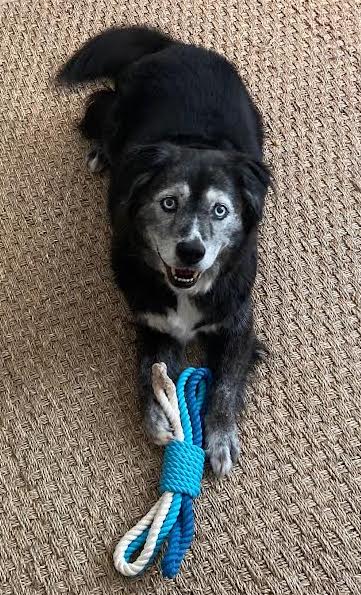
I have written before about my aging cattle dog Bella, now a 14-year-old with bright blue eyes, a black and white coat, and a very grey face. She’s always been a gentle girl, pretty much as far from an alpha dog as one can get.

My girl Bella is now 14, and it’s my job to make her comfortable.

She wasn’t feeling well recently, and the vet determined she had ear infections, a slight lung infection, and perhaps some abscessed teeth.

‘We need to check her mouth,” he said, something Bella wouldn’t allow while awake. (She feels the same way about the rectal thermometer, which seems perfectly understandable.) So, we scheduled the surgery, even though I fretted about putting her under anesthesia at her age.

Everything went well, and the vet seemed surprise that all of Bella’s teeth were fine, though she needed a deep cleaning.

“She’ll feel better now,” he said.

“Would you like an itemized receipt?” the vet tech said. I considered the $820 I’d spent on her initial visit and shook my head, though I couldn’t help glancing at the bottom line: $659. I handed over my credit card.

And it was all worth it, because in a couple of days my old girl was bright-eyed and dancing when we took out the leash for her daily walk around the neighborhood.

But then, for no apparent reason, she started limping. We hurried back to the vet for another exam. They checked Bella for tick-borne diseases and took some X-rays. As I waited for the results, I couldn’t help thinking of the time a few years back when I got a call from worried friends informing me that Bella had a broken leg. However, the tests proved otherwise. “Bella is just a drama queen,” the vet had pointed out that day, just before handing me a bill for $624.

“There are no breaks and no apparent damage,” the vet explained when she returned. “But we’ll have a tech read the X-rays and get back to you,”

“I squinted at my dog, wondering if she’d gone all drama queen on me again, then handed over my credit card without looking this time.

The next day, I received a call. “I’ve read the X-rays and there’s nothing remarkable.”

Bella seems to be on the mend. And she has her little sister Mousey looking out for her.

“You’re just average.” I mouthed at Bella who was sitting at my feet.

“She probably has some arthritis. She is… um…old.”

I scratched Bella behind the ear. “I know how she feels.”

“No walks for two weeks,” the woman explained, then reminded me that Bella had been given a shot to reduce inflammation and has some pain meds she should take twice a day.

I know what’s coming. I’ve been in that special room at the clinic more times than I can count. “We don’t do suffering,” I told the vet. “It’s about her quality of life.”

But Bella’s not there yet. I know it’s my job—and that of all pet owners—to be vigilent, pay the bills, and know when the time is right to let our babies go.

For now, Bella’s life has slowed down. She spends her days with her little sister Mousey and is always happy to be curled up near her people.

I’ll keep you posted.

Your Forgotten Sons

Inspired by a true story

Anne Montgomery

Bud Richardville is inducted into the Army as the United States prepares for the invasion of Europe in 1943. A chance comment has Bud assigned to a Graves Registration Company, where his unit is tasked with locating, identifying, and burying the dead. Bud ships out, leaving behind his new wife, Lorraine, a mysterious woman who has stolen his heart but whose secretive nature and shadowy past leave many unanswered questions. When Bud and his men hit the beach at Normandy, they are immediately thrust into the horrors of what working in a graves unit entails. Bud is beaten down by the gruesome demands of his job and losses in his personal life, but then he meets Eva, an optimistic soul who despite the war can see a positive future. Will Eva’s love be enough to save him?

Universal Buy Link

Amazon

Apple Books

Barnes & Nobel

Google Books

Kobo

Bookstores, libraries, and other booksellers can order copies directly from the Ingram Catalog.

Anne Montgomery’s novels can be found wherever books are sold.

Goodreads

Amazon

Authors: Polish that elevator pitch

I was at a book event a while back, and as often happens when you get a bunch of authors together, the same question was asked repeatedly: So what’s your book about?

Seems simple enough. But as I listened to a few of my peers rattle on and on about their books, I wanted to gently point out that the fewer words they use in what is called an “elevator pitch” the better. An elevator pitch, is a brief description of one’s current writing project, one that might pass between the author and the president of a huge publishing house on the occasion that they find themselves in an elevator for 30 seconds or so. Obviously, this pitch is short. Very short.

Writers know that it is much easier to fill five pages than a 30-word paragraph. The latter is extremely difficult as every word must count. Though the above elevator scenario is unlikely to happen, the ability to define your work in a few sentences is important to you and any agents, editors, publicists, or media people who might be interested in your book. So the elevator pitch is a tool that every author needs to have ready.

The pitch should be maybe 20-40 words. It should identify the main idea and what the protagonists are seeking. For example. The Other Boleyn Girl by Philippa Gregory: “Two sisters, Anne and Mary, are driven to advance their family’s power by courting the affections of the King of England and a ruthless rivalry develops between them.”

Here are a couple more, like the one above courtesy of Reedsy.

To All the Boys I’ve Loved Before by Jenny Han: “When her secret love letters somehow get mailed to each of her five crushes, Lara Jean finds her quiet high school existence turned upside down.”

The Da Vinci Code by Dan Brown: “A murder inside the Louvre, and clues in Da Vinci paintings, lead to the discovery of a religious mystery protected by a secret society for two thousand years, which could shake the foundations of Christianity.”

The point of course is to make your book unique and compelling and to get that CEO—or whomever your trying to pitch—to say, “Tell me more!”

Developing an elevator pitch that makes someone’s eyes light up and request additional information is the goal. Your handful of words needs to be striking and memorable. So, be clear: Who is your protagonist? What do they yearn for? How do they plan to get what they want? What is standing in their way? Make sure not to include spoilers. Memorize your pitch and be prepared to deliver it in a conversational way. Smile and sound confident

It is ironic that of the tens of thousands of words authors put into their books, the few in an elevator pitch are perhaps the most important.

Your Forgotten Sons

Inspired by a true story

Anne Montgomery

Bud Richardville is inducted into the Army as the United States prepares for the invasion of Europe in 1943. A chance comment has Bud assigned to a Graves Registration Company, where his unit is tasked with locating, identifying, and burying the dead. Bud ships out, leaving behind his new wife, Lorraine, a mysterious woman who has stolen his heart but whose secretive nature and shadowy past leave many unanswered questions. When Bud and his men hit the beach at Normandy, they are immediately thrust into the horrors of what working in a graves unit entails. Bud is beaten down by the gruesome demands of his job and losses in his personal life, but then he meets Eva, an optimistic soul who despite the war can see a positive future. Will Eva’s love be enough to save him?

Universal Buy Link

Amazon

Apple Books

Barnes & Nobel

Google Books

Kobo

Bookstores, libraries, and other booksellers can order copies directly from the Ingram Catalog.

Anne Montgomery’s novels can be found wherever books are sold.

Goodreads

Amazon

The case for metal flowers

I’ve been a gardener for decades, mainly in the desert. For the past 30 years I’ve toiled in the raised beds on the east side of my Phoenix, Arizona home. That’s the first thing you learn. Never plant your garden where the scorching fingers of the afternoon sun can creep in and turn your lovingly tended plants into sad little twigs.

I taught my son Troy how to plant and tend a garden, but when I left town, he forgot his lessons.

The other thing you learn is that we have two growing seasons. In the fall—the first week of October or whenever the heat has subsided to nonlethal temperatures— we plant greens and herbs. In the spring, around the first week of March, we plant carrots, tomatoes, cucumbers, beans, and peppers and hope they bear fruit before the heat hits.

It’s a delicate dance.

Today, I spend part of my time in St. Croix in the U.S. Virgin Islands, and I’ll admit I couldn’t wait to get my hands into that rich tropical soil. While I don’t have as much room as my garden in Phoenix affords, my sweetie pie built me a moveable rack from a discarded door where I hang pots. I figured container gardening couldn’t be all that tough, especially with all the gentle rain we get. For those of us who are desert dwellers, the idea that water comes naturally from the sky is quite exhilarating

What I didn’t expect is that gardening in the tropics can be as fraught as it is in the desert. My first crop was happy at first, but then inexplicably everything died. Who knew there were growing seasons in the tropics? Something a kind man pointed out while staring at my cleverly designed door that, at that point, held mostly dead plants.

“Try again in December,” he said. “It’s too hot now.”

My first attempt at gardening in the Virgin Islands didn’t pan out, but I’ll give it another try.

The problem is I’m not on my little island in December. We generally head back to Phoenix in November, where I recently found myself staring at what was previously my beautifully landscaped desert yard. What did I find? Dead plants! It had been an extraordinarily hot summer and fall, with virtually no rain. I expected the boys—okay, they’re men in their late 20s—who live in my home to have noticed my thirsty trees and flowers and herbs.

“Why didn’t you water the plants!” I pointed at the front yard where sad-looking foliaged drooped in the heat.

“I didn’t notice,” my son said, avoiding my gaze.

“How could you not see everything dying?”

He shrugged.

The indoor plants were equally as bedraggled, most overflowing as if they’d just been watered because I’d soon be coming home. As for my garden, nothing survived, not even the indestructible rosemary bush or the pomegranate tree that had shadowed my herb garden from the sun for decades.

The great thing about metal flowers is no one can kill them.

At that moment, I realized that given my nomadic lifestyle I might have to give up gardening altogether. Even if I’m in the right place at the right time to plant a garden, I won’t be there to tend it.

Recently, I walked around my backyard, rather depressed. It use to burst with color. But, as I am preparing to head back to St. Croix, there seemed to be no point in planting anything.

Then, I had a thought. I asked Ryan to get some paint to spiff up our two beige sheds, while I went to the Mexican Import Store.

Yes, I know they’re not real flowers. But, hey, no one ever has to water them. While my solution is not perfect, it works. And even the boys can’t kill my metal flowers.

Your Forgotten Sons

Inspired by a true story

Anne Montgomery

Bud Richardville is inducted into the Army as the United States prepares for the invasion of Europe in 1943. A chance comment has Bud assigned to a Graves Registration Company, where his unit is tasked with locating, identifying, and burying the dead. Bud ships out, leaving behind his new wife, Lorraine, a mysterious woman who has stolen his heart but whose secretive nature and shadowy past leave many unanswered questions. When Bud and his men hit the beach at Normandy, they are immediately thrust into the horrors of what working in a graves unit entails. Bud is beaten down by the gruesome demands of his job and losses in his personal life, but then he meets Eva, an optimistic soul who despite the war can see a positive future. Will Eva’s love be enough to save him?

Release Date: June 6, 2024

Universal Buy Link

Amazon

Apple Books

Barnes & Nobel

Google Books

Kobo

Bookstores, libraries, and other booksellers can order copies directly from the Ingram Catalog.

Anne Montgomery’s novels can be found wherever books are sold.

Goodreads

Amazon

Simple hacks to being a better writer

Luckily, writing is a skill not a talent, which means authors can impove as long as they practice. Just for reference, a talent is defined as an innate, natural ability one is born with. Think swimmer Michael Phelps, with his massive feet and incredible wingspan. I mean the guy was born to be a swimmer. A skill, meanwhile is something we acquire which develops over time through education, dedication, and practice. Note that Phelps didn’t just have immense physical talents, he had the drive to spend tens of thousands of hours in the pool over his career, honing his abilities on the road to those 28 Olympic medals.

Even though I was not a good student when I was young—I’m a low-level dyslexic and hated to read—I have spent much of my life writing as both a reporter and an author. I only mention this because I believe that if I can be a competent writer, lots of other people can too.

There are some things you can do right now to improve your writing. Little hacks that make your prose more professional. One is to avoid the repetition of words. There are about 170,000 words currently in use in the English language. Americans typically use only about 5,000 when speaking and 10,000 when they write. While that seems like a lot, it’s not. Using the same words over and over is a bore, and we lose the opportunity to add richness to our writing when we don’t branch out. Now don’t go crazy and use words that seem pretentious or grandiose. Also try to avoid overused words like good, bad, old, beautiful, happy, sad. Learn to love your thesaurus app and check out options if you find yourself repeating the same words in a paragraph.

Because writers love their words, they are often tempted to use too many. As a former journalist, I had to learn to utilize my words sparingly, since I was often constrained by time limits or word count. That often meant eliminating any words that were unnecessary. For example. Here’s how I initially wrote a previous paragraph. I deleted the underlined sentence because it added nothing essential to the story: Even though I was not a good student when I was young—I’m a low-level dyslexic and hated to read—I have spent much of my life writing as both a reporter and an author. That I ended up making a living from words surprised some who knew me back then. I only mention this because I believe that if I can be a competent writer, lots of other people can too. (I will point out here that in this paragraph I overused the word “word”. Sometimes, there’s just no way around it.)

Good writers take their readers along with them right into the story. The best way to do that is to give readers the opportunity to smell, taste, touch, and hear the story. Warm cotton sheets. Birds chirping in the trees. Smells of toast and bacon. That first sip of coffee. That’s called painting a picture for your audience, one that touches their senses. Note, however, that writers sometimes add too much description to a scene, and this often bogs the story down. There’s a fine line between not enough description and too much.

Another way to make your writing more dramatic is to use fewer pronouns. Try of avoid he, she, his, hers, it, we, they, them and all the other pronouns since they add little in the way of description. Now this doesn’t mean you can never use pronouns, just think before you do and consider if there’s an alternative. Using proper nouns or linking two sentences together are good ways to eliminate pronouns.

Like anything else improving your writing involves practice, practice, practice. So go ahead and give it a shot.

Your Forgotten Sons

Inspired by a true story

Anne Montgomery

Bud Richardville is inducted into the Army as the United States prepares for the invasion of Europe in 1943. A chance comment has Bud assigned to a Graves Registration Company, where his unit is tasked with locating, identifying, and burying the dead. Bud ships out, leaving behind his new wife, Lorraine, a mysterious woman who has stolen his heart but whose secretive nature and shadowy past leave many unanswered questions. When Bud and his men hit the beach at Normandy, they are immediately thrust into the horrors of what working in a graves unit entails. Bud is beaten down by the gruesome demands of his job and losses in his personal life, but then he meets Eva, an optimistic soul who despite the war can see a positive future. Will Eva’s love be enough to save him?

Universal Buy Link

Amazon

Apple Books

Barnes & Nobel

Google Books

Kobo

Bookstores, libraries, and other booksellers can order copies directly from the Ingram Catalog.

Anne Montgomery’s novels can be found wherever books are sold.

Goodreads

Amazon

Taking the cold plunge

I belong to this fancy-schmancy health club where many patrons are attractive and fit. It’s a far cry from the other gyms I’ve roamed in my life. Not very homey. A bit too much preening. Perhaps it’s the overabundance of thong bikinis versus my royal blue Speedo that makes me feel out of place.

If you’re wondering what I’m doing in a club with access to massages, sushi bar, café, salon, and rooftop lounge pool that’s totally useless for lap swimming, note that it’s free. Medicare, concerned that I’m old and out of shape, pays my monthly dues, which is apparently cheaper than footing the bill for a trip to the hospital.

Not my health club. Not me. Still a cold plunge is a cold plunge.

The best part of the club is a prettily tiled, softly lit room with a whirlpool, sauna, steam, and cold plunge, the last of which was something I’d never tried before joining. As you might expect, I was dubious the first time I stared down into the small glittering pool. I was reminded of the two previous occasions I’d been immersed in cold water. One was when I was about 12. I was crossing a frozen stream and fell through the ice. The water was shallow, so I wasn’t in any danger, but damn it was cold. The second time I plunged into frigid water was intentional. I was in St. Petersburg Florida where I’d joined 105 men for a five week course bent on making us better baseball umpires. After a long dusty session of calling balls and strikes, safes and outs, I eyed the pool near the barracks.

“It’s too cold to swim!” One of the instructors pointed out.

I’m a Jersey girl, so the low 70s didn’t seem cold to me. I darted back to my room, donned my one-piece, and ran back to the pool, by which time a bunch of my classmates were waiting for me.

“You’re crazy!” one called out.

Some of the guys laughed. I was tempted to dip a toe into the water to see what I was getting myself into.

“Go ahead. Jump in!”

“She’ll never do it!”

There was no turning back, so I dove in. As soon as I hit the water I felt like I’d been kicked in the chest. The air burst from my lungs. I tried to calm myself, as I didn’t want to surge up gasping. I managed to smile when I surfaced, and even though I could barely feel my limbs I paddled around, acting like it was all rather refreshing. The men seemed a bit disppointed as I walked unsteadily to my room. Not surprisingly, it took a long stay in a hot shower to thaw me out.

With those memories bright in my mind, I stepped into the cold plunge.

Before I go on…note that according to Web.MD, cold plunges can be good for us. Icy baths can improve heart health, help with muscle recovery after exercise, lower stress, boost your immune system, improve your mood, and may help diabetics lower their blood sugar. Of course, cold plunges may not be good for everyone, so check with your doctor before you the dive in.

I walked down the steps quickly and gasped as I sat on the tile seat, the frigid water reaching up to my neck. Then I checked the thermometer, which appeared to be somewhere in the mid-50 degree range. In less than a minute, I bolted out.

And yet, strangely perhaps, I did it again. And again.

I can’t say I love the plunge, which I manage mostly by deep breathing. But I now stay in five minutes. My old bones seem to like it. And there’s a feeling of badassery when I walk out, sometimes to the astonishment of those bikini bods in the room. I kind of like that.

Your Forgotten Sons

Inspired by a true story

Anne Montgomery

Bud Richardville is inducted into the Army as the United States prepares for the invasion of Europe in 1943. A chance comment has Bud assigned to a Graves Registration Company, where his unit is tasked with locating, identifying, and burying the dead. Bud ships out, leaving behind his new wife, Lorraine, a mysterious woman who has stolen his heart but whose secretive nature and shadowy past leave many unanswered questions. When Bud and his men hit the beach at Normandy, they are immediately thrust into the horrors of what working in a graves unit entails. Bud is beaten down by the gruesome demands of his job and losses in his personal life, but then he meets Eva, an optimistic soul who despite the war can see a positive future. Will Eva’s love be enough to save him?

Release Date: June 6, 2024

Universal Buy Link

Amazon

Apple Books

Barnes & Nobel

Google Books

Kobo

Bookstores, libraries, and other booksellers can order copies directly from the Ingram Catalog.

Anne Montgomery’s novels can be found wherever books are sold.

Goodreads

Amazon

When should you publish your book? It’s not an exact science.

Those unacquainted with the publishing world perhaps don’t know the vast number of decisions an author has to make. Note that I’m in the midst of remodeling my kitchen. It’s kind of like that. One has to consider plumbing and electrical, colors and texture, flooring and countertops, cabinets and appliances, and myriad other options on the road to the finished product.

Authors need to think about things like genre, characters, plot, setting, cover art, and marketing and promotional strategies, including blogs and podcasts and personal appearances.

But there’s another big decision to consider. Timing. When should authors release their baby to the public? For those who go the traditional route—meaning a publisher has acquired their book—the decision is often made for them. Since traditional publishers are paying the bills, they get to decide when to put your book on the market. Still, it never hurts to point out a specific date, if you have one in mind. My most recent book, Your Forgotten Sons—a World War II novel inspired by a true story—came out June 6, 2024 in honor of the 80th anniversary of D-Day, because I asked my publisher to hold it several months.

Of course, those who choose to self-publish have more options. So, assuming you have control over the timing of your release, what should you consider? One obvious idea is to launch your book alongside a holiday, as I did with Your Forgotten Sons. Are you a romance author? The weeks leading up to Valentine’s Day would be a simple choice. If horror’s your genre, time the release around Halloween. A memoire about your mom: Mother’s Day. Note that readers aren’t the only ones thinking about these topics as the holidays approach. Bookstores, bloggers, and podcasters are looking to feature holiday-themed books as well.

November and December are also good times to get your book out there. The idea is that people are buying gifts for loved ones and books are easy choices. Still, you might be surprised to know that January and February are considered a good time for self-published books to be launched. Why? People are itching to use all those new e-readers they got as presents, as well as those gift cards. And don’t forget the spring and summer months, when people have vacations on their minds, times when they are much more likely to sit and read at their leisure. Yes, book sales do tend to slump in the summer, but with traditional publishers heavily focused on back-to-school and holiday sales, there is certainly a window for those who self-publish when people are looking for beach reads.

There are certain books—primarily non-fiction based on or related to current events—that should be published quickly, while subject is a hot news topic. Getting these books out in a timely manner is not easy, but shoot for it if you can.

Despite all of the recommendations, this is not an exact science. There is no perfect date to launch your book. In the end, authors should revel in the fact that their book is out in the world. A finished project.

I wish I could say the same about my kitchen.

“What a brilliant book! I couldn’t put this novel down…It is a solid five-star read… Your Forgotten Sons should be a must-read for all lovers of fiction, especially WWII fiction. The tale was educational, provocative, enlightening..” 

Virginia Dill  Book Sirens

Your Forgotten Sons

Inspired by a true story

Anne Montgomery

Bud Richardville is inducted into the Army as the United States prepares for the invasion of Europe in 1943. A chance comment has Bud assigned to a Graves Registration Company, where his unit is tasked with locating, identifying, and burying the dead. Bud ships out, leaving behind his new wife, Lorraine, a mysterious woman who has stolen his heart but whose secretive nature and shadowy past leave many unanswered questions. When Bud and his men hit the beach at Normandy, they are immediately thrust into the horrors of what working in a graves unit entails. Bud is beaten down by the gruesome demands of his job and losses in his personal life, but then he meets Eva, an optimistic soul who despite the war can see a positive future. Will Eva’s love be enough to save him?

Release Date: June 6, 2024

Universal Buy Link

Amazon

Apple Books

Barnes & Nobel

Google Books

Kobo

Bookstores, libraries, and other booksellers can order copies directly from the Ingram Catalog.

Anne Montgomery’s novels can be found wherever books are sold.
Goodreads

Amazon

Defining success: It’s personal

I have been asked a number of times lately how I define success. I now realize my answer to that question has changed significantly over the years.

A few decades back I, like many others, may have considered my bank account first, when presented with the question. Do I have the money to do what I want? But success isn’t quantified that easily. While money can reduce financial anxiety and provides a sense of security, I don’t think wealth alone can make us feel successful. There’s simply more to it than that.

The funny thing is we often don’t grasp that we are successful. The Forbes article “Signs you’re being successful even if you don’t realize you are,” points out different ways to look at success.

For example, are you a person who can comfortably stand up and speak with authority? Studies show just 1% of employees feel confident enough to voice their views to others. This is a form of success.

Do you consider yourself happy? The vast majority of people, 90% in one study, believe that success comes from one’s sense of happiness and joy.

And what about your dreams? According to Forbes, “Successful people give themselves permission to dream as big as they want.  When you create a vision for your life that might seem wildly ambitious, but you take steps every day towards it, know you are successful.” 

And note here that you don’t necessarily have to achieve that dream to be successful. It’s the process of moving towards a goal that makes one a success. As the great Arthur Ashe once said, “Success is a journey, not a destination. The doing is often more important than the outcome.” 

And let’s not forget about failure, a frequent companion to those who are successful. Getting to the top of any mountain requires trial and error. Those who are successful pick themselves up after a disappointment, learn from their mistakes, and start climbing again. Thomas Edison famously admitted that he failed more than one thousand times while trying to invent the lightbulb. On failure in general he was quoted as saying, “I have not failed 10,000 times—I’ve successfully found 10,000 ways it will not work.”

Clearly, success comes in many forms. Some find it in the meaningful work they do. That means a job we look forward to. Not every day, perhaps, but maybe 85% of the time. And when I say job, I don’t mean only in the traditional sense. Of course, tending to one’s family would fall under the job umbrella. As would dedicated volunteer work. Success then might be attained by the contributions we make that impact our family and community.

The more I think about it, the more I realize success is personal. There is no one-size-fits-all. I suppose the ultimate test will come at the end of our lives. Can we look back and say, “Yes! I’m proud of what I did.” I do know that for me the answer will be simple. Success is dying with few regrets and good stories.

I’m working on it.

Your Forgotten Sons

Inspired by a true story

Anne Montgomery

Bud Richardville is inducted into the Army as the United States prepares for the invasion of Europe in 1943. A chance comment has Bud assigned to a Graves Registration Company, where his unit is tasked with locating, identifying, and burying the dead. Bud ships out, leaving behind his new wife, Lorraine, a mysterious woman who has stolen his heart but whose secretive nature and shadowy past leave many unanswered questions. When Bud and his men hit the beach at Normandy, they are immediately thrust into the horrors of what working in a graves unit entails. Bud is beaten down by the gruesome demands of his job and losses in his personal life, but then he meets Eva, an optimistic soul who despite the war can see a positive future. Will Eva’s love be enough to save him?

Release Date: June 6, 2024

Universal Buy Link

Amazon

Apple Books

Barnes & Nobel

Google Books

Kobo

Bookstores, libraries, and other booksellers can order copies directly from the Ingram Catalog.

Anne Montgomery’s novels can be found wherever books are sold.

Goodreads

Amazon

A publishing do-over: The tale of an orphan book

We don’t often get do-overs in life. But I’ve just gotten one and I couldn’t be happier. Now let me back up a little.

This past September I received word that one of my publishers was shutting down. I’d like to say this was the first time I’ve faced such a closure, but it’s not. Since I became an author 30 years ago, I’ve had three publishers call it quits. Which shouldn’t surprise anyone considering the crazy state of the industry.

According to the 2023 Brett-Koehler Publishing article “10 Awful Truths about Book Publishing,” “The book publishing world is in a never-ending state of change. The thin margins in the industry, high complexities of the business, intense competition, severe supply-chain disruptions, churning of new technologies, and rapid growth of other media lead to constant turmoil in bookselling and publishing, including the closure and sale of many publishing companies and publication programs each year.”

What does this mean to an author? Orphan books. When a publisher closes, book rights generally revert to the author. But what happens then? When you consider that approximately three million books are published annually in the U.S. alone—two million of which are self-published—it would seem unlikely that orphan books would make it back into circulation, unless an author wanted to foot the bill.

But I am delighted to say that I am getting a do-over courtesy of Next Chapter Publishing, where two of my novels—Your Forgotten Sons and Wild Horses on the Salt—currently have a home.

The book in question is called Wolf Catcher, a work of historical fiction that takes place in the American Southwest both in modern times and in the 11th century. Of all my books, this one is the most personal. One of the protagonists is a reporter tasked with ferreting out the identity of a man buried outside of Flagstaff, Arizona almost 900 years earlier. A man whose mummified remains looked different from the people who occupied the area at the time, one who was buried with 600 exquisite funerary objects, identifying him as a man of power and prestige.

The story of the man they call The Magician was my assignment when I worked as a reporter for Arizona Highways Magazine. That the reporter’s name in the book is Kate Butler might be a tipoff that she and I traveled the same path in search of the story. With the exception of the time when bullets are flying, everything that happened to Kate also happened to me.

Note that as a girl who grew up in New Jersey with little knowledge of Native Americans, the investigation was a long learning curve. I charged into my research with little understanding of the cultural traditions I might be trampling and, like Kate, changed a lot along the way.

I’m also happy to have a do-over on Wolf Catcher for another reason. In 2021, before the book was scheduled to launch, I contracted Covid, passed out, and suffered a severely broken leg that had to be surgically repaired. I carry a titanium plate and eleven screws as a reminder. Subsequently, there was no book launch and little marketing, as I spent eight months learning to walk again. As you can imagine, few people ever read the book. I’m hoping to change that this time around.

So my thanks to Next Chapter Publishing for taking Wolf Catcher on. I’m not yet sure of the timeline, but I’ll let you know when the mysterious story of The Magician is back.

Your Forgotten Sons

Inspired by a true story

Anne Montgomery

Bud Richardville is inducted into the Army as the United States prepares for the invasion of Europe in 1943. A chance comment has Bud assigned to a Graves Registration Company, where his unit is tasked with locating, identifying, and burying the dead. Bud ships out, leaving behind his new wife, Lorraine, a mysterious woman who has stolen his heart but whose secretive nature and shadowy past leave many unanswered questions. When Bud and his men hit the beach at Normandy, they are immediately thrust into the horrors of what working in a graves unit entails. Bud is beaten down by the gruesome demands of his job and losses in his personal life, but then he meets Eva, an optimistic soul who despite the war can see a positive future. Will Eva’s love be enough to save him?

Release Date: June 6, 2024

Universal Buy Link

Amazon

Apple Books

Barnes & Nobel

Google Books

Kobo

Bookstores, libraries, and other booksellers can order copies directly from the Ingram Catalog.

Anne Montgomery’s novels can be found wherever books are sold.

Goodreads

Amazon

Where’s the bread?

Remember when you’d go out to a restaurant and the first thing a server would put on the table was bread? Of course you do, at least if you’re over 30. In fact, restaurants sometimes went out of their way to prove just how bread-forward they were. I recall, quite fondly, the times when a linen napkin-covered basket filled with several types of bread all artfully arranged around a ramekin of warm butter would appear. Then there’d be the admonishment, “Don’t ruin your dinner.” Which did nothing to deter everyone from lunging for a piece of that delicious goodness.

Today, however, bread is rarely offered in restaurants, unless it’s part of a sandwich. And when I ask for some to go with my dinner, I’ve watched servers, hand over heart, exclaim, “We don’t serve bread!” as if I’d just asked about scoring some cocaine.

So what gives? First, bread costs money and patrons often expect it to be free, especially older folks who remember the good old days when, well, of course the bread was free. Note that I’m not one of them. I’m happy to pay for bread, and am often perplexed when informed that the restaurant does not serve bread just as a burger in a nice fat bun is delivered to the next table.

There is some evidence that serving bread prevents patrons from ordering appetizers, further cutting into a restaurant’s bottom line. I can see that. So, again, just charge me for the bread, don’t deny me those scrumptious carbs alltogether.

I also understand that those nice bread baskets sometimes were wasted, since bread got a bad rap somewhere around the time the gluten-free craze began. It’s amazing, don’t you think, that just 4% of people actually have a medical reason to follow a gluten-free diet, and yet given all the food labels that scream Gluten Free!, you’d think it was a scourge affecting the masses. It’s not. Note that it’s 18-34 year-olds who are most interested in avoiding gluten, so perhaps I should be angry with them when I can’t get a piece a bread.

I guess we can also blame the paleo diet for our inability to munch on a warm buttered baguette or a nice slice of sourdough, since all forms of cereal grains are verboten for people on that regimen, which is rather perplexing since the program is meant to mimic the way our ancient ancestors consumed food. Scientists now believe that our hunter-gatherer forebearers were eating bread 14,000 years ago and that carbohydrates were essential to human evolution, so that it’s stricken from today’s tables seems odd, don’t you think? Note that it’s mostly those in the 25-44 age group who tend to follow the paleo diet. (See where I’m going here?)

Now, I’m not a dope. I understand that copious amounts of bread are not good for us. Everything in moderation and all. Still, I think it’s time we stopped demonizing bread. I, for one, will emulate my ancient ancestors and continue eating bread. With every meal.

And don’t try to stop me!

Your Forgotten Sons

Inspired by a true story

Anne Montgomery

Bud Richardville is inducted into the Army as the United States prepares for the invasion of Europe in 1943. A chance comment has Bud assigned to a Graves Registration Company, where his unit is tasked with locating, identifying, and burying the dead. Bud ships out, leaving behind his new wife, Lorraine, a mysterious woman who has stolen his heart but whose secretive nature and shadowy past leave many unanswered questions. When Bud and his men hit the beach at Normandy, they are immediately thrust into the horrors of what working in a graves unit entails. Bud is beaten down by the gruesome demands of his job and losses in his personal life, but then he meets Eva, an optimistic soul who despite the war can see a positive future. Will Eva’s love be enough to save him?

Release Date: June 6, 2024

Universal Buy Link

Amazon

Apple Books

Barnes & Nobel

Google Books

Kobo

Bookstores, libraries, and other booksellers can order copies directly from the Ingram Catalog.

Anne Montgomery’s novels can be found wherever books are sold.

Goodreads

Amazon