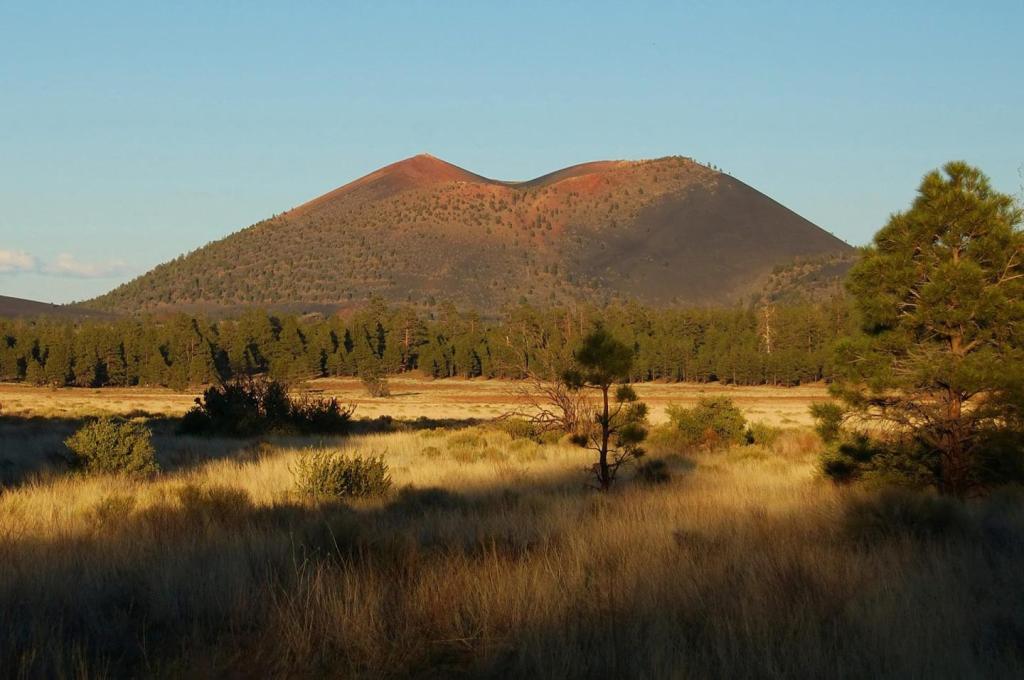
Volcanoes: Symbols of destruction and life

The cinders of Sunset Crater Volcano “glow” because they are infused with iron oxide, which makes the mountain appear to be bathed in a sunset.

While researching my historical-fiction novel Wolf Catcher, which was recently rereleased by Next Chapter Publishing, I found myself immersed in volcanoes. The reason? The Sunset Crater Volcano, which rests outside of Flagstaff, Arizona, and is today a National Monument.

A cinder cone volcano is one of several types all of which form differently. In the case of the Sunset Crater Volcano, scientists believe it began erupting about 900 years ago. Had we been on hand for the big event, we would have noticed the ground shaking on and off in the weeks leading up to the eruption. Then the earth would have split open, emitting steam, and fire, and a cloud of ash that rose five miles into sky. As lightning zigged and zagged above the high desert, ash rained down on 800-square miles of land. After several weeks, or months, the cone grew to about 1,000 feet high, a loosely-packed amalgam of volcanic ash and reddish basalt cinders.

While today we understand the geological forces that birth a volcano, ancient people could only guess about what was happening beneath the earth. Luckily, The Sunset Crater Volcano has a modern-day sister who gives us a look into how witnesses might have assessed the eruption.

Paricutín is a cinder cone volcano just like the one at Sunset Crater. But this volcano, near the west coast of Mexico in the southern half of the country, erupted on and off between 1943 and 1952 in full view of the terrified inhabitants of the area. These documented reactions helped scientists studying the Sunset Crater Volcano discern how the Native Americans who peopled the high plateau may have reacted upon witnessing the event.

Here I will let some of the characters from Wolf Catcher explain.

“They were the same kind of volcanoes, right?” Cooper asked.

Marty nodded. “They are both cinder cones and they both gave the people ample warning that something was happening. No one in Paricutín died as a direct result of the eruption, and from what they’ve discovered so far, probably no one died here either. But let’s backtrack a little. It’s easy to know what happened at Paricutín. We have eyewitnesses. We know exactly when the eruption occurred. But at Sunset Crater, for a long time, there was no foolproof way to determine when the big event happened.”

“Is there now?” Kate asked.

“Well, that depends on who you talk to. I can tell you this. Before a Sinagua pithouse was discovered buried in the cinders, scientists had no idea the volcano was so young. They were able to date the pithouse using tree-rings and the pottery they found, and concluded that the eruption happened sometime in the late eleventh century. The ash from Sunset Crater fell over an area of nearly eight hundred square miles. In some places, just an inch, in others, it was fifteen feet deep. Just to give you a good idea of what that means, four inches of ash, especially if it’s wet, is enough to collapse a modern-day roof.”

“So, if you were caught up in the ash fall you were dead?” Cooper said.

“Theoretically, but as I explained, we haven’t found any bodies. And if we use the Paricutín model, we assume the people escaped in time. What we also know is that in Mexico the people were sure there was an angry god under the ground. In fact, they erected a row of big white Christian crosses in front of the lava flow to protect their villages from the creature.”

“Did it help?” Kate smiled.

Marty laughed. “I’m afraid the crosses did no good at all. Five villages were damaged, some destroyed, by the lava and ash.

It’s not much of a stretch to assume the ancestors of the Hopi who occupied the area around Sunset Carter Volcano may have, like the people at Paricutín, believed angry gods were at work and that some appeasement was in order.

What we do know is that the ash fall proved a benefit to those villages situated in just the right places, locations that received a few inches of ash, enough to fortify the soil and grow crops, while others lost their homes completely when many feet of ash destroyed the productivity of their land. Those forced from their homes might have fought desperately with those who benefitted from the eruption in order to survive.

Then there were those who were lured to the area in search of religious understanding. Who was the god? Why was he angry? What could the people do to pacify him? The Sunset Carter Volcano might have become a place of sacred pilgrimage.

It is into this fractured landscape that the man I call Wolf Catcher arrived.

Wolf Catcher

Anne Montgomery

Historical Fiction

In 1939, archeologists uncovered a tomb at the Northern Arizona site called Ridge Ruin. The man, bedecked in fine turquoise jewelry and intricate bead work, was surrounded by wooden swords with handles carved into animal hooves and human hands. The Hopi workers stepped back from the grave, knowing what the Moochiwimi sticks meant. This man, buried nine hundred years earlier, was a magician.

Former television journalist Kate Butler hangs on to her investigative reporting career by writing freelance magazine articles. Her research on The Magician shows he bore some European facial characteristics and physical qualities that made him different from the people who buried him. Her quest to discover The Magician’s origin carries her back to a time when the high desert world was shattered by the birth of a volcano and into the present-day dangers of archeological looting where black market sales of antiquities can lead to murder.

Amazon

Apple Books

Barnes and Noble

Google Books

Rakuten Kobo

Bookstores, libraries, and other booksellers can order copies directly from the Ingram Catalog.

Anne Montgomery’s novels can be found wherever books are sold.

Goodreads

Amazon

A lesson learned: The dead and their funerary objects need to be respected

When I was asked by Arizona Highways Magazine to write an article about the man they call The Magician, I didn’t understand that I might be trampling on Native American religious beliefs. (Illustration by Brad Holland)

I’m not a religious person, so I have, in the past, missed signs that had spiritual implications. For example, when I was researching my novel Wolf Catcher—which was just rereleased by Next Chapter Publishing—I didn’t understand how offensive some of my requests were.

I was hired to write a magazine article about the man they call The Magician. His fabulous, nine-hundred-year-old tomb had been uncovered by archaeologists in 1939, beneath a pueblo on a lonely hillside about ten miles from Flagstaff, Arizona. Back in those days, exhuming indigenous burial grounds was an acceptable practice, which now seems absurd. Logically speaking, there’s not much difference between rifling through the belongings of ancient mummies and digging up one’s modern-day grandmother. Imagine collecting jewelry from grandma’s body and selling her precious possessions on eBay.  

As a kid, I sometimes visited the Museum of Natural History in New York, where burial offerings from around the world were often on exhibit. However, while trying to determine who The Magician might have been, I discovered just how offensive it is to put human remains and funerary objects on display. My first hint was a letter my editor at the magazine received when I ignorantly requested a DNA test on The Magician. My reasoning seemed sound. The Magician was described by those who found him as being physically different from the people who buried him in several ways. He was particularly tall for his time and did not resemble the Native Americans who populated the region. He was said to have some Caucasian facial features, so my first thought was how did a man who may have had some European ancestry make it to what would become the American Southwest almost one-thousand years ago.

My request for scientific analysis was met with a hard no from the Hopi tribal authorities. The Native American Graves Protection and Repatriation Act of 1990 stipulates that all remains and funerary objects must be treated with respect and dignity and that the destruction of any portion of a body—even something as seemingly insignificant as a tooth for a DNA sample—is unacceptable and illegal.

At that point, I was so focused on getting my story done, I didn’t understand why my request for scientific testing was such a big deal. Then, when I arrived to interview an archaeologist I’d worked with previously, I was shocked when he didn’t appear. It would be another archaeologist who would gently explain the problem. These scientists are bound by their relationships with Native American tribes. If they want to dig on tribal or even public land, they must get permission. If they don’t follow the rules, they will be shut out, which would hurt their reputations and limit their ability to work. My investigation posed a threat to the man’s career, a risk he wasn’t willing to take.

While researching the story, I picked up a number of pottery shards. My logic was simple. I was on public land, so clearly I had committed no crime. But again, I was wrong. Those beautiful pieces of ancient fired clay, many so bright and vibrant they looked as if they’d been painted yesterday, should never have been taken from their resting places, because once you’ve removed an artifact from its setting, you’ve destroyed its sense of time and place—it’s historical significance—something you can never get back.

After finishing Wolf Catcher, I found myself staring at those thousand-year-old bits of pottery and couldn’t pretend I hadn’t done something wrong. I spoke about my feelings with a friend who was a nondenominational pastor. She quickly responded that I should put the pieces back where I found them.

She and I traveled to Ridge Ruin where I gently returned the shards to the hillside. We stood on the rocky ground under which the pueblo that housed The Magician’s body lay hidden, having long ago been backfilled to protect it from looters. I stared at the spot where the man had been buried with such reverence all those years ago. My friend asked me to apologize for my mistake, which I did.

As I said earlier, I’m not a religious person, and yet, as we left that windswept hillside that held the remains of Ridge Ruin in its belly, I felt better. And I promised myself I would not make the same mistakes again.

If you’d like to learn more about my quest to understand who The Magician might have been and what his world was like, read my novel Wolf Catcher.

Wolf Catcher

Anne Montgomery

Historical Fiction

Next Chapter Publishing

Released August 4, 2025

The past and present collide when a tenacious reporter seeks information on an eleventh century magician…and uncovers more than she bargained for.

In 1939, archaeologists uncovered a 900-year-old tomb at the Northern Arizona site called Ridge Ruin. The man, bedecked in fine turquoise jewelry and intricate bead work, was surrounded by hundreds of extraordinary funerary objects, including wooden swords with handles carved into animal hooves and human hands. The Hopi workers stepped back from the grave, knowing what the Moochiwimi sticks meant. This man was a magician.

Sixty-five years later, investigative reporter Kate Butler discovers evidence that The Magician looked notably different from those who buried him. Her quest to discover The Magician’s origin carries her back to a time when the high desert world was shattered by the birth of a volcano and into the present-day dangers of archaeological looting where black market sales of antiquities can lead to murder.

Amazon

Apple Books

Barnes and Noble

Google Books

Rakuten Kobo

Bookstores, libraries, and other booksellers can order copies directly from the Ingram Catalog.

Praise for Wolf Catcher

“Blending archaeology and Native American mythology, “Wolf Catcher” by novelist Anne Montgomery is an original, exceptionally well written, and compelling work of historical fiction…” – Midwest Book Review

“The author’s ability to interweave the past and the present was masterful. The characters were complex and interesting, especially with the underlying theme of rethinking the history of worldly human migration … A real page turner and I am wondering when the movie is going to be made!” – Alicia Williams Goodreads

“The story is very well-paced, reaching a page-turning, action-packed climax to the end. This story has all the elements of a great suspense drama centered around a historical mystery.” – Heidi Slowinski Author

“I was deeply and thoroughly embroiled in this imaginative novel… (that) melds seamlessly much of fact with fiction. Totally recommended! “ – V. Williams Vine Voice

“What a journey! What a story! A truly epic tale that grabs you by a throat and moves your soul. Highly recommend for the readers of all age groups.” – Marina Sardarova Author

“Boy, didn’t this one grip me quickly and keep me glued to the pages! Loved the cliff-hanging chapter endings. Well researched, well-plotted and paced…Trust me, you’ll love it. Totally recommended and out now!” – Rosepoint Publishing

“Once again the author has created a beautiful story with a powerful message. She took a piece of history and brought it to life. I just can’t say enough good things about Wolf Catcher.” – Megan Salcido Wildwood Reads

Anne Montgomery’s novels can be found wherever books are sold.

Goodreads

Amazon