Apparently, you can now be an author “without typing a single word”

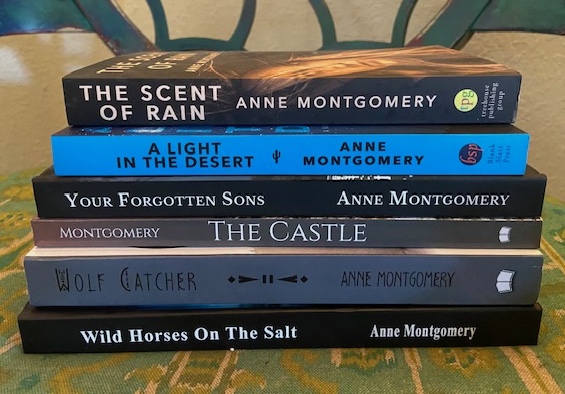
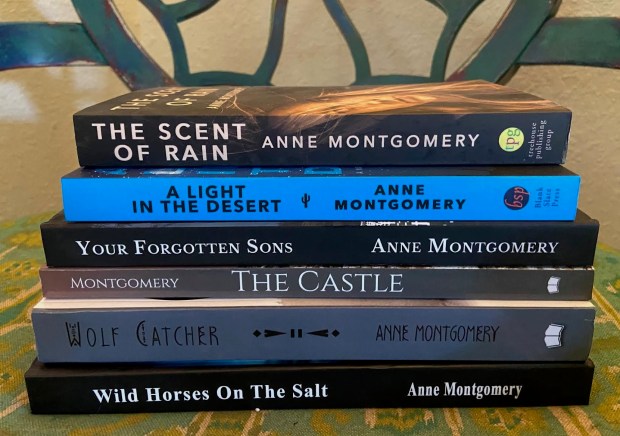
These are my books, my words, that’s why I get to call myself an author.

Most authors will tell you that we get offers every day from people who say they want to help us promote our brand or get published. I’m pretty used to these emails and just delete them, but I got one recently that made me pause. Here’s the first line: “What if you could become a published author without typing a single word?”

The sender explained that I could just “relax and chat” and through “transcription magic” a manuscript would be born. Then the “team” would proofread and edit the work, provide a “beautiful cover” and post the book on “Amazon and other major book retailers in as little as 2-3 weeks.” I’m going to guess here that this is simply a scam, meant to separate unsuspecting people from their money, but let’s assume it’s legitimate.

The whole idea was addressed to “’wannabe’ authors who have the knowledge but not the time, (to make) this is a dream come true.” Just for clarification, I checked the definition of wannabe, which is a person who tries to be like someone else or to fit in with a particular group of people. Note that the word generally carries a negative connotation, so perhaps those behind the email could do a better job of chosing their words, which, ironically, would pretty much be the definition of writing.

That said, I’m afraid that solicitations like this might actually appeal to certain people, which makes me want to scream. Still, I sense that some will fall for it and then go out and proudly claim to be authors, which is offensive to those of us who have immersed ourselves in the difficult world of publishing.

I have been writing books and painstakingly worked to get them out in the world for over 30 years, and it has been a long, difficult journey. Let’s just say that despite having written six traditionally published novels—which means a publisher has paid the bills—I must still depend on a pension and Social Security to keep a roof over my head, because since the advent of Amazon, making a living as an author has become increasingly difficult. The message? Please don’t quit your day job.

Be assured that if you let a company like the one above produce your book or you feed your information into AI, that “brilliant” memoir about your family will, in all likelihood, not sell more than 100 copies. And since you would most likely have to pay to publish your book, you will lose money in the long run.

Note that there are exceptions to not writing a book yourself, like those in the non-fiction world who can and do use ghost writers. I have no problem with that. But in the world of fiction and narrative nonfiction—think memoirs—I believe it’s the author’s duty to do their own writing if they want to proudly wear that author cap.

What offends me most is the idea that one might become an author “without typing a single word”, because there’s no point in being an author if you don’t enjoy the process. While you might disagree, the definition of author is quite clear: a writer of a book, article, or report. So if you’re not a writer you’re not an author. And I would greatly appreciate it if you would refrain from calling yourself one if you can’t do the work.

THE CASTLE

ANNE MONTGOMERY

Suspense/Thriller

NEXT CHAPTER PUBLISHING

Ancient ruins. Haunted memories. A ruthless predator. Can Maggie survive the ghosts of her past – and the monster hiding in plain sight?

When she returns to her job as a National Park Ranger at “The Castle”—a centuried-old Native American pueblo carved into an Arizona cliff—Maggie hopes the comfort of familiar ground will help her heal. Battling trauma and the grief of unimaginable loss, Maggie’s days are carefully measured, her life held together by the thinnest of threads.

But strange things are happening at the park. A mysterious child appears and vanishes without a trace. And a predator watches her every move, planning his attack.

With the help of friends, fellow survivors, and the land itself, Maggie begins to reclaim her strength. But the danger is closer than she knows, and soon Maggie will have to face a deadly threat… and her deepest fears.

Bookstores, libraries, and other booksellers can order copies directly from the Ingram Catalog.

UNIVERSAL BOOK LINK

AMAZON

APPLE BOOKS

BARNES & NOBEL

GOOGLE BOOKS

RAKUTEN KOBO

Praise for The Castle

A deftly written and riveting read from cover to cover, “The Castle” effectively showcases author Anne Montgomery’s genuine mastery of the Romantic Suspense genre.” – Midwest Book Review

“A slow burn thriller, mixed in with a touch of mystical realism…A true five-star experience!” – Sara Steven Chick Lit Central

“A beautifully considered, sumptuous novel from a skilled storyteller.” – SaraRose Auburn Writing & Reviews

“This is a novel about good rage, about channeling the injustices of the world around us and fighting to do some good with both words and deeds. Lucky for readers, it was penned by a maestra like Anne Montgomery, so that we got a tense, powerful novel in the bargain too.” – Jennifer deBie-Rosie Amber Book Reviews

Ms. Montgomery manipulates uncomfortable subjects and dark suspense into a gripping tale with hints of romance and humor carefully guiding readers on an informative journey of survival and self-discovery. Tonya Mathenia InD’tale Magazine

“Soul-stirring. A brilliant book…Truly a masterpiece.” – Anu Menon Thought is Free Book Blog

“I was gripped from start to end.” – Katherine Hayward Pérez Just Katherine Blog

“Ms. Montgomery has an almost magical talent to draw the reader into the worlds she creates through her words. Her characters are interesting, vulnerable and strong. While describing the locations in which her books are set, she weaves history with vivid images, immersing the reader in a hard-to-put-down story full of history, beauty and mystery.” – Margaret Millmore Author

An author’s dilemma: So many social media sites, so little time

Authors understand that they need to be on social media if they want to sell books. At least, I hope they do. In fact, anyone with a merchandise to sell needs to be regularly taping away, telling consumers why their product is a must have.

In case you’re skeptical, note that, according to DataReportal,  there are currently 5.31 billion social media users around the world, people who log onto almost seven different social media platforms each month, where they spend over 18 hours weekly visiting various sites.

Despite what youngsters tell you—Kids apparently prefer platforms that cater exclusively to them and don’t like scrolling through postings by old folks.— Facebook is still king in the social media world with over three billion users visiting monthly. I mention this because love it or hate it authors should have a presence on the site.  

But where should authors go from there? Depending on who you ask, Facebook, Instagram, LinkedIn, and TikTok are where they should be. But here’s the thing, when you throw in the effort required to run a website, write regular blogs, participate in podcasts, appear at speaking engagements and book events, as well as posting on myriad social media sites, authors can get overwhelmed. (And I didn’t even mention that they should also find time to write.)

The solution? Think carefully about where you’d like to spread the word about your books. Note which social media sites appeal to you. For example, I struggled with Instagram. The picture/video-dominant platform often confounded me. When TikTok somehow took over my Instagram account and I was unable to retrieve it, I just let it go. Similarly, I’m not a fan of X, still I do share my weekly blogs there.

If you’re looking for a time-saver, I recommend checking the pages where you share your work. Consider that Facebook has dozens of sites for authors, many with thousands of followers. But here’s the problem. There is often virtually no interaction on some of these sites. You can post your blog or ad, and pretty much never get a single like. I have spent time on these sites, but finally, in an effort to streamline, I let them go.

Authors must determine which sites they’re comfortable with, then put their best work into those platforms and build a clientele. If you don’t see results from one site, try another until you’re making progress. Just don’t spread yourself too thin. The hope is that authors will eventually settle in and learn to enjoy the social-media marketing aspect of their job.

Your Forgotten Sons

Inspired by a true story

Anne Montgomery

Bud Richardville is inducted into the Army as the United States prepares for the invasion of Europe in 1943. A chance comment has Bud assigned to a Graves Registration Company, where his unit is tasked with locating, identifying, and burying the dead. Bud ships out, leaving behind his new wife, Lorraine, a mysterious woman who has stolen his heart but whose secretive nature and shadowy past leave many unanswered questions. When Bud and his men hit the beach at Normandy, they are immediately thrust into the horrors of what working in a graves unit entails. Bud is beaten down by the gruesome demands of his job and losses in his personal life, but then he meets Eva, an optimistic soul who despite the war can see a positive future. Will Eva’s love be enough to save him?

Universal Buy Link

Amazon

Apple Books

Barnes & Nobel

Google Books

Kobo

Bookstores, libraries, and other booksellers can order copies directly from the Ingram Catalog.

Anne Montgomery’s novels can be found wherever books are sold.

Goodreads

Amazon

Authors need to polish their interviewing skills if they want authentic characters

Authors need lots of skills. And while writing is clearly at the top of the list, interviewing chops might be a close second, especially when one is writing fiction.

While many of us are quite comfortable writing about careers with which we are familiar, good novels are often filled with people who do a variety of different things. So, in order to create believable and interesting characters, we need to talk with real people who live in those realms. Hence the need for interviewing skills.

Before heading out to talk with people, authors should sketch an outline of a character. Perhaps you’re writing about a thirty-something police officer, a woman who’s been working in a small town for five years. She will need a backstory. Is she from the town or did she relocate? What kept her from leaving or what induced her to take a job there? Describe her physical characteristics. What are her quirks or flaws? On the latter, never make a character seem perfect. No one is and stories about unflawed characters are often boring and unrealistic.

Once you have an idea of who your character is, see if you can find a real person to talk to, in this case a woman who’s a small town police officer. The Internet makes this easy. But also think of family, friends, and acquaintances who might be able to help. Now pick up the phone or send an email. I may be old fashioned but I don’t think a text is appropriate at this point, because you will need to explain who you are and why you’d like to do an interview, and an email looks more professional.

I know what you’re thinking. Why would a complete stranger want to talk with me? But fear not! In my experience—I was a reporter for about 15 years, so I did this a lot.—people love to talk about themselves. Simply explain you’re doing research for a book and would love to speak with them. And, on the off chance they say no, do not be deterred. Just find someone else.

If you can, meet with your interviewee in person on their turf. You will get a better picture of who they are. Make sure you have a list of questions prepared, especially in regard to the day-to-day requirements of their job. Note this is especially important if you’re writing about someone, for example, in law enforcement, medicine, or the military. You don’t want to have your characters saying or doing things that real cops, doctors, or soldiers wouldn’t do.

In regard to your questions, there is no reason to religiously stick to them. I often recall the student I sent to interview a new teacher. The prepared questions were not very interesting: What brought the teacher to our school. Where did he come from? Why did he want to teach math? Then the teacher casually mentioned that he’d been an acrobat in the circus and toured the world for 20 years. Still, my student never followed up. I had to send the kid back to ask some more interesting questions.

The point is relax your ideas about your character. Note that I needed to write about a cattle rancher for my book Wild Horses on the Salt. I called one and he invited me to his ranch. While I was there, he mentioned he was a beekeeper and I ended up making my character a beekeeper, as well. In another case, the National Park ranger I interviewed for The Castle had served in the Coast Guard and was a plant specialist who spoke to tourists about the flora where she worked. My character shared those similarities. In another case, I interviewed a deputy sheriff who was a first responder to a deadly train wreck. When I went to his house, I was surprised to see that this “tough guy” collected fine glass objects. And you guessed it, my character also liked objects made of cut glass. So be open-minded.

I always record my interviews, but take notes, as well. I have often gotten more from my written notes than the actual recording, which I use to check for details I might have missed.

Many authors admit to being shy and the idea of interviewing someone makes them a bit nervous. But all you need to do is think of your interaction as a simple conversation with you leading the way. After the initial jitters, you’ll calm down. And, in the end, your characters will be more interesting and well-rounded.

Your Forgotten Sons

Inspired by a true story

Anne Montgomery

Bud Richardville is inducted into the Army as the United States prepares for the invasion of Europe in 1943. A chance comment has Bud assigned to a Graves Registration Company, where his unit is tasked with locating, identifying, and burying the dead. Bud ships out, leaving behind his new wife, Lorraine, a mysterious woman who has stolen his heart but whose secretive nature and shadowy past leave many unanswered questions. When Bud and his men hit the beach at Normandy, they are immediately thrust into the horrors of what working in a graves unit entails. Bud is beaten down by the gruesome demands of his job and losses in his personal life, but then he meets Eva, an optimistic soul who despite the war can see a positive future. Will Eva’s love be enough to save him?

Release Date: June 6, 2024

Universal Buy Link

Amazon

Apple Books

Barnes & Nobel

Google Books

Kobo

Bookstores, libraries, and other booksellers can order copies directly from the Ingram Catalog.

Anne Montgomery’s novels can be found wherever books are sold.

Goodreads

Amazon

When should you publish your book? It’s not an exact science.

Those unacquainted with the publishing world perhaps don’t know the vast number of decisions an author has to make. Note that I’m in the midst of remodeling my kitchen. It’s kind of like that. One has to consider plumbing and electrical, colors and texture, flooring and countertops, cabinets and appliances, and myriad other options on the road to the finished product.

Authors need to think about things like genre, characters, plot, setting, cover art, and marketing and promotional strategies, including blogs and podcasts and personal appearances.

But there’s another big decision to consider. Timing. When should authors release their baby to the public? For those who go the traditional route—meaning a publisher has acquired their book—the decision is often made for them. Since traditional publishers are paying the bills, they get to decide when to put your book on the market. Still, it never hurts to point out a specific date, if you have one in mind. My most recent book, Your Forgotten Sons—a World War II novel inspired by a true story—came out June 6, 2024 in honor of the 80th anniversary of D-Day, because I asked my publisher to hold it several months.

Of course, those who choose to self-publish have more options. So, assuming you have control over the timing of your release, what should you consider? One obvious idea is to launch your book alongside a holiday, as I did with Your Forgotten Sons. Are you a romance author? The weeks leading up to Valentine’s Day would be a simple choice. If horror’s your genre, time the release around Halloween. A memoire about your mom: Mother’s Day. Note that readers aren’t the only ones thinking about these topics as the holidays approach. Bookstores, bloggers, and podcasters are looking to feature holiday-themed books as well.

November and December are also good times to get your book out there. The idea is that people are buying gifts for loved ones and books are easy choices. Still, you might be surprised to know that January and February are considered a good time for self-published books to be launched. Why? People are itching to use all those new e-readers they got as presents, as well as those gift cards. And don’t forget the spring and summer months, when people have vacations on their minds, times when they are much more likely to sit and read at their leisure. Yes, book sales do tend to slump in the summer, but with traditional publishers heavily focused on back-to-school and holiday sales, there is certainly a window for those who self-publish when people are looking for beach reads.

There are certain books—primarily non-fiction based on or related to current events—that should be published quickly, while subject is a hot news topic. Getting these books out in a timely manner is not easy, but shoot for it if you can.

Despite all of the recommendations, this is not an exact science. There is no perfect date to launch your book. In the end, authors should revel in the fact that their book is out in the world. A finished project.

I wish I could say the same about my kitchen.

“What a brilliant book! I couldn’t put this novel down…It is a solid five-star read… Your Forgotten Sons should be a must-read for all lovers of fiction, especially WWII fiction. The tale was educational, provocative, enlightening..” 

Virginia Dill  Book Sirens

Your Forgotten Sons

Inspired by a true story

Anne Montgomery

Bud Richardville is inducted into the Army as the United States prepares for the invasion of Europe in 1943. A chance comment has Bud assigned to a Graves Registration Company, where his unit is tasked with locating, identifying, and burying the dead. Bud ships out, leaving behind his new wife, Lorraine, a mysterious woman who has stolen his heart but whose secretive nature and shadowy past leave many unanswered questions. When Bud and his men hit the beach at Normandy, they are immediately thrust into the horrors of what working in a graves unit entails. Bud is beaten down by the gruesome demands of his job and losses in his personal life, but then he meets Eva, an optimistic soul who despite the war can see a positive future. Will Eva’s love be enough to save him?

Release Date: June 6, 2024

Universal Buy Link

Amazon

Apple Books

Barnes & Nobel

Google Books

Kobo

Bookstores, libraries, and other booksellers can order copies directly from the Ingram Catalog.

Anne Montgomery’s novels can be found wherever books are sold.

Goodreads

Amazon

A publishing do-over: The tale of an orphan book

We don’t often get do-overs in life. But I’ve just gotten one and I couldn’t be happier. Now let me back up a little.

This past September I received word that one of my publishers was shutting down. I’d like to say this was the first time I’ve faced such a closure, but it’s not. Since I became an author 30 years ago, I’ve had three publishers call it quits. Which shouldn’t surprise anyone considering the crazy state of the industry.

According to the 2023 Brett-Koehler Publishing article “10 Awful Truths about Book Publishing,” “The book publishing world is in a never-ending state of change. The thin margins in the industry, high complexities of the business, intense competition, severe supply-chain disruptions, churning of new technologies, and rapid growth of other media lead to constant turmoil in bookselling and publishing, including the closure and sale of many publishing companies and publication programs each year.”

What does this mean to an author? Orphan books. When a publisher closes, book rights generally revert to the author. But what happens then? When you consider that approximately three million books are published annually in the U.S. alone—two million of which are self-published—it would seem unlikely that orphan books would make it back into circulation, unless an author wanted to foot the bill.

But I am delighted to say that I am getting a do-over courtesy of Next Chapter Publishing, where two of my novels—Your Forgotten Sons and Wild Horses on the Salt—currently have a home.

The book in question is called Wolf Catcher, a work of historical fiction that takes place in the American Southwest both in modern times and in the 11th century. Of all my books, this one is the most personal. One of the protagonists is a reporter tasked with ferreting out the identity of a man buried outside of Flagstaff, Arizona almost 900 years earlier. A man whose mummified remains looked different from the people who occupied the area at the time, one who was buried with 600 exquisite funerary objects, identifying him as a man of power and prestige.

The story of the man they call The Magician was my assignment when I worked as a reporter for Arizona Highways Magazine. That the reporter’s name in the book is Kate Butler might be a tipoff that she and I traveled the same path in search of the story. With the exception of the time when bullets are flying, everything that happened to Kate also happened to me.

Note that as a girl who grew up in New Jersey with little knowledge of Native Americans, the investigation was a long learning curve. I charged into my research with little understanding of the cultural traditions I might be trampling and, like Kate, changed a lot along the way.

I’m also happy to have a do-over on Wolf Catcher for another reason. In 2021, before the book was scheduled to launch, I contracted Covid, passed out, and suffered a severely broken leg that had to be surgically repaired. I carry a titanium plate and eleven screws as a reminder. Subsequently, there was no book launch and little marketing, as I spent eight months learning to walk again. As you can imagine, few people ever read the book. I’m hoping to change that this time around.

So my thanks to Next Chapter Publishing for taking Wolf Catcher on. I’m not yet sure of the timeline, but I’ll let you know when the mysterious story of The Magician is back.

Your Forgotten Sons

Inspired by a true story

Anne Montgomery

Bud Richardville is inducted into the Army as the United States prepares for the invasion of Europe in 1943. A chance comment has Bud assigned to a Graves Registration Company, where his unit is tasked with locating, identifying, and burying the dead. Bud ships out, leaving behind his new wife, Lorraine, a mysterious woman who has stolen his heart but whose secretive nature and shadowy past leave many unanswered questions. When Bud and his men hit the beach at Normandy, they are immediately thrust into the horrors of what working in a graves unit entails. Bud is beaten down by the gruesome demands of his job and losses in his personal life, but then he meets Eva, an optimistic soul who despite the war can see a positive future. Will Eva’s love be enough to save him?

Release Date: June 6, 2024

Universal Buy Link

Amazon

Apple Books

Barnes & Nobel

Google Books

Kobo

Bookstores, libraries, and other booksellers can order copies directly from the Ingram Catalog.

Anne Montgomery’s novels can be found wherever books are sold.

Goodreads

Amazon

Authors, watch what your characters say!

I just finished reading a novel that was based in Ireland. As a women of Irish descent, I loved the descriptions of the rural town where the story was located, all wild green countryside and soft rain and colorful characters. And the story was dramatic and engaging with a missing teenager and mysterious events.

It seems lots of people like the book as it’s a New Your Times best seller with several pages of glowing reviews. Still, I’m hesitant to give you the title, since—as an author myself—I feel badly about denigrating others in the field.

Still, there are things I must point out. The protagonist is a former Chicago detective who spent 25 years as a cop in that gritty city. He moves to Ireland, burned out by his career and a messy divorce, looking for peace. When we meet up with him, he’s fixing up a rundown cottage, where he’s only been for a month or two.

So, what’s my beef? It’s the things Jim says. (Note his real name is not Jim, since I’m doing my best not to reveal the book’s title.) The words coming out of his mouth kept throwing me off.

“People are fierce talkers around here.”

“Well, I’m not rightly sure.”

“Much obliged for the meal.”

Ugh!

Like many of you, I’ve spent way too much time watching American crime shows and reading mystery novels filled with police personnel and detectives, and I’ve never heard one of them speak this way.

“That suits me down to the ground.”

“Looks kind’a loco to me.”

“Got a mess of perch.”

The author points out once or twice that Jim grew up in North Carolina, still that doesn’t explain his choice of words, or that he seems to magically understand terms the local Irish people use. When he’s told that someone “gave grinds,” Jim instantly knew the person in question was tutoring students. Jim also uses the word “townland” repeatedly, when an American would simply say “town.” It’s ironic that at one point the author explains, “One of the reasons he picked Ireland is so he wouldn’t have to learn a new language,” and yet, clearly, Jim has done just that.

“I was just tidying up this thicket of mine.”

“Sang like a little birdie.”

“This dinner’s down to you.”

And now I bet you’re thinking, “Well, gosh, Anne, why do you care about this?”

The answer? Putting this type of language in a hardened Chicago cop’s mouth is distracting. It makes the reader momentarily pause and pulls one out of the story.

Adding to the dialogue issue, is the fact that authors need to understand that people do things differently in different parts of the world. For example, remember the World War II movies where the Germans could pick out an American spy simply by the way they smoked a cigarette? Europeans would hold it between the thumb and forefinger, while Americans held a cigarette between the index and middle fingers. Similarly Jim says with much certainty, “Etiquette is stuff you gotta do just cause that’s how everyone does it. Like holding your fork in your left hand.” And while Europeans eat that way, Americans primarily use their fork in their right hand, with the exception of the times they’re cutting meat when they shift from left to right.

I will admit here that I have also been guilty of errors like this. In the early drafts of my recently published World War II historical fiction novel Your Forgotten Sons, I had soldiers in the 1940s starting Jeeps with keys and adjusting rear-view mirrors. Oops! They used push starters back then and the vehicles had no mirrors. So, I admit, we can all make mistakes. The point is readers want to immerse themselves into the novels they’re reading, into the landscape and characters and plot, but when authors are sloppy, the book loses its magic, something we should all try to avoid.

YOUR FORGOTTEN SONS

INSPIRED BY A TRUE STORY

ANNE MONTGOMERY

Bud Richardville is inducted into the Army as the United States prepares for the invasion of Europe in 1943. A chance comment has Bud assigned to a Graves Registration Company, where his unit is tasked with locating, identifying, and burying the dead. Bud ships out, leaving behind his new wife, Lorraine, a mysterious woman who has stolen his heart but whose secretive nature and shadowy past leave many unanswered questions. When Bud and his men hit the beach at Normandy, they are immediately thrust into the horrors of what working in a graves unit entails. Bud is beaten down by the gruesome demands of his job and losses in his personal life, but then he meets Eva, an optimistic soul who despite the war can see a positive future. Will Eva’s love be enough to save him?

Order your copy today

Amazon

Apple Books

Barnes & Nobel

Google Books

Kobo

Universal Book Link

Find Anne Montgomery’s novels wherever you buy books.

Goodreads

Amazon