Should authors use their religious and political beliefs in marketing?

Small business owners often face challenges regarding what is and isn’t effective for boosting sales. I say small company owners because, even though large corporations face similar issues, I want to discuss authors in particular, since in essence we all manage our own small businesses.

The question is, when marketing books is it okay for authors to present personal political or religious beliefs to the public? Of course, the United States the Constitution guarantees us free speech, so there is nothing legally wrong with espousing one’s beliefs. However, if this is the route you want to take, you need to consider a few things.

Currently, 66% of business owners believe they should avoid political comments in advertising, while 36% feel those types of remarks might actually boost sales. A 2024 Gallup-Bentley Poll showed that just four in ten U.S. adults believe companies should take sides on political issues, a 10% decline from just two years ago, a clear indication consumers, perhaps facing an abundance of political commentary elsewhere, are losing interest in seeing those ideas expressed in promotional content.

As for religious expression, authors need to consider the benefits of sharing their personal beliefs against the big risk of alienating potential customers. If the idea of publicly stating your faith appeals, know that this might narrow your customer base, and not because those who believe differently have anything against your religion. It’s just that when one espouses specific religious principals in promotional content, it tends to make others feel excluded, a situation that is mirrored when one openly picks one political party over another.

Note that authors who’ve written books based on religious or political themes can and do successfully share their convictions in public forums, and I’m guessing their sales benefit. But for those whose books fall into the secular range, serious consideration is required when deciding whether to use one’s beliefs as marketing tools.

The bottom line then is to chose your words carefully when creating promotional ads, because what you say will have a direct impact on your sales, and your ability to convince reviewers, media outlets, and readers to give your book a chance.

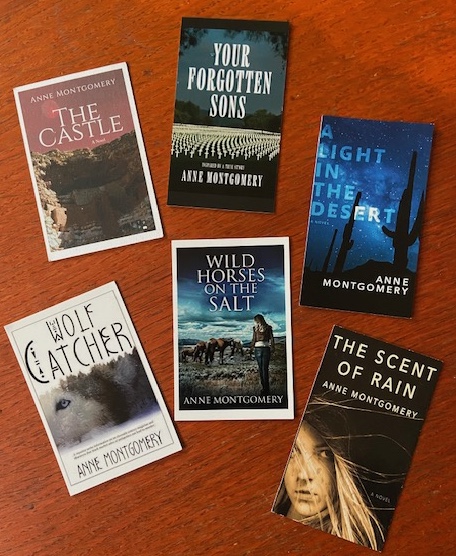
THE CASTLE

ANNE MONTGOMERY

Suspense/Thriller

Next Chapter Publishing

Ancient ruins. Haunted memories. A ruthless predator. Can Maggie survive the ghosts of her past – and the monster hiding in plain sight?

When she returns to her job as a National Park Ranger at “The Castle”—a centuried-old Native American pueblo carved into an Arizona cliff—Maggie hopes the comfort of familiar ground will help her heal. Battling trauma and the grief of unimaginable loss, Maggie’s days are carefully measured, her life held together by the thinnest of threads.

But strange things are happening at the park. A mysterious child appears and vanishes without a trace. And a predator watches her every move, planning his attack.

With the help of friends, fellow survivors, and the land itself, Maggie begins to reclaim her strength. But the danger is closer than she knows, and soon Maggie will have to face a deadly threat… and her deepest fears.

Bookstores, libraries, and other booksellers can order copies directly from the Ingram Catalog.

UNIVERSAL BOOK LINK

NEXT CHAPTER PUBLISHING

AMAZON

APPLE BOOKS

BARNES & NOBEL

GOOGLE BOOKS

RAKUTEN KOBO

Praise for The Castle

A deftly written and riveting read from cover to cover, “The Castle” effectively showcases author Anne Montgomery’s genuine mastery of the Romantic Suspense genre.” – Midwest Book Review

“A slow burn thriller, mixed in with a touch of mystical realism…A true five-star experience!” – Sara Steven Chick Lit Central

“A beautifully considered, sumptuous novel from a skilled storyteller.” – SaraRose Auburn Writing & Reviews

“This is a novel about good rage, about channeling the injustices of the world around us and fighting to do some good with both words and deeds. Lucky for readers, it was penned by a maestra like Anne Montgomery, so that we got a tense, powerful novel in the bargain too.” – Jennifer deBie-Rosie Amber Book Reviews

Ms. Montgomery manipulates uncomfortable subjects and dark suspense into a gripping tale with hints of romance and humor carefully guiding readers on an informative journey of survival and self-discovery. Tonya Mathenia InD’tale Magazine

“Soul-stirring. A brilliant book…Truly a masterpiece.” – Anu Menon Thought is Free Book Blog

“I was gripped from start to end.” – Katherine Hayward Pérez Just Katherine Blog

“Ms. Montgomery has an almost magical talent to draw the reader into the worlds she creates through her words. Her characters are interesting, vulnerable and strong. While describing the locations in which her books are set, she weaves history with vivid images, immersing the reader in a hard-to-put-down story full of history, beauty and mystery.” – Margaret Millmore Author

Literary contests: Think hard before grabbing your credit card

Everyone loves a prize.  I know I do! And the vast majority of people who run the hundreds of literary award competitions in the U.S. each year know this too. Authors are bursting with excitement to get the word out about their new book, and are drawn to these contests like teenage girls to a Taylor Swift concert.

I’ve entered book contests and on occassion I’ve actually won something. Still, are literary contests worth the time, effort, and costs?

Before I go on, note that there are certainly legitimate and influential literary competitions out there like the Pulitzer Prize, the Nobel Prize in Literature, the National Book Award, and the Booker Prize, to name few, ones that can obviously change the course of one’s writing career. I’m not talking about those.

While I’m not saying all the other pay-for-play literary contests are scams—though some are—the vast majority are just simple money-making schemes. When you check out those submission guidelines, send in your manuscript, and pay the application fee, someone will win. Maybe they’ll even take home a check, but it won’t be much, because those submission dollars generally stay with those running the contest. Still, the folks in charge will point out that you can win pretty stickers to put on your books, or maybe a free or discounted public relations/marketing package, or a visit with a literary agent. Hell, they might even invite you to a fancy dinner.

But, in the end, your little prize means, well . . . little. I suppose you can call yourself an award-winning author, still whenever I see that particular claim, I’m always skeptical. It reminds me of the hand-painted sign I saw on a recent road trip: World’s Best Jerky! I couldn’t help but wonder how said jerky earned that appellation. Was there a world-wide jerky contest? Or did the jerky-maker’s mom say, “Gosh, honey, that’s the best jerky in the world!”? (Note here that there apparently is a Top Artisan Jerky Creations of the Year contest—Who knew?—still I doubt the guy who painted the sign in the backwoods of Washington state had been a participant.)

The point is “award-winning” implies something big. At least it does to me. So, though I’ve earned a couple of literary awards, I don’t generally mention myself as being an award-winning author. Somehow, though it’s technically true, it seems a bit pretentious.

I’m going to guess that I have now annoyed some authors who proudly display their medals, ribbons, and stickers. And I’m certainly not saying they shouldn’t. It’s just that, in the long run, almost all of those contest submission fees go to waste. Authors might be better served spending on book promotions, hiring a publicist, or sprucing up their website, for example.

Now I understand the draw. We authors are all pretty sure we’ve written the best book in the history of the world. (I have six traditionally published novels and I believed every one of them was worthy of a Pulitzer. Sigh…) So if you feel compelled to enter literary competitions, maybe give yourself a contest-entering budget. Some small amount that won’t affect other areas of book promotion where you’ll get a bigger bang for your buck. Though I know it’s tempting to zip out one’s credit card and pay those submission fees, think before you do.

And here is where I’ll admit that despite what I know I couldn’t avoid the pull of winning a competition. I sent my World War II historical fiction novel Your Forgotten Sons to the Independent Publishers Book Awards. It’s tantamount to the excitement of buying a lottery ticket and like the lottery the chances are exceedingly slim. Still, a girl can dream.

Because I understand that you might also need a thrill, find a link to hundreds of literary contests here. Just carefully read the submission guidelines, consider what you might actually win, and think hard about clicking that payment key.

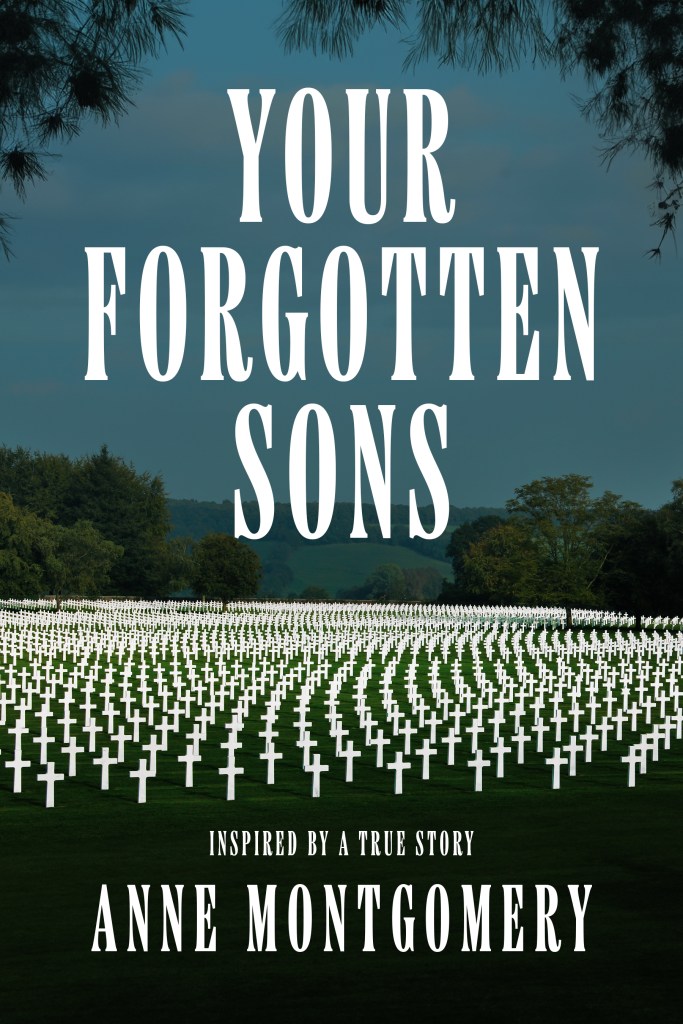
Your Forgotten Sons

Inspired by a true story

Anne Montgomery

Bud Richardville is inducted into the Army as the United States prepares for the invasion of Europe in 1943. A chance comment has Bud assigned to a Graves Registration Company, where his unit is tasked with locating, identifying, and burying the dead. Bud ships out, leaving behind his new wife, Lorraine, a mysterious woman who has stolen his heart but whose secretive nature and shadowy past leave many unanswered questions. When Bud and his men hit the beach at Normandy, they are immediately thrust into the horrors of what working in a graves unit entails. Bud is beaten down by the gruesome demands of his job and losses in his personal life, but then he meets Eva, an optimistic soul who despite the war can see a positive future. Will Eva’s love be enough to save him?

Universal Buy Link

Amazon

Apple Books

Barnes & Nobel

Google Books

Kobo

Bookstores, libraries, and other booksellers can order copies directly from the Ingram Catalog.

Anne Montgomery’s novels can be found wherever books are sold.

Goodreads

Amazon

Authors, even if you don’t sell a lot of books at a signing it can still be a success

Authors often have high expectations for books signings, but I wonder if they understand that it’s not all about how many books one manages to sell at an event. I’ve been behind that table, exhorting passersby to stop and take a look at my novels lots of times, and I can’t say I wasn’t disappointed on those occasions when no one seemed interested in buying my books.  However, that doesn’t mean the whole endeavor was a waste of time.

Authors need to consider all the promotional opportunities when participating in a book signing.

Note here that I am not talking about a book launch, which is generally a one author/new book event. It’s any other time an author sets up a table in public, especially those times when authors come together in groups, which means there are lots of people hawking books in the same place at the same time, so there’s an immense amount of competition.

We need to think of a book signing as more of an overall promotional opportunity. A chance to meet people and hand out business cards. Note that I’m a big believer in those humble little bits of paper. One should never head to a book event—or anywhere for that matter—without a bunch of well-designed business cards boasting a lovely photo of their most recent book cover, as well as a website address and contact information. Remember that today readers have options, and while we authors lug suitcases filled with physical books to our events, we should not forget about the folks who prefer to read audio and e-versions of our work.

Authors should also consider what they’re asking for their books. At a recent event where maybe 25 authors had gathered, the nice man next to me inquired about whether the $28 price he was charging for his paperback book was excessive, since no one was buying his books.

“Yes!” I said without a moment’s hesitation. “It’s too much!”

He looked perplexed.

I didn’t know the guy, but since he asked, I felt compelled to explain. “These events are not necessarily about making money. They’re about getting the word out,” I said. “I’ve given away lots of books, because I want people to read them. If you charge too much, you’ll never get your books in readers’ hands.”

Giving a book away also promotes goodwill. You’ve made someone’s day. That little bit of kindness just might drive business to your website, and the reader might like your book so much they’ll tell others about it. Yes, it’s a bit of a financial hit, but giveaways should be part of doing business. And, hey, you can take the cost off your taxes.

The most important thing an author can do is to bring their most personable self to an event. Your book won’t sell itself. That’s your job. So, look people in the eye. Stand when someone approaches your table. Have a very short speech that explains what the book is about and, if the patron shows interest, explain why you felt the need to write the story. Smile. Be animated. Hand out that business card and thank them for stopping buy even if they didn’t make a purchase

The idea is to get them to remember you and your book. And while you won’t see a rise in your book sales that day, you certainly may see one later on.

Your Forgotten Sons

Inspired by a true story

Anne Montgomery

Bud Richardville is inducted into the Army as the United States prepares for the invasion of Europe in 1943. A chance comment has Bud assigned to a Graves Registration Company, where his unit is tasked with locating, identifying, and burying the dead. Bud ships out, leaving behind his new wife, Lorraine, a mysterious woman who has stolen his heart but whose secretive nature and shadowy past leave many unanswered questions. When Bud and his men hit the beach at Normandy, they are immediately thrust into the horrors of what working in a graves unit entails. Bud is beaten down by the gruesome demands of his job and losses in his personal life, but then he meets Eva, an optimistic soul who despite the war can see a positive future. Will Eva’s love be enough to save him?

Release Date: June 6, 2024

Universal Buy Link

Amazon

Apple Books

Barnes & Nobel

Google Books

Kobo

Bookstores, libraries, and other booksellers can order copies directly from the Ingram Catalog.

Anne Montgomery’s novels can be found wherever books are sold.

Goodreads

Amazon

Book marketing and the humble business card

Old school? Yes! Still I love business cards.

When I tell people I’m an author, they often blurt out, “I’ve always wanted to write a book!” At which point I smile politely and urge them on. Why? Because writing books is fun and exciting. One gets to meet all kinds of people and travel to interesting places for research. And we live with fascinating characters, ones we can see and hear and chat with, which sometimes has loved ones questioning our sanity.

That said, the dark side of publishing is the part that comes moments after we slice open that delivery box and cuddle our baby in our arms, because then we must let them go. Like children we raise to grow up and head out into the world, we must also send our books away, hopefully to people who will love them as much as we do.

The question is how do we get readers to buy our books?

The marketing and selling of books has become multifaceted and complicated since the advent of the Internet, which sometimes makes writers want to toss their laptops out the window in frustration. In the old days—pre Amazon’s birth in 1995—an author could hand over a manuscript to a publisher, sit back, and wait for others to promote their book. But no more. Authors are now involved in every aspect of marketing, and if they don’t take it seriously, it won’t matter how brilliant their novel is. Did you know that before accepting a manuscript publishers will often scour the Internet to check an author’s digital footprint? And if they find the author is without a website, blog, podcast, proper social media links, and masses of followers, that manuscript—no matter how award-worthy—just might end up in the nearest digital trash bin.

I’ve done my best to follow book-marketing guidelines. I have a website where I blog weekly. I share reviews and promotions and am active on various social media platforms. I’ve engaged publicists at my own expense and held book signings. I give book talks and offer myself as a guest on podcasts. And despite all of that, let’s just say I’m delighted to be receiving  those monthly Social Security and pension checks, because there’s no way I could live on my royalties. (This is where I generally tell aspiring young authors that they should never, ever quit their day jobs to be writers.)

The thing is, authors need to find promotional avenues that work for them. And here is where I’ll mention the humble business card. I have always believed in that wee slice of paper, though I sense many feel that “technology” is outdated. But even today, in our digital world, business cards are perfect conversation starters, especially if one puts a little effort into their design. And then there’s the rather shocking idea that when one hands out a business card there’s a living, breathing human being reaching out to grasp it. Yes, I know when one hits the send button on our blogs and ads and posts they have the ability to reach lots of people, but there’s something special about looking someone in the eye and talking about your book.

Today, I rarely leave the house without a few business cards tucked in my pocket. I always have my latest book cover on the front and relevant contact information including my email address and website link on the back. I also list the titles of all my published books. Then I watch and listen. When I see someone with a book, I ask what they’re reading, which often leads to a conversation. Two strangers talking about books can be magical. If you don’t believe me, try it sometime.

As for all the other marketing approaches, the best advice is pick a few and stick with them. Try not to spread yourself too thin, and choose promotions you enjoy. For example, as a former TV sports reporter, I never met a microphone I didn’t like, so I enjoy being a guest on podcasts. However, Instagram always had me fumbling for something to post. It was almost a relief when someone from TikTok took over my account. (I know I should start over, but I just haven’t been able to make myself do it. Here’s hoping my publisher hasn’t noticed.)

So, get out there, fellow authors. Find what works for you. And always have a few business cards in your pocket.

Your Forgotten Sons

Inspired by a true story

Anne Montgomery

Bud Richardville is inducted into the Army as the United States prepares for the invasion of Europe in 1943. A chance comment has Bud assigned to a Graves Registration Company, where his unit is tasked with locating, identifying, and burying the dead. Bud ships out, leaving behind his new wife, Loryane, a mysterious woman who has stolen his heart but whose secretive nature and shadowy past leave many unanswered questions. When Bud and his men hit the beach at Normandy, they are immediately thrust into the horrors of what working in a graves unit entails. Bud is beaten down by the gruesome demands of his job and losses in his personal life, but then he meets Eva, an optimistic soul who despite the war can see a positive future. Will Eva’s love be enough to save him?

Release Date: June 6, 2024

Amazon

Apple Books

Barnes & Nobel

Google Books

Kobo

Universal Buy Link

Bookstores, libraries, and other booksellers can order copies directly from the Ingram Catalog.

Find Anne Montgomery’s novels wherever you buy books.

Goodreads

Amazon