Archaeological looting, a crime that hurts us all

One of the themes in my historical fiction novel Wolf Catcher, which was just rereleased by Next Chapter Publishing, is the problem of archaeological looting. Of course, this issue isn’t new. Humans have been rifling through ancient sites for thousands of years, mostly plundering burials for financial gain. But, before my reporting job took me to Arizona, I had little knowledge of the issue.

The state is vast, with a lasting history of the Native Americans who have populated this land for thousands of years. In the late 1800s grave robbing, especially in the western U.S., became the norm. The idea that the Native American culture was dying gave looters the ridiculous idea that stealing pottery, jewelry, and other funerary objects was perfectly fine, so the wonton destruction of ancient sites—looters have been known to employee backhoes and other large equipment to rip through pueblo dwellings and burials—is sadly common in the American Southwest.

While archaeological looting today is a crime, the law is very hard to enforce. Here I will let some of the characters in Wolf Catcher explain.

“How can this happen?” Kate asked.

Cooper placed his arm around her shoulders, all the levity and earnest excitement that had permeated their time at the site having evaporated into the chilled air. A thick bank of dark clouds blocked out the sun. “I have an idea that the problem of catching pothunters has to do with manpower, am I right?”

George spoke as he scanned the ground for evidence of looting. “Manpower is a great deal of the problem. First, the question is who is responsible for a specific site? A ruin could be on land controlled by National Park officers, Bureau of Land Management investigators, tribal authorities, U.S. Forest Service rangers, Bureau of Indian Affairs agents, or state investigators.”

“It sounds to me like you have too many people involved, not too few,” Kate said as she too searched the ground for clues.

“Consider this,” George said. “The BIA, which watches over about five hundred seventy tribes nationwide, currently has just one investigator assigned to looting. Here in Arizona, just two investigators cover looting on trust lands. That area covers nine million acres. BLM officers cover more than a million acres each.”

“The other problem is the sheer number of ruins,” Rebecca explained. “In Arizona, we have catalogued more than a hundred thousand sites, but most of them haven’t been inventoried, so we don’t even know what’s in them. How, then, can we know what’s missing?”

So manpower and vast areas of rugged wilderness make catching looters difficult. But prosecuting them is even more of a problem. The way the laws are written, those caught looting can play dumb and act as if they had no idea they were breaking the law. Often, they get off with little more than a warning.

Not only do we need to install harsher penalties for archaeological looting, we need to change the way we think about it. Looting is a crime against all of us, because once you’ve removed an artifact from its resting place, you’ve destroyed its sense of time and place. Our ability to understand its historical significance is then lost forever.

What can we do? Be very careful when you consider acquiring an ancient object. Even if it comes from a tony Scottsdale shop, ask about its provenance: Where and when was it harvested and by whom? And, when you’re out hiking, stop and think about picking up that pretty pottery shard or arrowhead. It’s best to admire the object then walk away.

Wolf Catcher

Anne Montgomery

Historical Fiction

Next Chapter Publishing

Released August 4, 2025

The past and present collide when a tenacious reporter seeks information on an eleventh century magician…and uncovers more than she bargained for.

In 1939, archaeologists uncovered a 900-year-old tomb at the Northern Arizona site called Ridge Ruin. The man, bedecked in fine turquoise jewelry and intricate bead work, was surrounded by hundreds of extraordinary funerary objects, including wooden swords with handles carved into animal hooves and human hands. The Hopi workers stepped back from the grave, knowing what the Moochiwimi sticks meant. This man was a magician.

Sixty-five years later, investigative reporter Kate Butler discovers evidence that The Magician looked notably different from those who buried him. Her quest to discover The Magician’s origin carries her back to a time when the high desert world was shattered by the birth of a volcano and into the present-day dangers of archaeological looting where black market sales of antiquities can lead to murder.

Amazon

Apple Books

Barnes and Noble

Google Books

Rakuten Kobo

Bookstores, libraries, and other booksellers can order copies directly from the Ingram Catalog.

Praise for Wolf Catcher

“Blending archaeology and Native American mythology, “Wolf Catcher” by novelist Anne Montgomery is an original, exceptionally well written, and compelling work of historical fiction…” – Midwest Book Review

“The author’s ability to interweave the past and the present was masterful. The characters were complex and interesting, especially with the underlying theme of rethinking the history of worldly human migration … A real page turner and I am wondering when the movie is going to be made!” – Alicia Williams Goodreads

“The story is very well-paced, reaching a page-turning, action-packed climax to the end. This story has all the elements of a great suspense drama centered around a historical mystery.” – Heidi Slowinski Author

“I was deeply and thoroughly embroiled in this imaginative novel… (that) melds seamlessly much of fact with fiction. Totally recommended! “ – V. Williams Vine Voice

“What a journey! What a story! A truly epic tale that grabs you by a throat and moves your soul. Highly recommend for the readers of all age groups.” – Marina Sardarova Author

“Boy, didn’t this one grip me quickly and keep me glued to the pages! Loved the cliff-hanging chapter endings. Well researched, well-plotted and paced…Trust me, you’ll love it. Totally recommended and out now!” – Rosepoint Publishing

“Once again the author has created a beautiful story with a powerful message. She took a piece of history and brought it to life. I just can’t say enough good things about Wolf Catcher.” – Megan Salcido Wildwood Reads

Anne Montgomery’s novels can be found wherever books are sold.

Goodreads

Amazon

The mysterious Virgin Islands

Here’s a look at my backyard on St. Croix in the USVI. Yep, as you can see, I’m a spoiled brat.

I live part time in a place that most people don’t seem to understand. Take Netflix for example, which denied me the opportunity to watch a new TV series by saying, “This title is currently unavailable for viewing in your country.”

Or Phoenix Sky Harbor Airport where the nice people behind the domestic flight counter shake their heads and say, “You have to get into the international flights line.”

Or my gas company in Arizona that refused to let me pay my bill online. “We cannot accept payment from your current location.”

USVI should not be that difficult to explain. It means the United States Virgin Islands. It’s just like living in Pennsylvania, or Colorado, or Montana, just without the flamboyant sea view.

And now I will put on my history teacher cap and explain. The U.S. Virgin Islands include 50 minor islands and cays, as well as St. Thomas, St. John, and St. Croix, where I get to sit on my patio and stare at the ever-changing colors of the Caribbean Sea whenever I want. Doesn’t that sound nice? These islands were purchased from Denmark—one of seven nations to hold sway here—in 1917 for a cool $25 million dollars in gold. That was the year the U.S. entered World War I and the thinking was it would be detrimental if the Germans got a foothold in the Caribbean, especially in the Virgin Island’s where there are several natural deep-water ports, the perfect place to park some of their warships so they could wreak havoc near American shores. In 1927 the islands were deemed an unincorporated territory and their inhabitants were granted U.S. citizenship.

If like the aforementioned entities you’re still skeptical, note that we even have ZIP codes, which are pretty much nonexistent outside of the U.S. Now, it’s true that Virgin Islanders do not get to vote in presidential elections, but we do have one non-voting representative in Congress. We are just like Puerto Rico, Guam, American Samoa, and the other U.S. Territories. When I set foot on my little island, I am on United States soil.

Here’s the thing. The U.S. Virgin Islands are magnificently beautiful with their tropical climate and the mesmerizing Caribbean Sea that surrounds them. And they have fascinating history. Way back in 1493, a landing party of two dozen men was sent ashore  by Christopher Columbus who was on his second voyage to the New World. They were met by a group natives who were surely astonded by the 17 ships they found in the waters off their shores. When the sailors captured women and children to be slaves, the natives fired arrows at them. One native was decapitated by Columbus’ men. It is the first documented instance of resistance by American indigenous peoples against European colonists. St. Croix alone boasts two forts built almost 300 years ago: Fort Chistiansvaern and Fort Fredrik, constructed to protect the island from other nations and the marauding pirates who periodically showed up waving the skull and cross bones. How cool is that? And let’s not forget young Alexander Hamilton who hip-hopped his way around St. Croix, before skipping over to the mainland to do his Founding Father thing.

But I digress.

I’m not sure what else I can say to convince the naysayers that the lovely island I call home is part of the United States. Maybe you can pass the word.

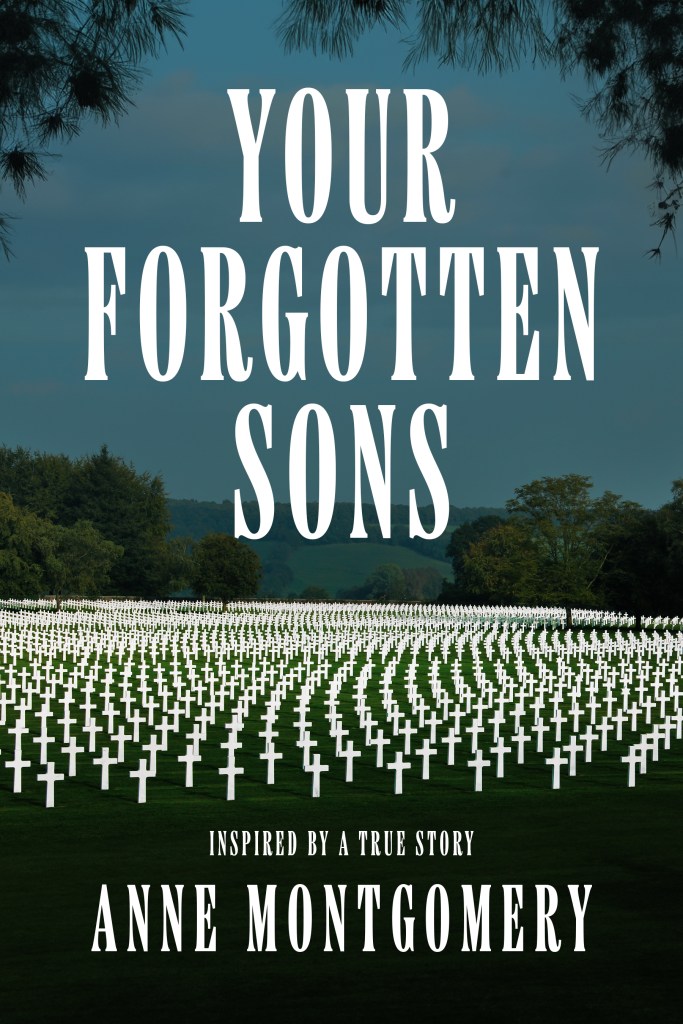
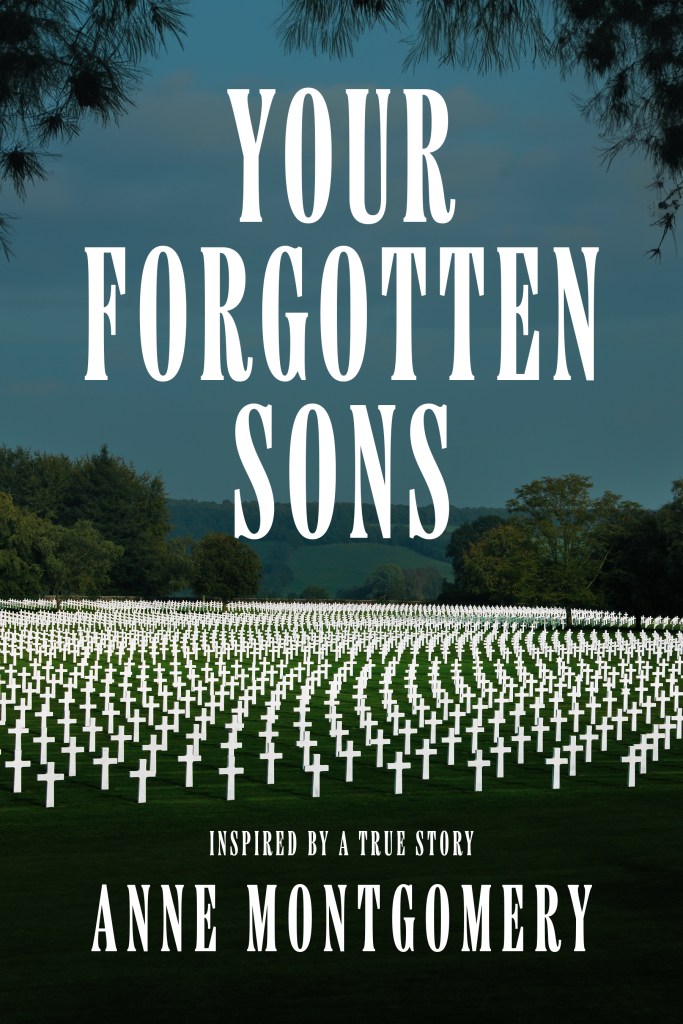
Your Forgotten Sons

Inspired by a true story

Anne Montgomery

Bud Richardville is inducted into the Army as the United States prepares for the invasion of Europe in 1943. A chance comment has Bud assigned to a Graves Registration Company, where his unit is tasked with locating, identifying, and burying the dead. Bud ships out, leaving behind his new wife, Lorraine, a mysterious woman who has stolen his heart but whose secretive nature and shadowy past leave many unanswered questions. When Bud and his men hit the beach at Normandy, they are immediately thrust into the horrors of what working in a graves unit entails. Bud is beaten down by the gruesome demands of his job and losses in his personal life, but then he meets Eva, an optimistic soul who despite the war can see a positive future. Will Eva’s love be enough to save him?

Amazon

Apple Books

Barnes & Nobel

Google Books

Kobo

Bookstores, libraries, and other booksellers can order copies directly from the Ingram Catalog.

Anne Montgomery’s novels can be found wherever books are sold.

Goodreads

Amazon

Memorial Day: A time for quiet contemplation

Memorial Day is different from other holidays, though it seems many of us have forgotten the point of the celebration. I ran into this issue back when I was a print reporter when my editor asked me to write a story about Memorial Day.

“Go find out about all the events people can attend,” he said. “Parties, big sales, parades. Things like that.”

I frowned, which caught him off guard. “What?” He held out his hands palms up.

I had never refused an assignment before, still I couldn’t help myself. “Memorial Day isn’t about shopping and drinking beer. It’s about remembering.”

He looked at me for a moment. “Write whatever you want.”

So, I contacted the local Veterans of Foreign Wars post and interviewed a number of aging veterans, men who despite their advanced years, recalled vividly those who were left behind. 

“I was a foot soldier in the 59th Field Hospital. My brother was in the 7th Armored Division. He chased me and I chased him, but he was killed before I got to him.”

“The pilot of the helicopter was going to lower me down into the water and I leaned out and took a look. Here was these huge fishes going around eating pieces of bodies. Sharks. And you know they couldn’t declare that person dead because they didn’t know if it was one person or two. I thought about it ever since.”

“A buddy of mine…we went all the way through the war right to the end. Just outside of Cheb, Czechoslovakia he got captured and they stuck a pistol in his mouth and pulled the trigger. He was…22.”

I have over the years spent Memorial Day thinking about the veterans in my life who are no longer with us. My father who faced kamikazes and rode a destroyer escort into Tokyo Bay at the end of World War II. My dear friend Don Clarkson, a decorated hero of the Vietnam War who spent the rest of his life struggling with the demons he brought home. And now, I also remember Bud.

Sergeant Bud Richardville served in the 606th Graves Registration Service in the European Theatre during World War II. His job? Locate, identify, and bury the dead. Think about that.

With the help of a packet of letters now 80 years old, I tracked Bud through the landing on the beaches of Normandy, the frigid forests of the Battle of the Bulge, and General George Patton’s drive to free Czechoslovakia from the Nazis. All the while soldiers died by the hundreds of thousands on both sides of the conflict and Bud and his men were tasked with recovering whatever was left. Then they buried the remains in the graceful cemeteries they built, hollowed peaceful grounds today, spread across what were once miserable killing fields.

My historical fiction novel Your Forgotten Sons tells not only Bud’s story, but those of the men who labored alongside him. Soldiers who have rarely appeared in books or films, but who toiled to give the fallen the respect and dignity they deserved.

So, on this Memorial Day, I will remember my soft-spoken father, and my dear friend Don. But I will also remember Bud and those who served with him.

Your Forgotten Sons

Inspired by a true story

Anne Montgomery

Bud Richardville is inducted into the Army as the United States prepares for the invasion of Europe in 1943. A chance comment has Bud assigned to a Graves Registration Company, where his unit is tasked with locating, identifying, and burying the dead. Bud ships out, leaving behind his new wife, Lorraine, a mysterious woman who has stolen his heart but whose secretive nature and shadowy past leave many unanswered questions. When Bud and his men hit the beach at Normandy, they are immediately thrust into the horrors of what working in a graves unit entails. Bud is beaten down by the gruesome demands of his job and losses in his personal life, but then he meets Eva, an optimistic soul who despite the war can see a positive future. Will Eva’s love be enough to save him?

Release Date: June 6, 2024

Pre-Order your copy today

Amazon

Apple Books

Barnes & Nobel

Google Books

Kobo

Review a copy early by going to NetGalley. Sign in here.

Bookstores, libraries, and other booksellers can order copies directly from the Ingram Catalog.

Anne Montgomery’s novels can be found wherever books are sold.

Goodreads

Amazon

Memorial Day: Why we celebrate

Back when I was a print reporter, my editor asked me to write a story on Memorial Day. “Go find out about all the events people can attend,” he said. “Parties, big sales, parades. Things like that.”

I frowned, which caught him off guard. “What?” He held out his hands palms up.

I had never refused an assignment before, still I couldn’t help myself. “Memorial Day isn’t about shopping and drinking beer. It’s about remembering.”

He looked at me for a moment. “Write whatever you want.”

So, I contacted the local Veterans of Foreign Wars post and interviewed a number of aging veterans, men who despite their advanced years, recalled vividly those who were left behind. 

“I was a foot soldier. Fifty-ninth field hospital. My brother was in the 7th Armored Division. He chased me and I chased him, but he was killed before I got to him.”

“The pilot of the helicopter was going to lower me down into the water and I leaned out and took a look. Here was these huge fishes going around eating pieces of bodies. Sharks. And you know they couldn’t declare that person dead because they didn’t know if it was one person or two. I thought about it ever since.”

“A buddy of mine…we went all the way through the war right to the end. Just outside of Cheb, Czechoslovakia he got captured and they stuck a pistol in his mouth and pulled the trigger. He was…22.”

I have over the years spent Memorial Day thinking about the veterans in my life who are no longer with us. My father who faced kamikazes and rode a destroyer escort into Tokyo Bay at the end of World War II. My dear friend Don Clarkson, a decorated hero of the Vietnam War who spent the rest of his life struggling with the demons he brought home. And now, I also remember Bud.

Sergeant Bud Richardville served in the 606th Graves Registration Service in the European Theatre during World War II. His job? Locate, identify, and bury the dead. Think about that.

With the help of a packet of letters now 80 years old, I tracked Bud through the landing on the beaches of Normandy, the frigid forests of the Battle of the Bulge, and General George Patton’s drive to free Czechoslovakia from the Nazis. All the while soldiers died by the hundreds of thousands on both sides of the conflict and Bud and his men were tasked with recovering whatever was left. Then they buried the remains in the graceful cemeteries they built, hollowed peaceful grounds today, spread across what were once miserable killing fields.

June 6, 2024 is the 80th anniversary of D-Day. My new historical fiction novel Your Forgotten Sons tells not only Bud’s story, but those of the men who labored alongside him. Soldiers who have rarely appeared in books or films, but who toiled to give the fallen the respect and dignity they deserved.

So, on this Memorial Day, I will remember my soft-spoken father, and my dear friend Don. But I will also remember Bud and those who served with him.

Your Forgotten Sons

Inspired by a true story

Anne Montgomery

Bud Richardville is inducted into the Army as the United States prepares for the invasion of Europe in 1943. A chance comment has Bud assigned to a Graves Registration Company, where his unit is tasked with locating, identifying, and burying the dead. Bud ships out, leaving behind his new wife, Lorraine, a mysterious woman who has stolen his heart but whose secretive nature and shadowy past leave many unanswered questions. When Bud and his men hit the beach at Normandy, they are immediately thrust into the horrors of what working in a graves unit entails. Bud is beaten down by the gruesome demands of his job and losses in his personal life, but then he meets Eva, an optimistic soul who despite the war can see a positive future. Will Eva’s love be enough to save him?

Release Date: June 6, 2024

Pre-Order your copy today

Amazon

Apple Books

Barnes & Nobel

Google Books

Kobo

Review a copy early by going to NetGalley. Sign in here.

Bookstores, libraries, and other booksellers can order copies directly from the Ingram Catalog.

Anne Montgomery’s novels can be found wherever books are sold.

Goodreads

Amazon

Writing historical fiction can be tricky

I almost got tripped up a few times, when writing about World War II Jeeps.

My new book, Your Forgotten Sons, is a work of historical fiction, a story inspired by Sergeant Joseph “Bud” Richardville who worked in the Graves Registration Service in Europe during World War II.

As many authors know, writing about the past can be tricky. One reason is we tend to look at history through our own modern-day lens. For example, when I was writing about Bud, I often had him riding in a Jeep. Today, Jeeps are ubiquitous on civilian roadways, but the origins of the vehicle are steeped in war.

Scripps Howard WWII reporter Ernie Pyle once said of the Jeep, “It did everything. It went everywhere. Was as faithful as a dog, as strong as a mule, and as agile as a goat. It constantly carried twice what it was designed for and still kept going.”

No doubt current Jeep owners prize the vehicle for many of the same attributes. The problem comes when one sees a Jeep and misses the evolution that led to today’s version. When I first wrote Your Forgotten Sons, I had Bud starting a Jeep with keys and adjusting the rearview mirror. Oops! Jeeps back then started with a pushbutton and the vehicles had no review mirrors.

I also had Bud and his fellow soldiers eating K-rations, but I would learn that he and his peers actually consumed C-rations. What’s the difference? K-rations were heavy, having been designed for static warfare, like the trench battles of World War I. But World War II was a different type of war, with fast-moving trucks and tanks and parachute troops who needed lighter combat rations, because soldiers were constantly on the move.

When I first envisioned Bud, I saw him in a green T-shirt, the iconic color of the Army. Today, Army personnel wear undershirts defined as Tan 499 which has a slight green tint to it, a shade referred to as “coyote”. But in Bud’s time, the plain, white cotton T-shirt was what all male service members sported.

When writing about the World War II era, I had to pay close attention to the facts. Luckily, the time is well documented with videos, and photographs, and eye-witness accounts. But consider writing about periods that go way back in history. My novel Wolf Catcher takes place in both modern times and the 11th century in what would become Arizona. I once wrote a scene where Native people used honey to sweeten their food, which could never have happened, because it was not until the early 1600s that European settlers first brought honey bees to the Americas.

It’s clear, then, that when authors choose to write stories based on history, they need to be meticulous in their research.

I’m working on it.

Your Forgotten Sons

Inspired by a true story

Anne Montgomery

Bud Richardville is inducted into the Army as the United States prepares for the invasion of Europe in 1943. A chance comment has Bud assigned to a Graves Registration Company, where his unit is tasked with locating, identifying, and burying the dead. Bud ships out, leaving behind his new wife, Loryane, a mysterious woman who has stolen his heart but whose secretive nature and shadowy past leave many unanswered questions. When Bud and his men hit the beach at Normandy, they are immediately thrust into the horrors of what working in a graves unit entails. Bud is beaten down by the gruesome demands of his job and losses in his personal life, but then he meets Eva, an optimistic soul who despite the war can see a positive future. Will Eva’s love be enough to save him?

Release Date: June 6, 2024

Pre-Order your copy today

Amazon

Apple Books

Barnes & Nobel

Google Books

Kobo

Review a copy early by going to NetGalley. Sign in here.

Find Anne Montgomery’s novels wherever you buy books.

Goodreads

Amazon

Who was Bud Richardville?

In 1943, Sergeant Bud Richardville left a new wife and headed off to World War II to serve in the Graves Registration Service. But he never came back and questions about his death lingered for 75 years.

Joseph “Bud” Richardville was not very different from the millions of other young men who served in the U.S. military in World War II. He came from rural Indiana, where his family lived in poverty, a hangover from the Great Depression. He knew little about the world outside of Vincennes, but as the inevitability of the coming conflict became clear, Bud moved to Michigan to work in the paper mills, an industry that was essential to the war effort and which kept him stateside until he was drafted in 1943.

When Bud boarded the train for Camp Warren, Wyoming that summer, he was 29 and found himself riding with other soon-to-be soldiers who were mostly kids, many still in their teens, some excited to be away from home for the first time, others quiet, perhaps fearing what was to come.

Once at bootcamp, Bud was assigned to the Graves Registration Service. Family stories indicate that when Bud was young he’d periodically been called upon to help remove the corpses of those who’d fallen from the trains that trundled through his neighborhood, travelers who’d jumped aboard, hoping for a free ride, but who’d slipped and fallen to their deaths. Perhaps he’d mentioned this fact during his induction at Camp Warren and that familiarity with the dead colored the decision to place him in a GRS. Bud would serve in the 606 Graves Registration Company where he and his brethren were tasked with locating, identifying, and burying the dead.

Sgt. Bud Richardville died just after the German’s surrendered in 1945. He lies in the American Cemetery in Épinal, France.

Think about that for a moment, and consider that the gathering of war dead is an undertaking that seems to have been erased from history. Consider all of those war movies where soldiers are mowed down on the beaches of Normandy or are mortally wounded on foreign battlefields, young men, some blown to pieces. But once their deaths are confirmed, the camera moves forward, ignoring the carnage.

It was left to those in the Graves Registration Service to gather up the horrific aftermath of battle in the hope of making some order out of all that death. They did their utmost to retrieve and identify the fallen and design and build the cemeteries that would hold their remains. Today, about 130,000 American war dead are said to be buried on foreign soil, men and women who were laid to rest with the reverence they deserved, because of the dedication of those in the GRS.

The efforts of Bud and his men additionally served another vital purpose: morale. As wave after wave of soldiers hit those Normandy beaches, the dead had to be collected quickly, so as not to traumatize the incoming troops. It is not hyperbole to say that the job of those in the GRS is perhaps one of the most difficult and least appreciated in the history of military service. And it is easy to understand the torment many of these soldiers, including Bud, faced for the rest of their lives.

It is ironic, perhaps, that Bud’s final resting place would be in the American Cemetery in Épinal, France, where he was buried by his brothers who also served in the GRS.

Your Forgotten Sons

Inspired by a true story

Anne Montgomery

Bud Richardville is inducted into the Army as the United States prepares for the invasion of Europe in 1943. A chance comment has Bud assigned to a Graves Registration Company, where his unit is tasked with locating, identifying, and burying the dead. Bud ships out, leaving behind his new wife, Lorraine, a mysterious woman who has stolen his heart but whose secretive nature and shadowy past leave many unanswered questions. When Bud and his men hit the beach at Normandy, they are immediately thrust into the horrors of what working in a graves unit entails. Bud is beaten down by the gruesome demands of his job and losses in his personal life, but then he meets Eva, an optimistic soul who despite the war can see a positive future. Will Eva’s love be enough to save him?

Release Date: June 6, 2024

NextChapter Publishing

Pre-Order your copy today

Amazon

Apple Books

Barnes & Nobel

Google Books

Kobo

Review a copy early by going to NetGalley. Sign in here.

Find Anne Montgomery’s novels wherever you buy books.

Goodreads

Amazon