Volcanoes: Symbols of destruction and life

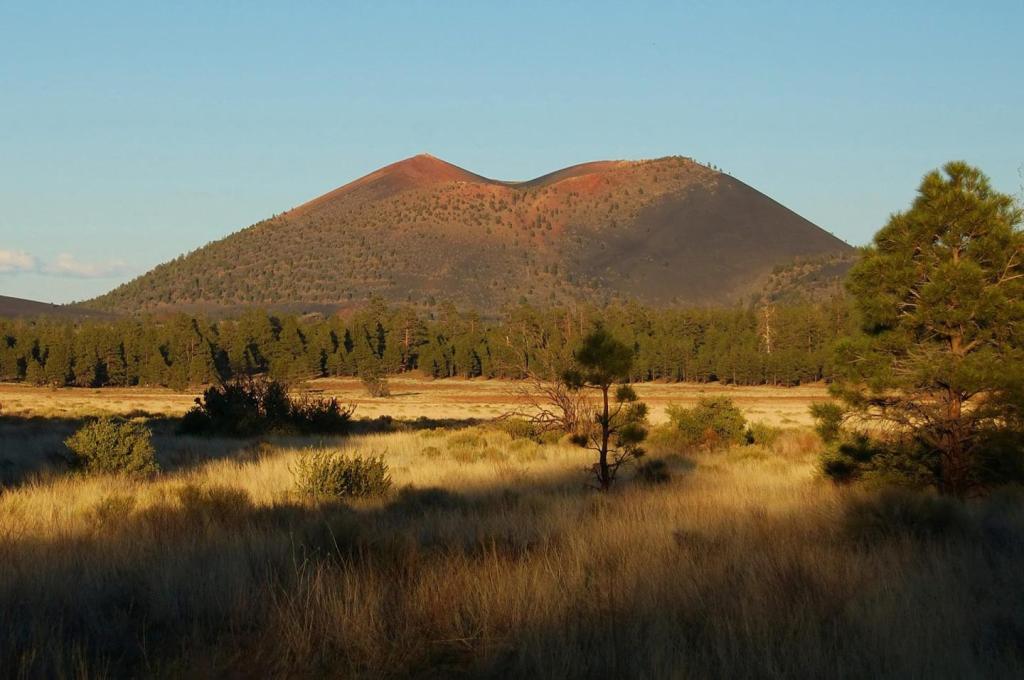
The cinders of Sunset Crater Volcano “glow” because they are infused with iron oxide, which makes the mountain appear to be bathed in a sunset.

While researching my historical-fiction novel Wolf Catcher, which was recently rereleased by Next Chapter Publishing, I found myself immersed in volcanoes. The reason? The Sunset Crater Volcano, which rests outside of Flagstaff, Arizona, and is today a National Monument.

A cinder cone volcano is one of several types all of which form differently. In the case of the Sunset Crater Volcano, scientists believe it began erupting about 900 years ago. Had we been on hand for the big event, we would have noticed the ground shaking on and off in the weeks leading up to the eruption. Then the earth would have split open, emitting steam, and fire, and a cloud of ash that rose five miles into sky. As lightning zigged and zagged above the high desert, ash rained down on 800-square miles of land. After several weeks, or months, the cone grew to about 1,000 feet high, a loosely-packed amalgam of volcanic ash and reddish basalt cinders.

While today we understand the geological forces that birth a volcano, ancient people could only guess about what was happening beneath the earth. Luckily, The Sunset Crater Volcano has a modern-day sister who gives us a look into how witnesses might have assessed the eruption.

Paricutín is a cinder cone volcano just like the one at Sunset Crater. But this volcano, near the west coast of Mexico in the southern half of the country, erupted on and off between 1943 and 1952 in full view of the terrified inhabitants of the area. These documented reactions helped scientists studying the Sunset Crater Volcano discern how the Native Americans who peopled the high plateau may have reacted upon witnessing the event.

Here I will let some of the characters from Wolf Catcher explain.

“They were the same kind of volcanoes, right?” Cooper asked.

Marty nodded. “They are both cinder cones and they both gave the people ample warning that something was happening. No one in Paricutín died as a direct result of the eruption, and from what they’ve discovered so far, probably no one died here either. But let’s backtrack a little. It’s easy to know what happened at Paricutín. We have eyewitnesses. We know exactly when the eruption occurred. But at Sunset Crater, for a long time, there was no foolproof way to determine when the big event happened.”

“Is there now?” Kate asked.

“Well, that depends on who you talk to. I can tell you this. Before a Sinagua pithouse was discovered buried in the cinders, scientists had no idea the volcano was so young. They were able to date the pithouse using tree-rings and the pottery they found, and concluded that the eruption happened sometime in the late eleventh century. The ash from Sunset Crater fell over an area of nearly eight hundred square miles. In some places, just an inch, in others, it was fifteen feet deep. Just to give you a good idea of what that means, four inches of ash, especially if it’s wet, is enough to collapse a modern-day roof.”

“So, if you were caught up in the ash fall you were dead?” Cooper said.

“Theoretically, but as I explained, we haven’t found any bodies. And if we use the Paricutín model, we assume the people escaped in time. What we also know is that in Mexico the people were sure there was an angry god under the ground. In fact, they erected a row of big white Christian crosses in front of the lava flow to protect their villages from the creature.”

“Did it help?” Kate smiled.

Marty laughed. “I’m afraid the crosses did no good at all. Five villages were damaged, some destroyed, by the lava and ash.

It’s not much of a stretch to assume the ancestors of the Hopi who occupied the area around Sunset Carter Volcano may have, like the people at Paricutín, believed angry gods were at work and that some appeasement was in order.

What we do know is that the ash fall proved a benefit to those villages situated in just the right places, locations that received a few inches of ash, enough to fortify the soil and grow crops, while others lost their homes completely when many feet of ash destroyed the productivity of their land. Those forced from their homes might have fought desperately with those who benefitted from the eruption in order to survive.

Then there were those who were lured to the area in search of religious understanding. Who was the god? Why was he angry? What could the people do to pacify him? The Sunset Carter Volcano might have become a place of sacred pilgrimage.

It is into this fractured landscape that the man I call Wolf Catcher arrived.

Wolf Catcher

Anne Montgomery

Historical Fiction

In 1939, archeologists uncovered a tomb at the Northern Arizona site called Ridge Ruin. The man, bedecked in fine turquoise jewelry and intricate bead work, was surrounded by wooden swords with handles carved into animal hooves and human hands. The Hopi workers stepped back from the grave, knowing what the Moochiwimi sticks meant. This man, buried nine hundred years earlier, was a magician.

Former television journalist Kate Butler hangs on to her investigative reporting career by writing freelance magazine articles. Her research on The Magician shows he bore some European facial characteristics and physical qualities that made him different from the people who buried him. Her quest to discover The Magician’s origin carries her back to a time when the high desert world was shattered by the birth of a volcano and into the present-day dangers of archeological looting where black market sales of antiquities can lead to murder.

Amazon

Apple Books

Barnes and Noble

Google Books

Rakuten Kobo

Bookstores, libraries, and other booksellers can order copies directly from the Ingram Catalog.

Anne Montgomery’s novels can be found wherever books are sold.

Goodreads

Amazon

Sea Turtles: Magical ocean ambassadors

Any scuba diver will tell you that often the highlight of a dive is meeting up with a sea turtle. These almost magical ambassadors of the ocean rarely seem afraid of humans, even though we might appear scary clad in our diving gear, emitting plums of bubbles that make us appear much larger than we actually are. Yet, sea turtles often swim right up to us, staring as we stare back. Then they gently move their flippers and glide away, seeming to fly more than swim.

I mention sea turtles because last week I had the opportunity to head out to Sandy Point Wildlife Refuge, a wild spot of forest and beach on the west end of St. Croix in the U.S. Virgin Islands where I live part of the time. The refuge was designed with sea turtles in mind.

Since I’ve been diving a couple of decades now, I’ve seen a lot of beaches, but when we emerged from the forest I gasped at the color of the water. It was a creamy turquoise caused by a convergence of currents that splash up onto a white sand beach scattered with long tendrils of green vines. Add in the various blues of the Caribbean Sea farther out and the early evening sky, and, as you can imagine, it was magnificent.

But while the view was exceptional, what was below us was of primary importance. Our guides from the St. Croix Sea Turtle Project explained that there were about 1,500 turtle nests beneath our feet, so the area is closed to the public from April through August. Green turtles, hawksbill turtles, and massive leatherbacks that can reach up to two-thousand pounds come to this beach every year to lay their eggs, a journey that takes them thousands of miles to Canada and back.

The volunteers of the St. Croix Sea Turtle Project were kind enough to escort us through the Sandy Point Wildlife Refuge where we learned all about the sea turtles that nest in the Virgin Islands. (Fun Fact: The final scene of the film Shawshank Redemption was filmed on this beach.)

That trip is fraught with danger. Often turtles come ashore with wounds inflicted by tiger sharks and propellers from boats. Fishermen take their share, as turtles are still harvested legally in some places for food. They also get caught in fishing nets and drown. And the land is not much more hospitable. Nests are ravaged by dogs, as well as mongooses and rats, invasive species brought to the islands by European colonists. Humans, too, take a toll. That’s why rules are in place on all Virgin Islands beaches forbidding chairs and tent poles that sink into the sand, as one never knows exactly where a turtle nest might be.

Sea Turtles today are an endangered species, the result of 200 years of over hunting, as they were valued for their meat, eggs, and shells. Climate change and coastal development have also eroded nesting and foraging habitats. Countries worldwide now protect sea turtles and in the U.S. penalties for harming them can including jail time and fines of up to $15,000 for each offense.

I sat in the sand and stared at the sea. Then I placed my palm on the warm sand. Was there a nest below? Would tiny hatchlings eventually emerge and head for the sea where only one in 1,000 would survive to adulthood?

As our guides herded us off the beach, I was glad these dedicated volunteers were there, focusing on sea turtle research and conservation, because a world without sea turtles would be a world with a little less magic.

Your Forgotten Sons

Inspired by a true story

Anne Montgomery

Bud Richardville is inducted into the Army as the United States prepares for the invasion of Europe in 1943. A chance comment has Bud assigned to a Graves Registration Company, where his unit is tasked with locating, identifying, and burying the dead. Bud ships out, leaving behind his new wife, Lorraine, a mysterious woman who has stolen his heart but whose secretive nature and shadowy past leave many unanswered questions. When Bud and his men hit the beach at Normandy, they are immediately thrust into the horrors of what working in a graves unit entails. Bud is beaten down by the gruesome demands of his job and losses in his personal life, but then he meets Eva, an optimistic soul who despite the war can see a positive future. Will Eva’s love be enough to save him?

Release Date: June 6, 2024

Amazon

Apple Books

Barnes & Nobel

Google Books

Kobo

Bookstores, libraries, and other booksellers can order copies directly from the Ingram Catalog.

Anne Montgomery’s novels can be found wherever books are sold.

Goodreads

Amazon

The case for metal flowers

I’ve been a gardener for decades, mainly in the desert. For the past 30 years I’ve toiled in the raised beds on the east side of my Phoenix, Arizona home. That’s the first thing you learn. Never plant your garden where the scorching fingers of the afternoon sun can creep in and turn your lovingly tended plants into sad little twigs.

I taught my son Troy how to plant and tend a garden, but when I left town, he forgot his lessons.

The other thing you learn is that we have two growing seasons. In the fall—the first week of October or whenever the heat has subsided to nonlethal temperatures— we plant greens and herbs. In the spring, around the first week of March, we plant carrots, tomatoes, cucumbers, beans, and peppers and hope they bear fruit before the heat hits.

It’s a delicate dance.

Today, I spend part of my time in St. Croix in the U.S. Virgin Islands, and I’ll admit I couldn’t wait to get my hands into that rich tropical soil. While I don’t have as much room as my garden in Phoenix affords, my sweetie pie built me a moveable rack from a discarded door where I hang pots. I figured container gardening couldn’t be all that tough, especially with all the gentle rain we get. For those of us who are desert dwellers, the idea that water comes naturally from the sky is quite exhilarating

What I didn’t expect is that gardening in the tropics can be as fraught as it is in the desert. My first crop was happy at first, but then inexplicably everything died. Who knew there were growing seasons in the tropics? Something a kind man pointed out while staring at my cleverly designed door that, at that point, held mostly dead plants.

“Try again in December,” he said. “It’s too hot now.”

My first attempt at gardening in the Virgin Islands didn’t pan out, but I’ll give it another try.

The problem is I’m not on my little island in December. We generally head back to Phoenix in November, where I recently found myself staring at what was previously my beautifully landscaped desert yard. What did I find? Dead plants! It had been an extraordinarily hot summer and fall, with virtually no rain. I expected the boys—okay, they’re men in their late 20s—who live in my home to have noticed my thirsty trees and flowers and herbs.

“Why didn’t you water the plants!” I pointed at the front yard where sad-looking foliaged drooped in the heat.

“I didn’t notice,” my son said, avoiding my gaze.

“How could you not see everything dying?”

He shrugged.

The indoor plants were equally as bedraggled, most overflowing as if they’d just been watered because I’d soon be coming home. As for my garden, nothing survived, not even the indestructible rosemary bush or the pomegranate tree that had shadowed my herb garden from the sun for decades.

The great thing about metal flowers is no one can kill them.

At that moment, I realized that given my nomadic lifestyle I might have to give up gardening altogether. Even if I’m in the right place at the right time to plant a garden, I won’t be there to tend it.

Recently, I walked around my backyard, rather depressed. It use to burst with color. But, as I am preparing to head back to St. Croix, there seemed to be no point in planting anything.

Then, I had a thought. I asked Ryan to get some paint to spiff up our two beige sheds, while I went to the Mexican Import Store.

Yes, I know they’re not real flowers. But, hey, no one ever has to water them. While my solution is not perfect, it works. And even the boys can’t kill my metal flowers.

Your Forgotten Sons

Inspired by a true story

Anne Montgomery

Bud Richardville is inducted into the Army as the United States prepares for the invasion of Europe in 1943. A chance comment has Bud assigned to a Graves Registration Company, where his unit is tasked with locating, identifying, and burying the dead. Bud ships out, leaving behind his new wife, Lorraine, a mysterious woman who has stolen his heart but whose secretive nature and shadowy past leave many unanswered questions. When Bud and his men hit the beach at Normandy, they are immediately thrust into the horrors of what working in a graves unit entails. Bud is beaten down by the gruesome demands of his job and losses in his personal life, but then he meets Eva, an optimistic soul who despite the war can see a positive future. Will Eva’s love be enough to save him?

Release Date: June 6, 2024

Universal Buy Link

Amazon

Apple Books

Barnes & Nobel

Google Books

Kobo

Bookstores, libraries, and other booksellers can order copies directly from the Ingram Catalog.

Anne Montgomery’s novels can be found wherever books are sold.

Goodreads

Amazon