TV football coverage could be better: Here’s how!

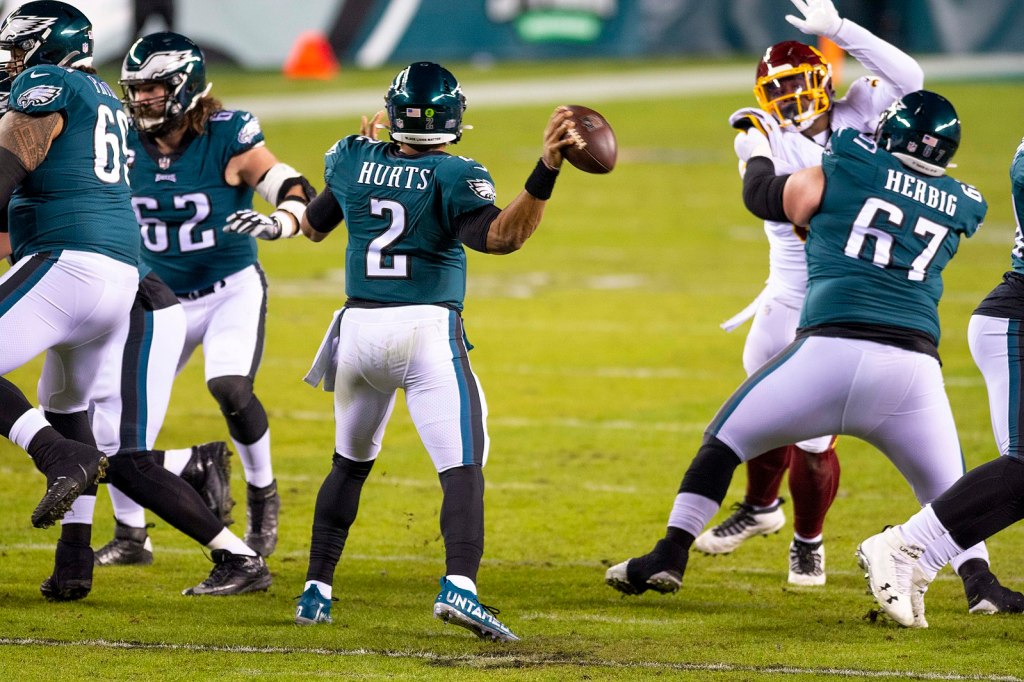
While I love watching football the broadcasts need some updating. (Photo Courtesy All-Pro Reels Photography)

I love football, but I think broadcasts could be improved on various fronts.

First, I realize those in charge are in a collective tizzy to shorten games. It seems younger folks don’t have the attention spans needed to stick around for anything longer than the average Instagram reel, so keeping them engaged is a monumental issue. In case you’re wondering, studies show that Gen Zers and Millennials can stay focused eight  and 12 seconds respectively, while Baby Boomers can pay attention for between 25 and 30 minutes. (Talk among yourselves.)

Since we older folks are dying off,  the NFL has been scrambling to make rule changes regarding timing and game pace, all to keep broadcasts under the golden three-hour mark. (Not sure why that’s the sweet spot, but there you have it.) Clearly, dumping some of the commercials might help, but I’m guessing that’s the last thing the league wants to do.

With all this in mind, the NFL decided that those pesky officials were not capable of speedily determining whether the ball had reached the line to gain. So, the guys on the sidelines holding the chains were told, “No more!” I know what you’re thinking. “But, Anne, AI is so much more accurate in regard to measurements.”

As a former amateur football referee, I’ve stared at the space between the ball and stick on myriad occasions. Note here: Not rocket science. It’s simply that the machine does it more quickly.  So now those sweet moments of anticipation preceding the ref’s announcement are gone, a bit of football pageantry eliminated. All in the interest of shaving a little time off the clock.

A better option is eliminating the two-minute warning, a rule that is archaic and completely unnecessary with all those clocks pasted onto our stadiums and screens. I’ll let my AI friend handle it here:  “The two-minute warning is a legacy rule that remains because it provides a scheduled commercial break…” There is also something about it building game-end drama and a shift to endgame rules, none of which I’m buying. So, if only advertisers would miss it, why not dump the two-minute warning and save some time?

Another change I’d like to see involves reporters on the sidelines, which of course is the most useless “sportscasting” job there is. The only reason the position exists is so the networks can point and say, “Look how diverse our crew is!” That’s because it’s mostly women manning those mics. I say give those girls a shot in the booth or as commentators on those pre-halftime-and-post-game shows. Here’s where you’ll remind me that there are women on those programs and you’d be right. But why are they generally the ones asking the questions and not those giving the answers? Do the networks doubt women can provide pithy, clever comments about football? And don’t say it’s because they never played football. There are plenty of male sports reporters who never played either. That said, the only real reason to have announcers on the sidelines involves player injuries. So I say scrap the reporters, grab a few nurses, mic them up, and let medical professionals do the updates.

Don’t get me wrong. I love watching football, but the broadcasts can be better. Here’s hoping someone is listening. I’ll let you know whan I have some more good ideas.

Wolf Catcher

Anne Montgomery

Historical Fiction

In 1939, archeologists uncovered a tomb at the Northern Arizona site called Ridge Ruin. The man, bedecked in fine turquoise jewelry and intricate bead work, was surrounded by wooden swords with handles carved into animal hooves and human hands. The Hopi workers stepped back from the grave, knowing what the Moochiwimi sticks meant. This man, buried nine hundred years earlier, was a magician.

Former television journalist Kate Butler hangs on to her investigative reporting career by writing freelance magazine articles. Her research on The Magician shows he bore some European facial characteristics and physical qualities that made him different from the people who buried him. Her quest to discover The Magician’s origin carries her back to a time when the high desert world was shattered by the birth of a volcano and into the present-day dangers of archeological looting where black market sales of antiquities can lead to murder.

Universal Book Link

Amazon

Apple Books

Barnes and Noble

Google Books

Rakuten Kobo

Bookstores, libraries, and other booksellers can order copies directly from the Ingram Catalog.

Anne Montgomery’s novels can be found wherever books are sold.

Goodreads

Amazon

Football: Too much of a good thing?

I can’t believe I’m about to say this, but I must. I, Anne Montgomery, am getting sick of football.

I spent almost 40 years as an amateur football official, so I never imagined I could get tired of the game.

I know what you’re thinking. Clearly, I must have hit my head since football was a big part of my world for such a long time. I routinely covered football as a sports reporter, and was even the beat reporter for the Arizona Cardinals when I worked in television in Phoenix. That means I covered their games and practices, and was expected to know everything that was happening with the team on a daily basis. On top of that, I officiated amateur football for about 40 years, 24 of which I spent as a high school referee and crew chief.

So what gives?

I am old enough to remember the kinder, gentler days of football, when one could expect games on a simple timetable that even a child could comprehend. High school football reined mostly on Friday nights, Saturday was college ball, and the NFL took charge on Sundays. Of course, pro ball changed a bit in 1970 when the first Monday Night Football game aired, but that didn’t seem too overwhelming at the time.

Today, however, there is almost no escaping football. The NFL bled into Thursdays in 2006, which in my opinion is barbaric. How is it even remotely fair to make teams play just four days after suiting up for a Sunday game? Feel free to laugh when the league says the health and well-being of its players are of utmost importance.

In olden times, there were two time slots for pro games, quaintly referred to as the early game and the late game. Now, we sometimes have an early-early game—a 9:30 AM EST matchup courtesy of NFL Europe—as well as a Sunday night contest.

And college football has expanded as well. Now, instead of ruling just on Saturdays, you can catch games on Tuesday, Wednesday, Thursday, and Friday. But don’t worry, the NCAA cares deeply about the student-athletes who represent State U. I’m sure all those kids are making it to their classes.

As a sports reporter, I covered football for years, but now my love for the game seems to be waning.

Perhaps you are now scratching your head and wondering why football has literally taken over every night of the week. And I bet you know the answer. (See what I did there?) Though no one is saying so, the idea that we are all free to gamble on the game has made more football equate to more money. Tons of it.

According to the American Gaming Association, it’s estimated that approximately $35 billion will be wagered on the NFL with legal sports books this year, 30% more than last season. The NCAA, meanwhile, is rather opaque in regard to how much legalized gambling on football brings into its confers annually, but I’d wager the sum is easily in the billions.

Note that 48% of sports gamblers are 18-to-34-year-olds, and according to the NCAA’s own 2023 study, 67% of 18-to-22-year-olds had engaged in sports betting in the previous year. But the ruling body in the college sports world says not to worry.  Last March the organization announced that, “The NCAA’s longstanding efforts regarding sports wagering, which aim to protect the well-being of student-athletes and the integrity of competition, continue to evolve alongside the (gambling) industry’s rapid growth.”

Well, now I feel better. Don’t you?

Humans love things that are rare. Which football used to be say in comparison to the pretty endless Major League Baseball season. The NFL had just 16 regular season games, before a 17th matchup was added in 2021. Still, the relatively short football season was something to look forward to. The anticipation—for you younger readers who are used to instant gratification, look it up—was delicious as we waited for that opening kickoff.

So, why am I getting tired of football? It’s like anything else we can do anytime we want. It becomes a case of too much of a good thing. After a while, the shine wears off. Simply put, football has lost its sparkle. But I haven’t given up on the game yet. I’m holding on. Here’s hoping my passion returns.

Your Forgotten Sons

Inspired by a true story

Anne Montgomery

Bud Richardville is inducted into the Army as the United States prepares for the invasion of Europe in 1943. A chance comment has Bud assigned to a Graves Registration Company, where his unit is tasked with locating, identifying, and burying the dead. Bud ships out, leaving behind his new wife, Lorraine, a mysterious woman who has stolen his heart but whose secretive nature and shadowy past leave many unanswered questions. When Bud and his men hit the beach at Normandy, they are immediately thrust into the horrors of what working in a graves unit entails. Bud is beaten down by the gruesome demands of his job and losses in his personal life, but then he meets Eva, an optimistic soul who despite the war can see a positive future. Will Eva’s love be enough to save him?

Release Date: June 6, 2024

Universal Buy Link

Amazon

Apple Books

Barnes & Nobel

Google Books

Kobo

Bookstores, libraries, and other booksellers can order copies directly from the Ingram Catalog.

Anne Montgomery’s novels can be found wherever books are sold.

Goodreads

Amazon

.

Life after sports: Athletes need to have a plan

Like a lot of sports fans, I’ve been thinking about Miami Dolphins quarterback Tua Tagovailoa who suffered his third NFL concussion in a recent game against the Buffalo Bills. Understandably, the question now is whether the 26-year-old should continue donning a helmet.

Dec 27, 2021; New Orleans, Louisiana, USA; Miami Dolphins quarterback Tua Tagovailoa (1) calls for the ball from center Michael Deiter (63) against New Orleans Saints during the first half at Caesars Superdome. Mandatory Credit: Stephen Lew-USA TODAY Sports

In recent years, the medical community has shined a light on the devastating effects concussions can have on a person’s quality of life. The links between Chronic Traumatic Encephalopathy (CTE), Amyotrophic Lateral Sclerosis (ALS), Alzheimer’s, and dementia are frightening clear. Note that in the case of CTE, the degenerative brain disease has been confirmed through autopsies in 345 out of 376 former NFL players.

Logic would dictate that Tua—who has guaranteed compensation to the tune of $167 million dollars, though exactly how much he would retain is not yet clear—should retire, especially considering that he has a wife and two young children. And yet, Tua says he wants to play again.

Dr. Myron Rolle, an American neurosurgeon and Rhodes Scholar who is currently doing a Pediatric Neurosurgery Fellowship at John’s Hopkins, shared the following on Instagram. “I would hate to see him fall down this pathway of wanting to play this sport, wanting to be tough for your teammates, wanting to be on the field, wanting to not disappoint people…I hope we can get to him…to speak life into him and protect him from himself. For him, it’s time to step away. It’s time to rest and recover and to put away any ideas of retuning to play.”

Note that Rolle understands Tua’s world more than you might expect. The former safety played football at Florida State, then spent three seasons in the NFL with the Tennessee Titans and the Pittsburg Steelers, before he retired and turned to medicine. I heard him speak in a CNN interview recently where he admitted that he also had a difficult time hanging up his cleats, even though he had another career waiting for him.

It was that last part that caught my attention. That Rolle had a plan for the years after football. Which made me wonder how many young athletes have the foresight to see beyond the game to a time when their skills and bodies decline and they are no longer competitive, but when they have many more years to live.

Dr. Myron Rolle, a former NFL player turned neurosurgeon, understands Tua Tagovailoa’s desire to stay in the game, but is hoping the quarterback will retire.

As a former high school teacher, I can’t count the number of times teenage boys insisted that their only goal was to play professional football, basketball, or baseball. I would then gently point out that those few who make it to the pros rarely play more than four years. “What do you want to do after that?” I’d say. Blank stares were all I got in return.

I looked into Rolle’s background to see what made him different. I smiled when I read that on top of participating in high school football, basketball, and track, he sang in a school theater production, played saxophone in the band, and was the sports editor for the student newspaper.

Why is this important? It shows that Rolle had interests outside of playing sports, something I always recommended to my students. Participating in extracurricular activities can help young people move toward careers they might enjoy, an especially important idea for young athletes, since the vast majority of them will never play a team sport after high school.

Now consider college athletes who often spend up to 40 hours a week practicing, working out, playing, and traveling. When that commitment ends—as it will for 98% of them—what happens next? Are schools encouraging them to branch out and consider life after sports?

I will now share two personal examples, both of which took place when I was teaching sports reporting at Arizona State’s Walter Cronkite School of Journalism. I’d expected to see some football players in my class, or at least some walking around the department, but I did not. My boss eventually told me that the coach forbade his players from taking any of our courses for fear they would fail a class and lose their eligibility. Similarly, one of my students explained that her lacrosse coach recommended she forgo my class for the same reason, but she wanted to be a sports reporter, so she took it anyway. I doubt ASU is any different from most universities that seem to value the athlete more than the student.

One wonders if the NFL, which teaches rookies about player agents, finances, education, drugs and steroids, alcohol and HIV prevention, might also prepare them for life after football. Somehow, I doubt it. But wouldn’t it be nice if they did?

So perhaps it’s left up to high school teachers—and lets not forget parents—to encourage young athletes to diversify their interests, so that when the end of their sports lives eventually comes, they will be prepared to meet a fulfilling future.

Your Forgotten Sons

Inspired by a true story

Anne Montgomery

Bud Richardville is inducted into the Army as the United States prepares for the invasion of Europe in 1943. A chance comment has Bud assigned to a Graves Registration Company, where his unit is tasked with locating, identifying, and burying the dead. Bud ships out, leaving behind his new wife, Lorraine, a mysterious woman who has stolen his heart but whose secretive nature and shadowy past leave many unanswered questions. When Bud and his men hit the beach at Normandy, they are immediately thrust into the horrors of what working in a graves unit entails. Bud is beaten down by the gruesome demands of his job and losses in his personal life, but then he meets Eva, an optimistic soul who despite the war can see a positive future. Will Eva’s love be enough to save him?

Release Date: June 6, 2024

Universal Buy Link

Amazon

Apple Books

Barnes & Nobel

Google Books

Kobo

Bookstores, libraries, and other booksellers can order copies directly from the Ingram Catalog.

Anne Montgomery’s novels can be found wherever books are sold.

Goodreads

Amazon

.