The youth sports landscape is crumbling

We have forgotten the point of youth sports, and if we don’t alter our behvior someday there may be no youth sports at all.

Recently, I found out that a long-time sports reporter friend is, for now, hanging up his microphone.

“Lately the landscape has had its share of toxicity, with overzealous parents and poor leadership coupled with unsavory social media standards, which has now led to me taking some time away from broadcasting! My decision,” he said in a Facebook post.

This man spent 45 years covering sports, especially high school sports.

While I am saddened that he’s stepping down, I understand his frustration. Amateur sports, especially youth sports, has become a mess in the last decade or so. Why? There are a number of reasons.

First, I’ll blame parents who have ridiculous expectations. The number of adults who believe their child will earn a DI scholarship and go onto the pros borders on the bizarre. Less than two-percent of high school athletes will play at NCAA Division I schools, and just one percent receive full-ride scholarships, funds that are awarded for just one year, so if a kid breaks a leg or struggles in the classroom, bye-bye sports dreams.

And then what? Parents who put their kids on the year-long, one-sport merry-go-round, spending what could amount to college tuition on personal coaches, deny their children the chance to branch out and grow. Maybe play an instrument, or perform in a play, or even participate in a different sport, things they should be doing throughout high school. This single-mindedness will doom their children when they can no longer participate in the single thing that occupied their lives. Every athlete has to stop playing at some point. Something that tends to happen when we’re young. As I often mentioned to my students who insisted they would one day be professional athletes, “What happens after that? The average professional career lasts between three and six years. What will you do then?”

Before I go on, note that I spent 40 years officiating amateur sports. I called ice hockey, soccer, and basketball games, but spent the vast majority of my time on football and baseball fields. I realize today how lucky I was that much of my career came before the advent of social media, which has made calling games a nightmare. It used to be that when I made a mistake—Yes, all officials do, just like players and coaches.—the hysteria and verbal assaults were pretty much over when I left the field. Today, however, fans splash video and photos of calls they dislike all over the Internet, often implying the official made the errant call intentionally to benefit a team. Trust me. No official wants to make a bad call. We just do. Sometimes we’re tired from working our day jobs, or we’re hungry, or we just blink. Those of us in the amateur ranks only get one look at a play. There aren’t replay officials or nine-camera angles to check. And yet, we are required to be perfect, which is simply impossible.

Recent studies show that approximately 45% of officials say they have feared for their safety because of the behavior of administrators, players, and fans. One in three officials have received threats or felt unsafe at a game, something I understand since I have, on occassion, required a police escort to my car. So, is it any wonder that roughly 50% of new officials quit within their first two years? Myriad games are being cancelled at youth levels because of a dearth of officials. And this trend will get worse.

Here’s what needs to happen, though I won’t hold my breath. We need to remember the real purpose of kids sports. Children learning teamwork and punctuality, how to follow rules, goal-setting, social skills, and resilience. And, perhaps, most importantly, leadership skills. All of which will make them better human beings.

Maybe, if we adults adjust our expectations the miasma surrounding youth sports will clear. And then my friend will once again pick up his microphone and go back to the thing he loves.

Your Forgotten Sons

Inspired by a true story

Anne Montgomery

Bud Richardville is inducted into the Army as the United States prepares for the invasion of Europe in 1943. A chance comment has Bud assigned to a Graves Registration Company, where his unit is tasked with locating, identifying, and burying the dead. Bud ships out, leaving behind his new wife, Lorraine, a mysterious woman who has stolen his heart but whose secretive nature and shadowy past leave many unanswered questions. When Bud and his men hit the beach at Normandy, they are immediately thrust into the horrors of what working in a graves unit entails. Bud is beaten down by the gruesome demands of his job and losses in his personal life, but then he meets Eva, an optimistic soul who despite the war can see a positive future. Will Eva’s love be enough to save him?

Release Date: June 6, 2024

Pre-Order your copy today

Amazon

Apple Books

Barnes & Nobel

Google Books

Kobo

Review a copy early by going to NetGalley. Sign in here.

Bookstores, libraries, and other booksellers can order copies directly from the Ingram Catalog.

Anne Montgomery’s novels can be found wherever books are sold.

Goodreads

Amazon

A teacher’s tale: Foster care gave me a family I never expected

Thanks to the foster care system, I became a mom at 55. Today my son Brandon has also given me a grandson, Adrian.

Fifteen years ago, a small frightened boy called me. “I’m hungry,” he said.

Now let me backtrack a bit.

I taught in a Title I high school for 20 years, a designation signifying that a large segment of the student population lives below the poverty line. As you might expect, the hardships are many and can have life-long ramifications. Consider substandard housing, lack of child care, homelessness, gangs, hunger, neglect, addiction, unsafe neighborhoods, and underfunded schools.

As a teacher, I learned to consider what might be happening in the lives of the children I served. I and many of my fellow educators understood that a student who hadn’t slept or eaten or bathed might put the idea of completing homework on time way down the list of important things to do. So, we addressed those issues when we could.

Understandably, we worried about our students, especially as summer break approached. Some of our kids had little food at home, which during the school year we supplemented with free breakfast and lunch and a pantry where they could get food boxes, when needed. I also struggled with the idea that ten weeks of unstructured living might lead children to take risky chances. With that in mind, I always put my phone number on the board on the last day of school.

“If you find yourself in a tough situation and don’t know what to do, call me,” I told my students. “I’ll help you if I can.”

When Brandon phoned that day, he started me on a journey I could have never anticipated. He’d been placed in foster care and was living in a group home. Note here that few people want to take in teenagers, especially boys. As you might expect, many are only interested in babies and toddlers, so older kids often languish in the system.

Here is where I’ll mention that I was never able to have biological children, an issue that plagued me for a decade or so, but by my mid-fifties when I got that call I had long given up on ever being a mom. Then, in what felt like an instant, a hungry child had me considering the empty bedrooms in my home. I called foster care, was directed to Foster Mom School—Yep it’s a thing.—and two weeks later that frightened boy was delivered to my doorstep.

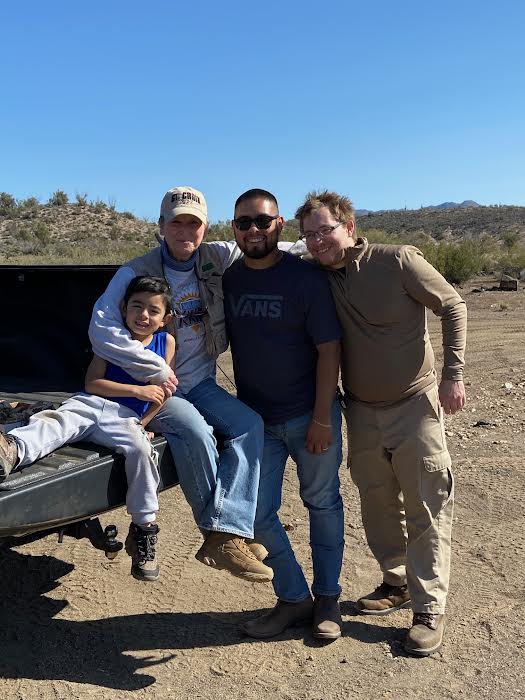
The foster care system gave me a family I never expected. Here are my grandson Adrian and my boys Brandon and Troy.

Was it easy? No! The trauma that puts a child into foster care, as well as a system that pushes kids from home-to-home, leave an indelible mark. I often hear people say that if you love a child enough everything will be fine, but that is simply not the case. That said, I am eternally grateful for the the heroes who taught those foster-parent classes, the social workers who kept tabs on me and Brandon, and the psychologists who helped us sort out our differences.

Fifteen years ago a frightened child moved into my home. Now, Brandon will soon be 30 and is a father himself. A grown man who continually makes me proud. I must mention here that Brandon started me on a track that would eventually have seven young people live in my home. Though they were not all legal foster children, every one of them was in need of a spot to tread water, a place to calmly figure out where they were going, and then make that jump into the world.

Today, I am immensely grateful for the opportunity I’ve had to participate in these young lives. Like any parent, I watch them from a front row seat and marvel at their sucesses. And I have assured them that no matter how grown up they become, I’ll be here for them.

I must admit that I never expected to find such joy in being called “Mom”. I wouldn’t have missed it for the world.

Your Forgotten Sons

Inspired by a true story

Anne Montgomery

Bud Richardville is inducted into the Army as the United States prepares for the invasion of Europe in 1943. A chance comment has Bud assigned to a Graves Registration Company, where his unit is tasked with locating, identifying, and burying the dead. Bud ships out, leaving behind his new wife, Lorraine, a mysterious woman who has stolen his heart but whose secretive nature and shadowy past leave many unanswered questions. When Bud and his men hit the beach at Normandy, they are immediately thrust into the horrors of what working in a graves unit entails. Bud is beaten down by the gruesome demands of his job and losses in his personal life, but then he meets Eva, an optimistic soul who despite the war can see a positive future. Will Eva’s love be enough to save him?

Release Date: June 6, 2024

Universal Buy Link

Amazon

Apple Books

Barnes & Nobel

Google Books

Kobo

Bookstores, libraries, and other booksellers can order copies directly from the Ingram Catalog.

Anne Montgomery’s novels can be found wherever books are sold.

Goodreads

Amazon

Parents: Please rethink those school-year vacations

Vacations are fun, but if you’re planning to take your kids out of school for one, you might want to reconsider.

A story on the news the other day had me reaching for heavy objects to throw at the TV. The reporter was interviewing two sets of parents, both of whom thought it was just peachy to remove their kids from school to take family vacations.

I wanted to scream!

Now, before I express my concerns, please note that I understand taking a few days off in the event of a death or family illness, but the idea of dragging the kids to Disney World or Six Flags for some family fun—which is what the parents were suggesting—when the kids should be in school is just plain dumb.

Both mothers explained that since prices at the theme parks drop after summer, taking their offspring out of school should be perfectly fine. One even suggested that keeping children on a school schedule is too difficult, one that leads to their little darlings becoming bored. “Kids just going to school and home and back and forth gets really repetitive.”

So you know where my allegiance lies and in the interest of full disclosure note that I spent 20 years running a classroom. And I sometimes faced students who casually informed  me that they would be gone for a week or two because of a party or wedding. I knew what the extended absence meant for them and me. Said child would fall behind and it would be my job to catch them up.

If the student in question was on top of their studies and they agreed to take work with them on vacation, often the damage would be negligible. But, more often than not, the student would already be behind, mostly because of already missing too many school days, which is the natural outcome when school isn’t considered a priority. When adults make education secondary to vacations, children get the point loud and clear.

When you take your child out of school for a family vacation, it’s the teacher who has to get them caught up on the work they missed.

Here’s where I hear folks saying, “Parents know what’s best for their kids!” But I can’t help but opine that it’s the parents who are bored and are projecting their feelings onto their children.

School is a time to grow and discover what we’re good at, which hopefully leads to a career we enjoy. The daily schedule also prepares young people for life in the business world. Or at least it should. I recall my daughter with a sour look on her face when she discovered that when one has a fulltime job there are generally no summer vacations. Or fall, winter, and spring breaks.

“That’s not fair,” she said with a pout.

Sigh…

The thing is…children see what adults do and copy their behavior. If the parents instill the idea that school is of secondary importance to a fun vacation or family party, the kids will grow up with that attitude.

So, parents, please give that family fling at Disneyland a second thought if it’s during the school year. If not for your child for their teacher. Because, as I mentioned, it’s those of us who helm a classroom who have to scramble to pick up the pieces of your child’s education when you trot them off to ride roller coasters instead of being in school.

Anne Montgomery’s novels can be found wherever books are sold.

Goodreads

Amazon