Writing historical fiction can be fascinating and frustrating, an effort that often feels like digging for buried treasure. Sometimes you find what you’re looking for. Other times the facts are elusive. And then there are the moments when intriguing new evidence emerges, details that put your story in a new light.
That was the case in regard to my most recent book, Your Forgotten Sons, a story inspired by Sergeant Joseph “Bud” Richardville, who served in the Graves Registration Service in Europe during World War II, arguable the most difficult assignment in the military. Bud and his men were tasked with the job no soldier wanted: locate, identify, and bury the dead.
But there was another side of Bud’s story. A love story. In fact, quiet family rumors suggested there may have been two women in Bud’s life.
During the course of my research, I learned about Allotment Annies, women who married men just as they were headed off to war. My thanks to Linda Pennell, a fellow historical fiction author, for sharing my story on her website History Imagined
Bud Richardville is inducted into the Army as the United States prepares for the invasion of Europe in 1943. A chance comment has Bud assigned to a Graves Registration Company, where his unit is tasked with locating, identifying, and burying the dead. Bud ships out, leaving behind his new wife, Lorraine, a mysterious woman who has stolen his heart but whose secretive nature and shadowy past leave many unanswered questions. When Bud and his men hit the beach at Normandy, they are immediately thrust into the horrors of what working in a graves unit entails. Bud is beaten down by the gruesome demands of his job and losses in his personal life, but then he meets Eva, an optimistic soul who despite the war can see a positive future. Will Eva’s love be enough to save him?
Five years ago, my dear friend Regina Liparoto and I began a journey, one dedicated to telling the story of her uncle, Sergeant Joseph “Bud” Richardville, a man who served in the Graves Registration Service during World War II. Bud’s job—no doubt one of the least appreciated and most harrowing in the military—required that he locate, identify, and bury the dead.
I learned Bud’s story through a packet of 75-year-old letters and family oral history, stories Regina collected throughout her life. The result was Your Forgotten Sons, a novel inspired by Bud and those with whom he served in the GRS that was released this past June 6th in honor of the 80th anniversary of D-Day.
Recently, I traveled to Indiana where I met with Regina and members of the Richardville family, descendants who gathered to remember the soldier they never knew, but one they wanted to welcome back home.
And here is where I’d like to thank the people at Vincennes PBS for being there as we honored Bud. You can find that story here.
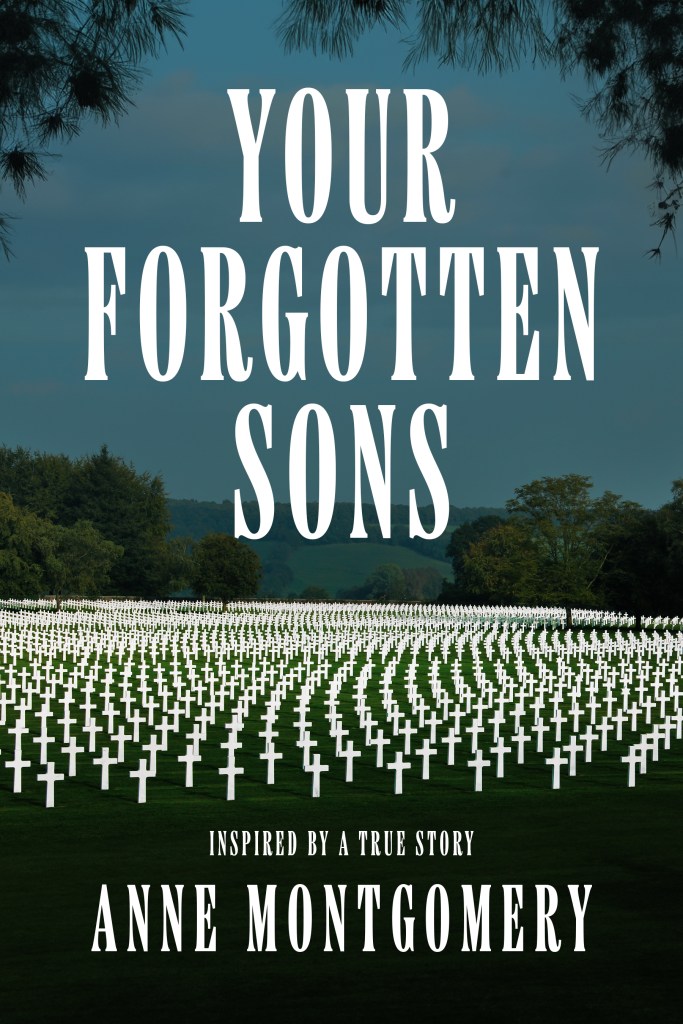
Your Forgotten Sons
Inspired by a true story
Anne Montgomery
Bud Richardville is inducted into the Army as the United States prepares for the invasion of Europe in 1943. A chance comment has Bud assigned to a Graves Registration Company, where his unit is tasked with locating, identifying, and burying the dead. Bud ships out, leaving behind his new wife, Lorraine, a mysterious woman who has stolen his heart but whose secretive nature and shadowy past leave many unanswered questions. When Bud and his men hit the beach at Normandy, they are immediately thrust into the horrors of what working in a graves unit entails. Bud is beaten down by the gruesome demands of his job and losses in his personal life, but then he meets Eva, an optimistic soul who despite the war can see a positive future. Will Eva’s love be enough to save him?
Bud Richardville married Lorraine, a woman he barely knew, right before heading off to war. But there were rumors of another woman who stole his heart.
There were quiet whispers of another woman in Sergeant Bud Richardville’s life. Someone he met while serving in the Graves Registration Sevice in Europe during World War II.
But Bud was married and Catholic.
My World War II historical fiction novel Your Forgotten Sons is set for release June 6, 2024 in honor of the 80th anniversary D-Day. While Bud’s story details the ordeals he and his men confronted as they gathered the dead, it also presents the moral delema he faced by loving two women.
Find below an excerpt of Bud’s story.
Luxembourg City
1945
Since it was midmorning, Bud opted for coffee and a croissant with a slice of white cheese and some jam. That the coffee was real was astonishing. The nutty, smoky aroma was almost overwhelming. And the pastry was warm and buttery, and Bud couldn’t remember the last time he’d eaten anything so delicious. He wanted another one, so he raised an arm to attract the waiter, but stopped when he sensed someone watching him. She stood on the other side of the ornate, cast-iron railing that enclosed the patio of the café. Again, she stared at Bud with those unblinking blue eyes.
“Hello.” Bud stood and smiled, dropping his napkin on the ground. Her bright red hair was uncovered and fell in short curls around her face. Freckles spread across her nose and cheeks. “We met at Malmédy.” Immediately, Bud wanted the words back, the horror of that place still fresh in his memory.
“I do not think we actually met.” Her English was laced with a British accent.
They stared at one another for a long time, until Bud, feeling awkward, broke the silence. “Can I offer you a cup of coffee?”
“Eva! How nice to see you!” The waiter smiled at the woman.
“Bonjour, Victor!” She smiled as well, and the change in her expression was startling.
Bud pulled out a chair at the table where he’d been sitting. Eva paused, seemingly unsure.
“Yes, yes! Have some coffee, Eva. It’s been such a long time. I had no idea you were back.” The man’s brow furrowed. “I hope everything is all right.”
She took a deep breath. “At least I am home now.”
Bud watched as she turned and walked away, and his heart unexpectedly sank until she stepped into the doorway that led to the interior of the patio. Then Eva walked to the table and sat.
Bud didn’t know what to say, and several moments ticked away. Victor broke the silence when he returned with a fresh pot of coffee, a cup and saucer, and two warm croissants balanced on a tray. He placed everything on the table and gave Bud a fresh napkin. Then he turned to Eva. “You are too thin, my dear. Eat!”
She nodded, a sad expression on her face. After Victor filled her cup and topped off Bud’s, the proprietor walked away, leaving the two strangers alone.
Bud watched Eva take a bite of the croissant. Her eyes closed briefly as she chewed.
“Exactly the way I remember it.” She placed her palm on her heart, and Bud noticed she was missing several fingernails and the index finger on her right hand, a ragged pink scar marking where the finger had once been. She saw Bud staring but kept her hand in place for a moment longer, as if wanting him to look at the damage, then she reached for the coffee cup.
“So…you live here?” Bud focused on his second croissant and slathered some jam on the pastry.
“I was born here. I am a Luxembourger.”
The appellation sounded funny to Bud, but he didn’t mention it. “Are you friends with the owner?” It was all he could think of to ask.
She raised her eyebrows, which were golden-red like her hair. “Victor?”
Bud nodded toward the window where the man was polishing glasses inside the café.
“Victor and my father were best friends. I used to come here when I was a child. When the café was slow, they’d play chess.” Her English was flawless. “And they’d give me breadcrumbs so I could feed the pigeons.” She gazed into the street. “Not so many birds now. The people had to eat them. Both my parents are also gone.” She smiled, but the expression was sad, so Bud remained quiet, unusually tongue-tied.
“Were you in medicine before the war?” Bud finally asked.
Eva pierced him with those icy blue eyes that were hard to read. “No. Were you?”
Bud laughed. “No, I worked in a paper mill. Why do you ask?”
She gave the smallest of shrugs. “You were working with the bodies.”
“I’m part of a graves registration company. I’m not really sure how I ended up there. Most of the men I work with have no medical training, though Doc is a veterinarian.”
Eva nodded. Then she stared toward the sidewalk, where a young couple walked past arm-in-arm. They smiled and spoke animatedly in French. She blinked several times as if remembering something.
“More coffee?” Victor stood nearby, and Bud could see a bright red stain on the man’s white apron, one that reminded Bud of blood but appeared to be strawberry jam.
“Thank you, yes?” Eva held out her cup.
“I’m so glad you’ve returned, Eva. You know, I worried.”
Eva reached out and grasped the man’s hand. “I know you did, Victor.”
He glanced at her damaged hand and proffered a sad smile.
Eva just nodded.
Bud wanted to ask what had happened to her, where her father and mother were, and what her life was like before the war, among a hundred other questions, but just the fact that he was dining with a woman who was not his wife seemed wrong. Then he felt silly. After all, it was only a pastry and a cup of coffee. What harm was there in that? And still, he felt unsettled, guilty.
Your Forgotten Sons
Inspired by a true story
Anne Montgomery
Release Date: June 6, 2024
Bud Richardville is inducted into the Army as the United States prepares for the invasion of Europe in 1943. A chance comment has Bud assigned to the Graves Registration Service where his unit is tasked with locating, identifying, and burying the dead. Bud ships out, leaving behind his new wife, Lorraine, a mysterious woman who has stolen his heart but whose secretive nature and shadowy past leave many unanswered questions. When Bud and his men hit the beach at Normandy, they are immediately thrust into the horrors of what working in a graves unit entails. Bud is beaten down by the gruesome demands of his job and losses in his personal life, but then he meets Eva, an optimistic soul who despite the war can see a positive future. Will Eva’s love be enough to save him?
Join us at Changing Hands Bookstore in Phoenix on June 6, 2024, for the lanuch of Your Forgotten Sons. Find out more about the event here.
I am delighted to announce that the launch for my new historical fiction novel Your Forgotten Sons will be held June 6, 2024—The 80th anniversary of D-Day—at Changing Hands Bookstore in Phoenix. And I couldn’t be more thrilled because TV icon Mary Jo West will be on hand to be the MC. Please come and join us at 300 West Camelback Road at 6:30 PM. Find out more about the event here.
Can’t wait to see you!
Your Forgotten Sons
Inspired by a true story
Anne Montgomery
Bud Richardville is inducted into the Army as the United States prepares for the invasion of Europe in 1943. A chance comment has Bud assigned to the Graves Registration Service where his unit is tasked with locating, identifying, and burying the dead. Bud ships out, leaving behind his new wife, Lorraine, a mysterious woman who has stolen his heart but whose secretive nature and shadowy past leave many unanswered questions. When Bud and his men hit the beach at Normandy, they are immediately thrust into the horrors of what working in a graves unit entails. Bud is beaten down by the gruesome demands of his job and losses in his personal life, but then he meets Eva, an optimistic soul who despite the war can see a positive future. Will Eva’s love be enough to save him?
Praise for Your Forgotten Sons
“Although a defty crafted work of original fiction, “Your Forgotten Sons” by Anne Montgomery is inspired by a true story. An original and inherently interesting read from start to finish, “Your Forgotten Sons” will prove to be an immediate and enduringly appreciated pick.” Midwest Book Review
“This was a quick, riveting read that really challenged me to think differently about our servicemen and women, especially those who take on the jobs that don’t get heroically depicted in the media or news…I really highly recommend this book to anyone that is looking for a different take on American history. I left it with a newfound appreciation for the unsung heroes.” Bekah C NetGalley
“This is the truth. It’s gritty and painful and bittersweet – and true. When you think you’ve read every perspective of WWII, along comes Bud to break your heart.” Bridgett Siter Former Military Reporter
“Anne Montgomery writes a strong story and I was hooked from the first page. It had a great concept and I enjoyed that this was inspired by a true story…It was written perfectly and I was invested in the story. Anne Montgomery has a great writing style and left me wanting to read more.” – Kathryn McLeer NetGalley
Approximately 73,000 Allied troops died during the Battle of Normandy. Did you ever wonder where all the bodies went?
There’s no way to sugarcoat it. My new historical fiction novel Your Forgotten Sons, which will be released on June 6, 2024 in honor of the 80th anniversary of D-Day, is necessarily gruesome. For those who have seen the first 24 minutes of Saving Private Ryan, or Apocalypse Now, or the more recent 1917, the violence of war is hard to ignore.
But can there be too much carnage in our artistic representations of battle? That probably depends on who you ask. I sense many young people, raised on bloodbath video games like Resident Evil, Mortal Combat, and Grand Theft Auto, might not find the graphic vestiges of war a big deal. Yet today’s average TV viewer—sheltered from the actual violent aftermath of crimes and war and natural disasters by anchors who warn them that “the following video might be disturbing” only to see anything remotely upsetting blurred out on the screen—perhaps might disagree.
The problem for me was trying to mitigate the horrors those in the Graves Registration Service experienced in World War II without discounting the morale-destroying realities of the consequences of battle. The job of the GRS was simple but ghastly: retrieve, identify, and bury the dead. Think about that for a minute.
For Sergeant Bud Richardville and his men who served in the GRS during the invasion of Normandy, the incredible brutality of the Battle of the Bulge, and beyond, their jobs were no doubt horrifying. It’s interesting, I think, that the efforts of these soldiers who labored to literally piece fallen soldiers back together to discern who they were in life and then lay them to rest in the elegant cemeteries they built, have been dismissed from history. Don’t believe me? When was the last time you even caught a glimpse of anyone in a movie caring for the dead. I’m guessing almost never, as war movies are about shooting and exploding bombs, fast-moving tanks and fighter planes, but rarely about the carnage left behind.
Not surprisingly, those who’ve served in the GRS have the highest rates of post-traumatic stress disorder in the military, psychological pressure that follows them the rest of their lives. And yet, they have rarely gotten praise for the grueling duties they performed. I read one startlingly sad description of a convoy of GRS soldiers who drove down a road in France where they encountered a unit of American soldiers. When those troops realized it was GRS men bearing the dead in their trucks, the soldiers turned their backs and looked away.
Initially, my goal in writing Your Forgotten Sons was to tell the story of Bud Richardville and his service to our country. But in the end, I wanted to shine a light on all the unsung heroes who toiled in the Graves Registration Service, who, despite the horrors of the tasks they were assigned, did their jobs with grace and honor.
Your Forgotten Sons
Inspired by a true story
Anne Montgomery
Bud Richardville is inducted into the Army as the United States prepares for the invasion of Europe in 1943. A chance comment has Bud assigned to a Graves Registration Company, where his unit is tasked with locating, identifying, and burying the dead. Bud ships out, leaving behind his new wife, Lorraine, a mysterious woman who has stolen his heart but whose secretive nature and shadowy past leave many unanswered questions. When Bud and his men hit the beach at Normandy, they are immediately thrust into the horrors of what working in a graves unit entails. Bud is beaten down by the gruesome demands of his job and losses in his personal life, but then he meets Eva, an optimistic soul who despite the war can see a positive future. Will Eva’s love be enough to save him?
Though I wanted to go to Europe to follow in the footsteps of Sergeant Bud Richardville, the pandemic made travel impossible.
When I first accepted the responsibility for telling the story of Sergeant Bud Richardville and his work in the Graves Registration Service during World War II, I intended to follow his footsteps, beginning with the area north of London where he was stationed in a castle as the Allied forces prepared for D-Day. I wanted to walk the beaches of Normandy and the forests of the Ardennes where the Battle of the Bulge was waged. And I wanted to visit the American Cemetery in Épinal France where Bud was laid to rest following his strange death near the end of the war.
But as I was considering my plans, a worldwide disruption occurred. The Covid-19 pandemic shut everything down and all of us in, leaving travel out of the question.
I have never written a book without studying the locations involved firsthand, an effort to capture the sights and sounds and smells of a story, so my initial thought was to put off writing the book until a later date. But as the lockdown dragged on, Bud’s story lured me in, almost demanding to be told.
So…I began writing, but every time I needed what I call “color”—meaning what Bud might have seen and sensed—I had to pause, because I had no notes reminding me of the color of the landscape or the smells in the air or the feel of crossing the English Channel.
Then, after a long period of frustration, I realized that I already had memories that would work in the telling of Bud’s story, recollections of my time living in the tiny country of Luxembourg. I was attending Miami University in Oxford Ohio when, near the end of my sophomore year, I passed a table in the student center. Glossy photos of castles, and rivers, and and rolling green hillsides were displayed, advertising the school’s small branch campus in Luxembourg. I was entranced!
Luxembourg is one of the most beautiful countries in Europe, and though I originally had no factual evidence that Sergeant Bud Richardville was deployed there, I made the country the backdrop for some of the scenes in my World War II historical novel Your Forgotten Sons.
I would spend six months living and studying in that small country, where in one day you could board a train for breakfast in France, have dinner in Belgium, then late-night drinks in Germany. The more I thought about my travels from my base in Luxembourg, the more I realized that I had perhaps already overlapped Bud’s trail.
Note that Bud’s military records were destroyed along with those of 80% of Army servicemen and women who were discharged between 1912 and 1960 in a fire in St. Louis in 1973, so the only way I was able to track him was through the postmarks on the fragile letters that were saved by his family and entrusted to me. Those stamps showed that Bud was most likely in England, France, Belgium, Germany, and Czechoslovakia.
Still, it made sense that Bud might have also been in Luxembourg, since the Luxembourg American Cemetery—built by the GRS and today holding over 5,000 American war dead—is located just outside the capital city. And so, though I had no physical evidence that Bud was actually in Luxembourg, I placed him there.
Then, just as the book was going to press, Gina—Bud’s niece and the driving force behind the book—sent me an obituary about Bud that had appeared in his hometown newspaper. It read, “He landed in France on D-Day and was with Hodge’s First Army as a member of the 606th Graves Registration Company. Action took him from France to Luxembourg, Belgium, Czechoslovakia, and Germany.” And there it was. Proof that Bud had been in Luxembourg.
Your Forgotten Sons will be launched June 6, 2024 in honor of the 80th anniversary of D-Day.
Your Forgotten Sons
Inspired by a true story
Anne Montgomery
Bud Richardville is inducted into the Army as the United States prepares for the invasion of Europe in 1943. A chance comment has Bud assigned to a Graves Registration Company, where his unit is tasked with locating, identifying, and burying the dead. Bud ships out, leaving behind his new wife, Lorraine, a mysterious woman who has stolen his heart but whose secretive nature and shadowy past leave many unanswered questions. When Bud and his men hit the beach at Normandy, they are immediately thrust into the horrors of what working in a graves unit entails. Bud is beaten down by the gruesome demands of his job and losses in his personal life, but then he meets Eva, an optimistic soul who despite the war can see a positive future. Will Eva’s love be enough to save him?
Was Bud Richardville’s wife an Allotment Annie? It’s quite possible that she was.
During World War II, American servicemen were confronted by many dangers on foreign soil, but they were also at the mercy of some homegrown risks: women who spent their time enticing men to marry them. These women seduced young servicemen—many of whom were naïve and away from home for the first time—into whirlwind marriages, just as they were about to ship out.
It would be discovered later that some of these women, who would be dubbed Allotment Annies, were married to multiple servicemen at the same time. Elvira Taylor is one of the few women to be prosecuted for what was essentially polygamy, after she was found to be married to six sailors at the same time. Taylor might have gotten away with her crime had two of those men not reportedly met in an Australian pub. There they did what men in love do. They took out photos of their wives, and were shocked to discover that they were married to the same woman.
But why would women marry multiple men during a war? The answer is simple: money! Wives of servicemen were issued a weekly allotment of $20, which doesn’t sound like much today, but back in 1945 was equivalent to almost $340. Multiply that by four and Elvira was pulling in $1360 a month. When you consider that the median income in the U.S. at that time was just $1,400 annually, you can see why women were tempted to game the system. On top of the weekly stipend, wives were entitled to a one-time death benefit of $10,000, which works out to about $170,000 today.
I’m now patting myself on the back for doing a little math—not my best subject—but the numbers are important in regard to Allotment Annies, women I will now defend, if only a little. High-paying job opportunities were practically nonexistent for women at that time. Though they toiled in factories and in other sectors for the war effort, I’m sure many realized that when the boys came home, their time in the workforce would end. They’d had a taste of earning and managing their own money, and no doubt many chaffed at going back to being dependent on men for an income.
We will never know just how many women married servicemen for the paychecks and death benefits, but the issue was well-known to the military which produced videos warning men about the practice. Even Hollywood got into the act with the 1945 film noir release of Allotment Wives, a story about an Army investigator who tries to stop a woman from preying on unsuspecting soldiers.
I mention Allotment Annies because over the course of my research for my World War II historical novel Your Forgotten Sons, I became convinced that I’d found one. The book, inspired by a true story, traces the path of Sergeant Bud Richardville who was inducted into the Army in 1943 as the United States prepared for the invasion of Europe. He met a woman named Lorraine—at least that’s what she told him—and they were quickly married before he deployed.
The marriage would cause Bud great pain and confusion, and it wouldn’t be until years later, long after both Bud and Lorraine were dead, that questions about the union were broached. Had Bud married an Allotment Annie? And why is it that records indicated there was never a marriage, even though Lorraine received and cashed his allotment checks? Bud writes about his “wife” constantly in his letters. Clearly he believed he was married to Lorraine, but so apparently were two other men. Whether these marriages overlapped is unclear, but in those days divorce was practically unheard of, so multiple marriages would certainly have been looked upon with suspicion.
One wonders about the mindset of the women who duped unsuspecting servicemen into marriage as they headed off to war. Were they desperate, greedy, or just cruel? It’s unlikely we will ever know.
Your Forgotten Sons
Inspired by a true story
Anne Montgomery
Bud Richardville is inducted into the Army as the United States prepares for the invasion of Europe in 1943. A chance comment has Bud assigned to a Graves Registration Company, where his unit is tasked with locating, identifying, and burying the dead. Bud ships out, leaving behind his new wife, Lorraine, a mysterious woman who has stolen his heart but whose secretive nature and shadowy past leave many unanswered questions. When Bud and his men hit the beach at Normandy, they are immediately thrust into the horrors of what working in a graves unit entails. Bud is beaten down by the gruesome demands of his job and losses in his personal life, but then he meets Eva, an optimistic soul who despite the war can see a positive future. Will Eva’s love be enough to save him?
I almost got tripped up a few times, when writing about World War II Jeeps.
My new book, Your Forgotten Sons, is a work of historical fiction, a story inspired by Sergeant Joseph “Bud” Richardville who worked in the Graves Registration Service in Europe during World War II.
As many authors know, writing about the past can be tricky. One reason is we tend to look at history through our own modern-day lens. For example, when I was writing about Bud, I often had him riding in a Jeep. Today, Jeeps are ubiquitous on civilian roadways, but the origins of the vehicle are steeped in war.
Scripps Howard WWII reporter Ernie Pyle once said of the Jeep, “It did everything. It went everywhere. Was as faithful as a dog, as strong as a mule, and as agile as a goat. It constantly carried twice what it was designed for and still kept going.”
No doubt current Jeep owners prize the vehicle for many of the same attributes. The problem comes when one sees a Jeep and misses the evolution that led to today’s version. When I first wrote Your Forgotten Sons, I had Bud starting a Jeep with keys and adjusting the rearview mirror. Oops! Jeeps back then started with a pushbutton and the vehicles had no review mirrors.
I also had Bud and his fellow soldiers eating K-rations, but I would learn that he and his peers actually consumed C-rations. What’s the difference? K-rations were heavy, having been designed for static warfare, like the trench battles of World War I. But World War II was a different type of war, with fast-moving trucks and tanks and parachute troops who needed lighter combat rations, because soldiers were constantly on the move.
When I first envisioned Bud, I saw him in a green T-shirt, the iconic color of the Army. Today, Army personnel wear undershirts defined as Tan 499 which has a slight green tint to it, a shade referred to as “coyote”. But in Bud’s time, the plain, white cotton T-shirt was what all male service members sported.
When writing about the World War II era, I had to pay close attention to the facts. Luckily, the time is well documented with videos, and photographs, and eye-witness accounts. But consider writing about periods that go way back in history. My novel Wolf Catcher takes place in both modern times and the 11th century in what would become Arizona. I once wrote a scene where Native people used honey to sweeten their food, which could never have happened, because it was not until the early 1600s that European settlers first brought honey bees to the Americas.
It’s clear, then, that when authors choose to write stories based on history, they need to be meticulous in their research.
I’m working on it.
Your Forgotten Sons
Inspired by a true story
Anne Montgomery
Bud Richardville is inducted into the Army as the United States prepares for the invasion of Europe in 1943. A chance comment has Bud assigned to a Graves Registration Company, where his unit is tasked with locating, identifying, and burying the dead. Bud ships out, leaving behind his new wife, Loryane, a mysterious woman who has stolen his heart but whose secretive nature and shadowy past leave many unanswered questions. When Bud and his men hit the beach at Normandy, they are immediately thrust into the horrors of what working in a graves unit entails. Bud is beaten down by the gruesome demands of his job and losses in his personal life, but then he meets Eva, an optimistic soul who despite the war can see a positive future. Will Eva’s love be enough to save him?
In 1943, Sergeant Bud Richardville left a new wife and headed off to World War II to serve in the Graves Registration Service. But he never came back and questions about his death lingered for 75 years.
Joseph “Bud” Richardville was not very different from the millions of other young men who served in the U.S. military in World War II. He came from rural Indiana, where his family lived in poverty, a hangover from the Great Depression. He knew little about the world outside of Vincennes, but as the inevitability of the coming conflict became clear, Bud moved to Michigan to work in the paper mills, an industry that was essential to the war effort and which kept him stateside until he was drafted in 1943.
When Bud boarded the train for Camp Warren, Wyoming that summer, he was 29 and found himself riding with other soon-to-be soldiers who were mostly kids, many still in their teens, some excited to be away from home for the first time, others quiet, perhaps fearing what was to come.
Once at bootcamp, Bud was assigned to the Graves Registration Service. Family stories indicate that when Bud was young he’d periodically been called upon to help remove the corpses of those who’d fallen from the trains that trundled through his neighborhood, travelers who’d jumped aboard, hoping for a free ride, but who’d slipped and fallen to their deaths. Perhaps he’d mentioned this fact during his induction at Camp Warren and that familiarity with the dead colored the decision to place him in a GRS. Bud would serve in the 606 Graves Registration Company where he and his brethren were tasked with locating, identifying, and burying the dead.
Sgt.Bud Richardville died just after the German’s surrendered in 1945. He lies in the American Cemetery inÉpinal, France.
Think about that for a moment, and consider that the gathering of war dead is an undertaking that seems to have been erased from history. Consider all of those war movies where soldiers are mowed down on the beaches of Normandy or are mortally wounded on foreign battlefields, young men, some blown to pieces. But once their deaths are confirmed, the camera moves forward, ignoring the carnage.
It was left to those in the Graves Registration Service to gather up the horrific aftermath of battle in the hope of making some order out of all that death. They did their utmost to retrieve and identify the fallen and design and build the cemeteries that would hold their remains. Today, about 130,000 American war dead are said to be buried on foreign soil, men and women who were laid to rest with the reverence they deserved, because of the dedication of those in the GRS.
The efforts of Bud and his men additionally served another vital purpose: morale. As wave after wave of soldiers hit those Normandy beaches, the dead had to be collected quickly, so as not to traumatize the incoming troops. It is not hyperbole to say that the job of those in the GRS is perhaps one of the most difficult and least appreciated in the history of military service. And it is easy to understand the torment many of these soldiers, including Bud, faced for the rest of their lives.
It is ironic, perhaps, that Bud’s final resting place would be in the American Cemetery in Épinal, France, where he was buried by his brothers who also served in the GRS.
Your Forgotten Sons
Inspired by a true story
Anne Montgomery
Bud Richardville is inducted into the Army as the United States prepares for the invasion of Europe in 1943. A chance comment has Bud assigned to a Graves Registration Company, where his unit is tasked with locating, identifying, and burying the dead. Bud ships out, leaving behind his new wife, Lorraine, a mysterious woman who has stolen his heart but whose secretive nature and shadowy past leave many unanswered questions. When Bud and his men hit the beach at Normandy, they are immediately thrust into the horrors of what working in a graves unit entails. Bud is beaten down by the gruesome demands of his job and losses in his personal life, but then he meets Eva, an optimistic soul who despite the war can see a positive future. Will Eva’s love be enough to save him?


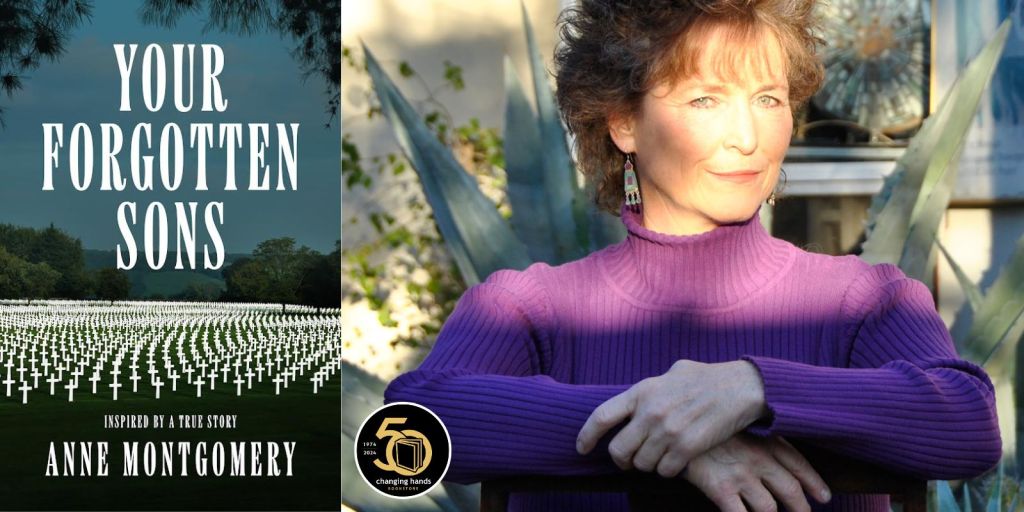



 Author Anne Montgomery