Your Forgotten Sons: The origin story

Authors get ideas for books in a variety of ways. In my case, since I’m a former reporter, the topics for my novels often came from stories I read about in the paper or watched on the news, subjects, discoveries, or societal issues that intrigued me, inviting me to learn more about them.

My most recent novel, however, came to me in a different way. My friend was in trouble, a health issue that, if things went wrong, would have had disastrous results, possibly paralyzing her from the waist down. She asked for my help. And then, the night before the surgery, she made a strange request.

“No matter what happens to me, promise that you’ll tell Bud’s story,” Gina said.

“A book?”

My friend of 40 years nodded and, despite what she was facing the next morning, she smiled.

How could I say no?

The blog Women Writers, Women’s Books asked me to write about how my World War II historical fiction novel Your Forgotten Sons—which was released June 6th in honor of the 80th anniversary of D-Day—came to be and the pitfalls I faced in my efforts to tell the story.

Find that article here.

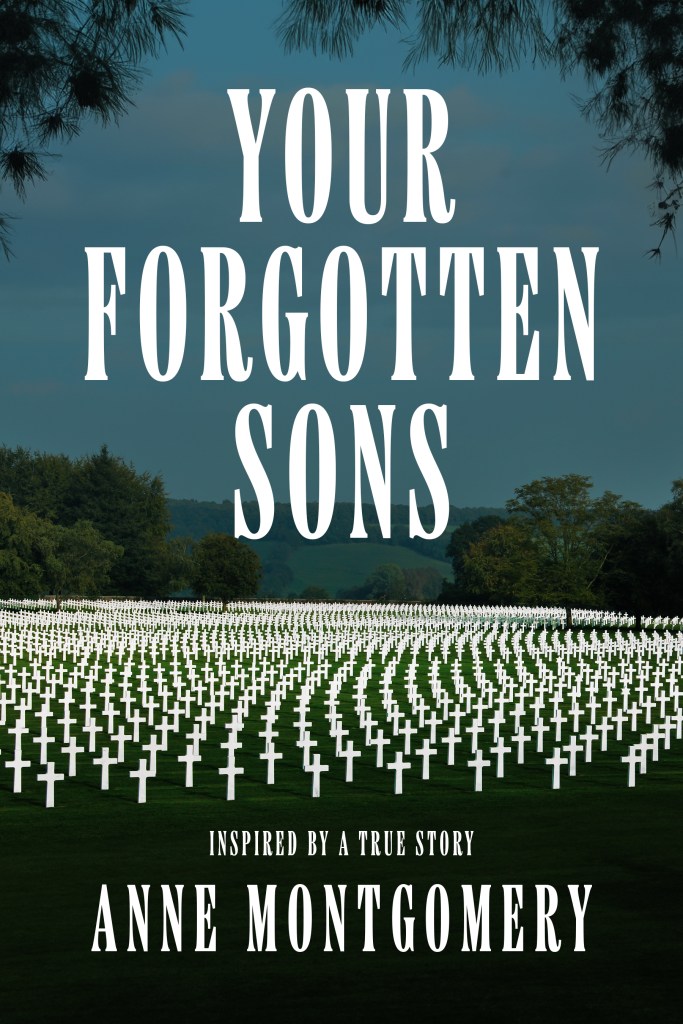
Your Forgotten Sons

Inspired by a true story

Released June 6, 2024

Anne Montgomery

Bud Richardville is inducted into the Army as the United States prepares for the invasion of Europe in 1943. A chance comment has Bud assigned to a Graves Registration Company, where his unit is tasked with locating, identifying, and burying the dead. Bud ships out, leaving behind his new wife, Lorraine, a mysterious woman who has stolen his heart but whose secretive nature and shadowy past leave many unanswered questions. When Bud and his men hit the beach at Normandy, they are immediately thrust into the horrors of what working in a graves unit entails. Bud is beaten down by the gruesome demands of his job and losses in his personal life, but then he meets Eva, an optimistic soul who despite the war can see a positive future. Will Eva’s love be enough to save him?

Order Your Copy Today

Amazon

Apple Books

Barnes & Nobel

Google Books

Kobo

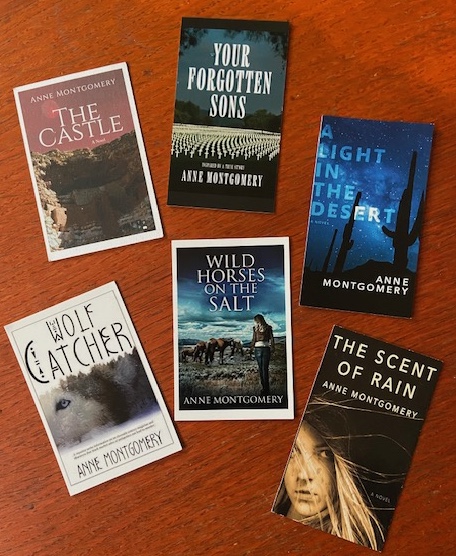
Anne Montgomery’s novels can be found wherever books are sold.

Goodreads

Amazon

On being an author

Being an author is exciting and exhilarating. It allows one to travel to far-off places without leaving home and to meet new people, ones you might never get to know in your regular life. But writing can also be a solitary struggle to get things just right. And then there is the fight involved in trying to get a book published, which can be daunting, as well as the added marketing and social media demands that inevitably come along. It’s understandable, perhaps, that authors often wonder if it’s all worth the effort.

All that said, I never set out to write books. It just happened. And despite the everyday battles I can’t imagine doing anything else.

My new historical fiction novel Your Forgotten Sons, a story of a man who served in the Army’s Grave Registration Service during World War II, has just launched. All I can say is that it’s kind of like raising a child and then sending them out into the world, all wrapped up in your hopes and dreams.

The online magazine Books Uplift, just posted an interview with me where I discuss my new novel, as well as what it means to be an author and what aspiring authors should consider when contemplating a long-term relationship with written words. Find that I interview here.

Your Forgotten Sons

Inspired by a true story

Anne Montgomery

Bud Richardville is inducted into the Army as the United States prepares for the invasion of Europe in 1943. A chance comment has Bud assigned to a Graves Registration Company, where his unit is tasked with locating, identifying, and burying the dead. Bud ships out, leaving behind his new wife, Lorraine, a mysterious woman who has stolen his heart but whose secretive nature and shadowy past leave many unanswered questions. When Bud and his men hit the beach at Normandy, they are immediately thrust into the horrors of what working in a graves unit entails. Bud is beaten down by the gruesome demands of his job and losses in his personal life, but then he meets Eva, an optimistic soul who despite the war can see a positive future. Will Eva’s love be enough to save him?

Order Your Copy Today

Amazon

Apple Books

Barnes & Nobel

Google Books

Kobo

Anne Montgomery’s novels can be found wherever books are sold.

Goodreads

Amazon

Writing historical fiction can be tricky

I almost got tripped up a few times, when writing about World War II Jeeps.

My new book, Your Forgotten Sons, is a work of historical fiction, a story inspired by Sergeant Joseph “Bud” Richardville who worked in the Graves Registration Service in Europe during World War II.

As many authors know, writing about the past can be tricky. One reason is we tend to look at history through our own modern-day lens. For example, when I was writing about Bud, I often had him riding in a Jeep. Today, Jeeps are ubiquitous on civilian roadways, but the origins of the vehicle are steeped in war.

Scripps Howard WWII reporter Ernie Pyle once said of the Jeep, “It did everything. It went everywhere. Was as faithful as a dog, as strong as a mule, and as agile as a goat. It constantly carried twice what it was designed for and still kept going.”

No doubt current Jeep owners prize the vehicle for many of the same attributes. The problem comes when one sees a Jeep and misses the evolution that led to today’s version. When I first wrote Your Forgotten Sons, I had Bud starting a Jeep with keys and adjusting the rearview mirror. Oops! Jeeps back then started with a pushbutton and the vehicles had no review mirrors.

I also had Bud and his fellow soldiers eating K-rations, but I would learn that he and his peers actually consumed C-rations. What’s the difference? K-rations were heavy, having been designed for static warfare, like the trench battles of World War I. But World War II was a different type of war, with fast-moving trucks and tanks and parachute troops who needed lighter combat rations, because soldiers were constantly on the move.

When I first envisioned Bud, I saw him in a green T-shirt, the iconic color of the Army. Today, Army personnel wear undershirts defined as Tan 499 which has a slight green tint to it, a shade referred to as “coyote”. But in Bud’s time, the plain, white cotton T-shirt was what all male service members sported.

When writing about the World War II era, I had to pay close attention to the facts. Luckily, the time is well documented with videos, and photographs, and eye-witness accounts. But consider writing about periods that go way back in history. My novel Wolf Catcher takes place in both modern times and the 11th century in what would become Arizona. I once wrote a scene where Native people used honey to sweeten their food, which could never have happened, because it was not until the early 1600s that European settlers first brought honey bees to the Americas.

It’s clear, then, that when authors choose to write stories based on history, they need to be meticulous in their research.

I’m working on it.

Your Forgotten Sons

Inspired by a true story

Anne Montgomery

Bud Richardville is inducted into the Army as the United States prepares for the invasion of Europe in 1943. A chance comment has Bud assigned to a Graves Registration Company, where his unit is tasked with locating, identifying, and burying the dead. Bud ships out, leaving behind his new wife, Loryane, a mysterious woman who has stolen his heart but whose secretive nature and shadowy past leave many unanswered questions. When Bud and his men hit the beach at Normandy, they are immediately thrust into the horrors of what working in a graves unit entails. Bud is beaten down by the gruesome demands of his job and losses in his personal life, but then he meets Eva, an optimistic soul who despite the war can see a positive future. Will Eva’s love be enough to save him?

Release Date: June 6, 2024

Pre-Order your copy today

Amazon

Apple Books

Barnes & Nobel

Google Books

Kobo

Review a copy early by going to NetGalley. Sign in here.

Find Anne Montgomery’s novels wherever you buy books.

Goodreads

Amazon

AI Editor: Part deux

I named my AI editor Hal Jr. and I think he did a pretty good job.

A while back, I wrote about an experiment I agree to. My publisher asked if I’d like to try a new kind of editor. I have a book coming out in June—a historical fiction, World War II novel inspired by a true story called Your Forgotten Sons—and the idea was that I would work with an editor of the “artificial intelligence” variety.

I thought about that for a while, and when my publisher said I could switch to a human editor if I was unhappy with the results, in the interest of not being called old and technology averse, I agreed.

I recently sent the completed manuscript back, so here’s what I’ve learned about working with an AI editor, who I dubbed Hal Jr. First, since we authors have long been working remotely with our editors, the process didn’t feel all that strange. I received my document full of those red lines leading to comments I needed to consider. My job was to accept Hal Jr.’s fixes or not.

Almost universally, I said yes. He did a great job finding all those grammatical boo-boos I’ve made most of my life. You’d think that after writing nine books and having five published, not to mention my years working as a print reporter, that I would have figured out to spell compound words by now. But, no! Hal Jr. gently pointed out that corkscrew and curveball were single words, terms that have meant a great deal in my life and which one might think I would have no trouble spelling.

Then there were the homophones, which for those who don’t recall elementary school English are words that are pronounced alike but that differ in spelling and meaning. I have a serious issue with those, and Hal Jr. had his red pen out to illustrate my deficiencies: alter and altar, aisle and isle, and, rather embarrassingly, your and you’re.

I am also grateful that Hal Jr. sometimes identified words I misused, ones that were similar to what I wanted, but clearly wrong: resemble and reassemble, barley and barely, shuddered and shuttered, cheeks and checks.

And Hal Jr. did a damn good job at picking up those missing quotation marks and other errant punctuation, especially all those outdated commas. As a girl who grew up in a home where we debated comma use at the dinner table, I can tell you that the wee squiggle is no longer used as much as it once was. It’s all about clarity and flow, so I let Hal Jr. lead the way in the comma department.  

My AI editor and I then ran into one big argument. He kept correcting things that I thought were right. Turns out there was an issue with which English we were using. Hal Jr., it appears, is British and I’m American. Who knew there were so many disparate spellings between us: pummeled or pummelled, apologize or aplologise, humor or humour, ad nauseum. He and I agreed to disagree, and the American versions won out.

All in all, I think Hal Jr. did a great job, so much so that I wish he and I could maybe have a beer to celebrate the completion of the manuscript. I’m not sure if AIs drink beer, but if I had to guess, I’d say Hal Jr. would drink his warm, yet another difference between we Americans and Brits.

The manuscript is now out of my hands, so I hope it’s perfect, but I know that’s probably impossible. But should you find any errors please feel free to blame Hal Jr.

Anne Montgomery’s novels can be found wherever books are sold.

Goodreads

Amazon