
My new book, Your Forgotten Sons, is a work of historical fiction, a story inspired by Sergeant Joseph “Bud” Richardville who worked in the Graves Registration Service in Europe during World War II.
As many authors know, writing about the past can be tricky. One reason is we tend to look at history through our own modern-day lens. For example, when I was writing about Bud, I often had him riding in a Jeep. Today, Jeeps are ubiquitous on civilian roadways, but the origins of the vehicle are steeped in war.
Scripps Howard WWII reporter Ernie Pyle once said of the Jeep, “It did everything. It went everywhere. Was as faithful as a dog, as strong as a mule, and as agile as a goat. It constantly carried twice what it was designed for and still kept going.”
No doubt current Jeep owners prize the vehicle for many of the same attributes. The problem comes when one sees a Jeep and misses the evolution that led to today’s version. When I first wrote Your Forgotten Sons, I had Bud starting a Jeep with keys and adjusting the rearview mirror. Oops! Jeeps back then started with a pushbutton and the vehicles had no review mirrors.
I also had Bud and his fellow soldiers eating K-rations, but I would learn that he and his peers actually consumed C-rations. What’s the difference? K-rations were heavy, having been designed for static warfare, like the trench battles of World War I. But World War II was a different type of war, with fast-moving trucks and tanks and parachute troops who needed lighter combat rations, because soldiers were constantly on the move.
When I first envisioned Bud, I saw him in a green T-shirt, the iconic color of the Army. Today, Army personnel wear undershirts defined as Tan 499 which has a slight green tint to it, a shade referred to as “coyote”. But in Bud’s time, the plain, white cotton T-shirt was what all male service members sported.
When writing about the World War II era, I had to pay close attention to the facts. Luckily, the time is well documented with videos, and photographs, and eye-witness accounts. But consider writing about periods that go way back in history. My novel Wolf Catcher takes place in both modern times and the 11th century in what would become Arizona. I once wrote a scene where Native people used honey to sweeten their food, which could never have happened, because it was not until the early 1600s that European settlers first brought honey bees to the Americas.
It’s clear, then, that when authors choose to write stories based on history, they need to be meticulous in their research.
I’m working on it.
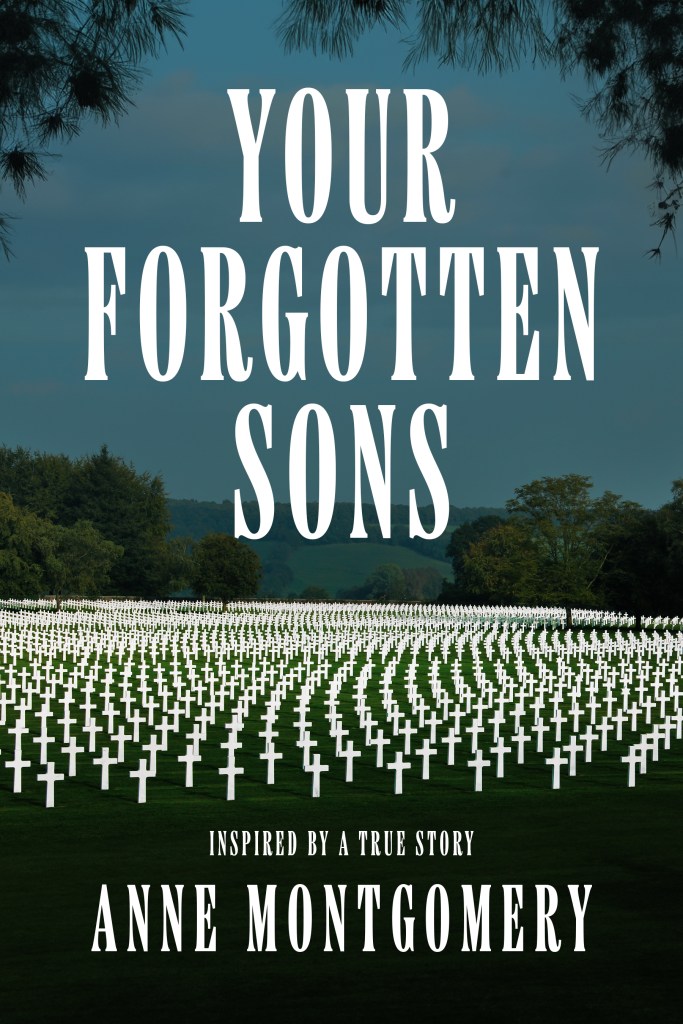
Your Forgotten Sons
Inspired by a true story
Anne Montgomery
Bud Richardville is inducted into the Army as the United States prepares for the invasion of Europe in 1943. A chance comment has Bud assigned to a Graves Registration Company, where his unit is tasked with locating, identifying, and burying the dead. Bud ships out, leaving behind his new wife, Loryane, a mysterious woman who has stolen his heart but whose secretive nature and shadowy past leave many unanswered questions. When Bud and his men hit the beach at Normandy, they are immediately thrust into the horrors of what working in a graves unit entails. Bud is beaten down by the gruesome demands of his job and losses in his personal life, but then he meets Eva, an optimistic soul who despite the war can see a positive future. Will Eva’s love be enough to save him?
Release Date: June 6, 2024
Pre-Order your copy today
Review a copy early by going to NetGalley. Sign in here.
Find Anne Montgomery’s novels wherever you buy books.


 Author Anne Montgomery
I find it fascinating how much I enjoy reading history NOW compared to reading it in my adolescence. It’s ALL so darn interesting. How was it SO boring. Hats off to cultures that are able to share their stories with youth in ways that are instructive and inspiring. America could do much better at teaching us all “ how we got to where things are today”.
Get Outlook for iOShttps://aka.ms/o0ukef ________________________________
LikeLike
Agreed, Sherm! I hated history until I got to college. I think it’s because sometimes people who teach history aren’t so enthused about it. I had a history cert, and when my journalism classes weren’t full they asked me to teach another subject. I said, “Yes! I’ll teach history.” Then my principal said, “No, coaches teach history.” Ugh!
LikeLike
What is it with coaches and history????
Get Outlook for iOShttps://aka.ms/o0ukef ________________________________
LikeLike
I have a theory. The idea probably is that unlike science and math, for example, no deep insight into the subject is necessary. What is needed is enthusiasm to get the kids excited. So, it becomes a self-defeating loop of boredom, so they can keep coaches on the field.
LikeLike
You know, I’ve always loved history. Makes sense that I write time travel. Wink. Now, there’s a lot of research in that genre! Augh! Great post, Ms. Anne! Cheers!
LikeLike
I know you understand, Sharon! Rock on. 😉
LikeLike