And now that the flooding has receded and the lights are back on after Tropical Storm Ernesto…
Not too long ago, I posted a blog about the hermit crabs that periodically wander through my home on St. Croix in the U.S. Virgin islands. At first, the little guys startled me, especially the one that was almost as big as my fist. But eventually, we got used to them. Now, my sweetie pie and I just pick them up and gently place them back outside.
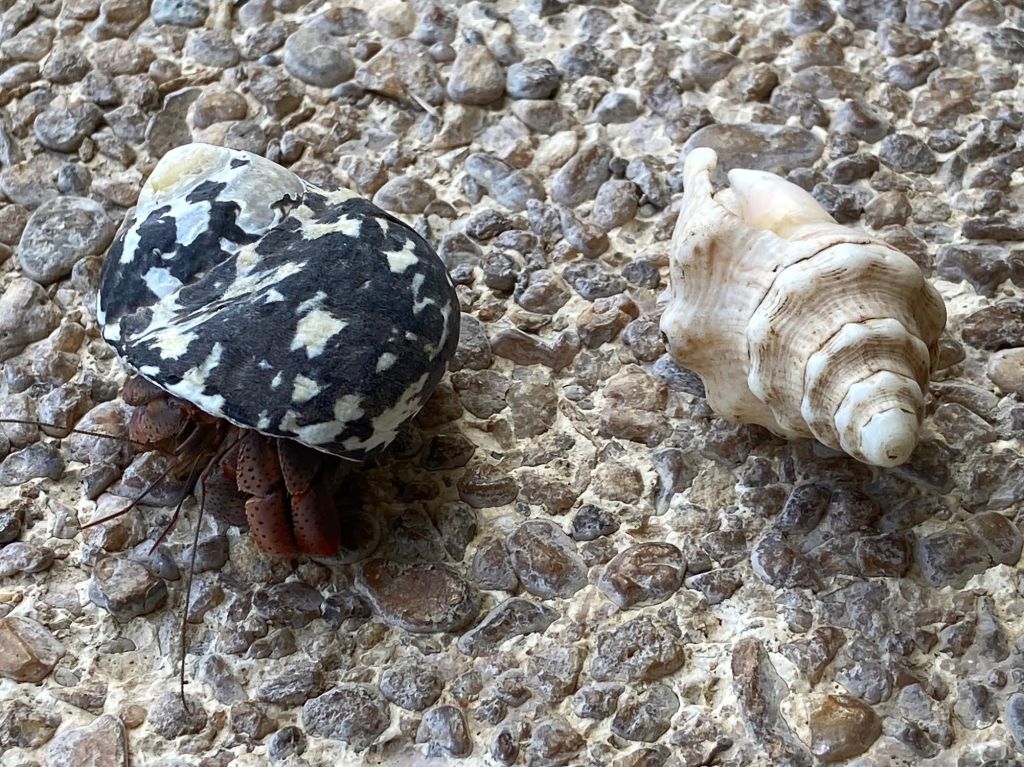
Then we discovered the crabs were looking for something: crabby real estate. It seems they grow out of their shells and often congregate to switch out, a situation where hopefully everyone crawls away with the perfect place to live, until it’s time again to upsize. Since we live above a rocky beach, Ry and I headed out to gather some shells, which we placed in a corner of the patio, so we periodically get to watch the crabby get-together and find joy when they all wander off in their new digs.

Then something changed. There weren’t enough shells that fit, so we had crabs wandering around looking quite ill at ease in poorly-fitting homes, which prompted us to head back to the beach. But when we got there we discovered that huge swaths of sargassum had swept in. For the uninformed, sargassum is a red seaweed that in moderate amounts is a good thing. It’s a habitat for small fish and tiny sea turtles, is a wonderful fertilizer, and is, so I’ve heard, quite eatable. But with climate change the blooms have become massive, and when they come to shore the piles can become several feet thick, a red blanket that covers everything on the beach, so any suitable shells were impossible to reach.
Then I did what many of us do when we’re in need of something. I went to Amazon. And you wouldn’t believe how many hermit-crab shells were for sale. Great big bags of them. But whenever I went to buy some, I was told they were “currently unavailable.”
In a never-give-up moment, I called what I thought was a local pet store, but instead I reached a women on the mainland who told me tales of all the hermit crabs she’d provided homes for over the years, even explaining how she’d paint dates on their shells so she could recognize them whenever they returned. At first, I was delighted to meet a kindred spirit, but then I realized that perhaps we both sounded a bit deranged.
She explained that while she had no shells, I could call the Virgin Islands Fish & Wildlife people for some help, which I did. The woman who answered the phone paused for a very long time after I explained my predicament.

“I don’t know anything about that!” She sounded as if I might be a danger to myself or others.
“Do you know of anyone else I can ask?” I said sweetly.
“No!”
The next morning, a large crab in a small shell pulled himself slowly across the patio. He was clearly depressed. (Don’t ask me how I knew. I just did.) Now I realize I’m not talking about a basket of kittens here, still I felt for the little guy and the rest of his poorly-housed freinds.
So I went back on line and eventually I found a women who specializes in all things hermit crab. In Tennessee. Amy at the Naples Seashell Company assured me she could ship shells to my little island, but her website encouraged me to measure the shell openings for each crab who required a new home and order an appropriately sized shell for them to move into. Note that some of the shells are the size of a pencil eraser and they get progressively bigger, up to the size of the previously mentioned fist-sized behemouth. While I did grab the tape measure, I realized I had no idea where the crabs live when they’re not sauntering through my home, so I picked out a whole bunch of shells in different sizes—note they range from an eighth of an inch to several inches—and placed my order.

When they arrived, I spilled the shells into a shallow pan, put them in the corner of the patio, and waited for the games to begin. At which point I noticed the depressed crab huddled in the corner. In a matter of seconds, he zeroed in on a shell and—with no quibbling about price or closing costs—hoisted himself into his new home, and then trundled off. I’m guessing he’ll tell the others some new dwellings are on the market.
I’ll let you know how it goes.

Your Forgotten Sons
Inspired by a true story
Anne Montgomery
Bud Richardville is inducted into the Army as the United States prepares for the invasion of Europe in 1943. A chance comment has Bud assigned to a Graves Registration Company, where his unit is tasked with locating, identifying, and burying the dead. Bud ships out, leaving behind his new wife, Loryane, a mysterious woman who has stolen his heart but whose secretive nature and shadowy past leave many unanswered questions. When Bud and his men hit the beach at Normandy, they are immediately thrust into the horrors of what working in a graves unit entails. Bud is beaten down by the gruesome demands of his job and losses in his personal life, but then he meets Eva, an optimistic soul who despite the war can see a positive future. Will Eva’s love be enough to save him?
Release Date: June 6, 2024
Bookstores, libraries, and other booksellers can order copies directly from the Ingram Catalog.
Find Anne Montgomery’s novels wherever you buy books.


You are creating wonderful karma, Anne. You truly are a beautiful soul. Cheers!
LikeLike
Awww…now I’m blushing, Sharon. Thank you! 😉
LikeLiked by 1 person
Wow. That’s an amazing story.
LikeLiked by 1 person
Thank you, Andrew. Hermit crabs are amazing little creatures. 😉
LikeLiked by 1 person
You’re welcome.
LikeLike