“Follow your heart”: A baseball dream

Don Wordlow never wavered in pursuing his dream job.

As anyone who knows me understands, I’ve never met a microphone I didn’t like. With that in mind, I recently started doing podcasts, where I’ve met some very interesting people. The one who stands out the most is Don Wordlow, who invited me to be a guest on his show: The Baseball Lifer.

As you can probably guess, baseball is Don’s passion, and as I spent 25 years umpiring amateur baseball and covered all levels of the sport as reporter, we had a lot to talk about. Like me, Don was in the media end of the game, spending 12 years as a color commentator.

The thing is…Don is blind. From birth.

“I discovered the game at the age of eight listening to it on the radio,” he said. “I went to my first game when I was nine. The magical part was Dad arranged for what we now call a meet-and-greet with the Mets three broadcasters, all of whom are now enshrined at Cooperstown: Lindsey Nelson, Ralph Kiner, and Bob Murphy. Dad knew that meeting the broadcasters would be even more exciting than meeting any of the players.”

Something sparked in Don’s young brain. He decided that he too would be a baseball broadcaster, which early on had his parents perplexed.

“Mom wanted me to be the next Ray Charles and said listening to baseball games would get me nowhere. When it mattered though my parents believed in me when I wanted to become a communications major.”

Though his peers viewed the idea differently.

“My friends…thought I was a nut for wanting to be on the radio.”

As you might expect, there were a lot of naysayers along the way, those who couldn’t wrap their brains around a blind man as a baseball broadcaster.

“I was a particularly stubborn…I kept pushing until I ran into Jim Lucas, who worked with me in college and later as a pro.”

The pair spent four years in AA ball in New Britain Connecticut from 1993-96, a time during which there were few technological advances to assist the blind. Don didn’t even have a computer.

“When the team was at home, Jim—or somebody else who could see—would read the daily stats into a tape recorder,” Don said. “I would then braille them. I was expected to have all my braille notes written before I got to the park. I would spend time preparing “all-time gems” because (we) were sponsored by a local jeweler. These gems were recordings of great moments in baseball from the 30s to the 90s. We ran them during pitching changes. When we started in AA, five gems might last two games. As the number of pitching changes proliferated during the 90s…I had to have ten or more ready.”

Don, who said the braille transcriptions took the most time, also prepared pre-game features of highlights from the game that happened the night before.

Over the years, Don was known to lean out of the press box and lead the crowd in singing “Take Me Out to the Ballgame” during the seventh inning stretch. He said there were a lot of memorable moments along the way, including the time he and Jim were invited to work part of a Major League game on June 23, 1994 between the Miami Marlins and the Chicago Cubs.

“It was a whirlwind, a fairytale blur,” Don said. “Double A games required me to have between 25 and 50 pages of braille stats in my lap. Quickly, we found it would take more than that to prepare for three half-innings of a single game.”

Don had close to 200 pages to juggle that day. Don and Jim were treated like celebrities, riding in limousines provided by the Marlins. They also appeared on ABC’s Good Morning America.

“Having my mom and my brother at the Major League game where we broadcast was a huge thrill,” he said.

Today, thanks to advances in technology, those with disabilities have an easier time integrating into society, still those journeys can be difficult. Like everyone, Don has suffered setbacks. A divorce. A severe back injury. Bouts of depression. Still, his sense of humor shines through. Don is working on a book about his life, one he says will be filled with funny stories. In the meantime, he has some advise.

“Professionally, persist in your search for an education and the right job,” he said. “Read both for work and pleasure. In your personal life, follow your heart.”

Listen to Don’s Major League broadcast here.

Listen to my visit with Don here

Find Don’s podcast here.

Anne Montgomery’s novels can be found wherever books are sold.

Goodreads

Amazon


“Original, exceptionally well written, and compelling”

Midwest Book Review

Synopsis: In 1939, archaeologists uncovered a tomb at the Northern Arizona site called Ridge Ruin. The entombed man, bedecked in fine turquoise jewelry and intricate beadwork, was surrounded by wooden swords with handles carved into animal hooves and human hands. The Hopi workers stepped back from the grave, knowing what the Moochiwimi sticks meant. This man, buried nine-hundred years earlier, was a magician.

Former television journalist Kate Butler hangs on to her investigative reporting career by writing freelance magazine articles. Her research on The Magician shows he bore some European facial characteristics and physical qualities that made him different from the people who buried him. Her quest to discover The Magician’s origin carries her back to a time when the high desert world was shattered by the birth of a volcano and into the present-day dangers of archaeological looting where black market sales of antiquities can lead to murder.

Critique: Blending archaeology and Native American mythology, “Wolf Catcher” by novelist Anne Montgomery is an original, exceptionally well written, and compelling work of historical fiction that is especially and unreservedly recommended for community library collections. It should be noted for personal reading lists that “Wolf Catcher” is also readily available in a digital book format (Kindle, $4.99).

Editorial Note: Anne Butler Montgomery (https://annemontgomerywriter.com/about) has worked as a television sportscaster, newspaper and magazine writer, teacher, and amateur sports official. She was also a freelance and/or staff reporter for six publications, writing sports, features, movie reviews, and archeological pieces. Her novels include The Castle, The Scent of Rain, A Light in the Desert, and Wild Horses on the Salt. Anne Montgomery taught high school journalism for 20 years and was an amateur sports official for four decades, a time during which she called baseball, ice hockey, soccer, and basketball games and served as a high school football referee and crew chief.

Find Anne Montgomery’s novels wherever you buy books.

Goodreads

Amazon

Street Racing: The auto industry needs to stop promoting speed!

Young people see street racing as exciting, a notion car companies and Hollywood promote. Somehow the ultimate carnage isn’t mentioned.

You’ve seen the ads. Attractive young people, slipping their sleek new vehicles into gear, careening around sharp mountain curves or downtown city streets. What fun they’re having, when their cars can go from zero to 60 in under three seconds!

Of course there’s the flip side. Roughly 46,000 people in the U.S. die in traffic accidents annually. Motor vehicle accidents are the leading cause of death for people under 30.

And yet it is speed and daring that automakers promote, and those little tiny disclaimers at the bottom of the screen noting that “the course is closed,” and “the cars are operated by professional drivers,” are ludicrous.

An article in Bloomberg titled “Traffic crashes are getting worse. Car ads are part of the problem,” reporter Danny Harris pointed out that “marketing speed, power and reckless driving as a selling point for cars is part of a longstanding advertising tradition for automakers.”

Note that in 2022 the auto industry spent over $17 billion on advertising. Currently, an average automobile weighs a little over 4,000 pounds. Weight combined with  high rates of speed can produce horrific carnage. So the question is should car manufactures be treated like other companies that produce dangerous products.

“The U.S. has a substantial history of affecting how industries, especially those with harmful products, market their goods,” Harris wrote. “Advertisements for cigarettes were banned from American radio and television by an act of Congress in 1971. Billboard ads for cigarettes, including cartoon advertisements that target children, like Joe Camel, were banned in 1998 as part of a settlement. The alcohol industry has developed its own standards for self-regulation— a model the car industry could also follow.”

The Fast & Furious franchise promotes speed and reckless driving and our young people are getting the message loud and clear.

If the car makers cared, they’d find other ways to sell their vehicles. But they won’t, because speed sells. But let’s not put all the blame on the auto industry. How about Hollywood with its endless movie car chases and the Fast & Furious franchise which spouts the message that you’re only cool if you drive recklessly and fast?

That message is being heard loud and clear by teen drivers. In 2020, 2,800 teens were killed and about 227,000 were injured in the U.S. in auto accidents. The majority of these dangerous drivers are boys, especially those 16 to 19, who are three times more likely to die on the road than female drivers of the same age.

One of my sons was sucked into the street-racing world when he was young. Luckily, he was caught before anyone was hurt. That such a smart young man would think speeding on city streets was a fine idea is frightening.

I grieve for parents who get that visit from the police. And I’m angry at the stupidity. We know young people don’t always make the best decisions, so perhaps it’s way past the time for auto companies and film makers to stop promoting dangerous driving as something glamorous, as opposed to what might easily be a tragic end to a short life.

Find Anne Montgomery’s novels wherever you buy books.

Goodreads

Amazon

It’s a tough time to be a teacher

Life is getting tougher for teachers. One of the biggest problems is lack of respect for the difficult job they do.

This is not an easy time to be a teacher. Practically every day there are news stories about what’s going on in classrooms nationwide, accounts that are rather ridiculous.

As a teacher of 20 years, the idea that my peers are pedophiles “grooming” children, that they are spreading their “radical agendas”, and that they’re teaching students to hate themselves for who they are is not only insulting but hurtful.

Once upon a time, teachers were respected, as was the occupation itself. The job was considered a calling, like nursing or religious ministry. Today we live in a world where many believe that horrid, old saying: Those who can’t do teach. (It pains me to even write those words.)

I had many jobs prior to becoming a teacher at 45, which included being a sportscaster and reporter, as well as an amateur sports official for 40 years. My world was chronically stressful. I was in the public eye daily and when I made mistakes, I was frequently called out. The attacks were sometimes personal. On occasion, I was accompanied to my car by police officers concerned for my safety.

And still, teaching was the toughest job I’ve ever had. I spent 20 years in a Title I school where the vast majority of my students lived in poverty, a place where drug and alcohol abuse, neglect, hunger, hopelessness, and gangs ruled. My job was to give them hope in a future they couldn’t see. Some didn’t believe they’d live to be 20.

For our students to become healthy world citizens, we teachers had to help them acquire important skills beyond the basic core subjects of math, science, history, and English. Communication skills especially are paramount to building strong relationships and making good empathetic decisions. But there’s a problem. Getting along with others, assertivenessis, and problem solving-skills are part of what’s referred to as Social Emotional Learning. For reasons I can’t fathom, SEL is now a dirty phrase. How can teaching a child to be resilient and self-assured be a bad thing?

School districts all across the country are desperate for teachers. If attitudes don’t change there will be many more empty classrooms.

When I researched the subject what came up was baffling. Somehow SEL became linked to another educational acronym, CRT, which stands for Critical Race Theory. Before I go any further, understand that there are no elementary or secondary schools in the country teaching CRT. Zero! Zilch! None! That’s because the class was designed for college students, primarily those in law schools. CRT studies involve using “sociology to explain social, political, and legal structures and power distribution…focusing on the concept of race, and experiences of racism.”

This idea has been so twisted that parents believe educators are teaching children to hate who they are because of past history. If you’re a White child, you must carry the sins of 19th century slave owners on your back. If you’re family hails from Germany, you are responsible for the evils of the Holocaust. (While I’d like to think those who oppose CRT care equally about the feelings of Black and Brown children, I doubt that’s the case.)

Since I taught history for a brief spell, I can tell you I never saw or sensed any student who seemed to feel uncomfortable learning about bleak eras in our past. So you can imagine that recent legislation has me confused. At least eight states now have laws about how any subject involving race can be taught, laws that say students can never be made to feel guilt or discomfort because of who they are.  I believe these laws are completely unnecessary, because the last thing teachers want is make children uncomfortable.

I’m not saying here that all educators are perfect. Like every vocation, some get it wrong. But I’d stake all I have on the idea that the vast majority of teachers only want their students to become happy, healthy, productive citizens. To reach that lofty goal, we must teach kids to understand both themselves and the past. To do that they need empathy, understanding, and a feeling of self-worth.

Someone please tell me how these lessons can be anything but positive.

Find Anne Montgomery’s novels wherever you buy books.

Goodreads

Amazon

A fancy bra and cowboy boots

Faced with a formal affair, I wondered what attire might be appropriate.

I found myself in a bit of a pickle recently. I had to attend a wedding. A formal wedding! Dressing up meant I had to make nice with things like shoes and lingerie, neither of which I’ve ever gotten along with.

“I only have one dress,” I said to my sweetie pie.

“So wear that one.”

“Then I’ll have to wear heels!”

Shoes have been the bane of my existence all my life. I was born with a crooked left foot, and a while back I suffered a severely broken leg, one that required extensive surgery. It took eight months for me to learn to walk properly again, so you can imagine the idea of donning heels had me apprehensive.

“Just wear your cowboy boots.”

“We’re not going line dancing. And the bride has been pretty specific that this is a formal affair.” In fact the young woman in question—who I’d never met—actually sent invitations suggesting a proper color palette for guests’ attire, and my purple dress was not one of the requested shades. I sensed that the combination of that dress and my boots might make the bride swoon.

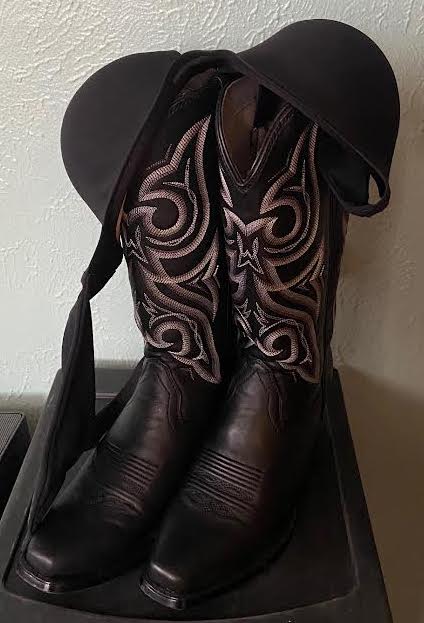
I fretted over the upcoming affair, wondering if I might get away with wearing nice pants. I checked into whether slacks would be a serious fashion faux pax, and to my surprise I discovered that it is permissible for women to wear pants to a formal wedding, which meant my pretty, black tooled cowboy boots would work, as well. (I live in Arizona. Things are a bit different here, so trust me on this.)

I pulled together a black jacket, nice pants, and a sheer black shirt, but then frowned. Clearly, I needed appropriate undergarments. But when I searched my drawers, I discovered that my daughter had appropriated my one dressy bra. Okay. My only bra. Since I’m a child of the 70s, I’d tossed that torturous device when I was 16. It wasn’t until I was 51 and a teacher that anyone seemed to notice.

“You can’t do that in front of your students,” a fellow teacher said.

“Do what?” I was perplexed.

“You have to wear a bra?”

“Why?” I looked down. Several layers of fabric separated my bits from the world. “I’m old enough to be their grandmother. They won’t even notice.”

But I was wrong. I caught numerous boys checking me out, so I started wearing sports bras, which still bugged me, but which were not as uncomfortable as a regular brassiere. But a sports bra wouldn’t cut it for a formal wedding, not even in Arizona.

So I traipsed off to a lingerie store in a swanky mall. Since I’m not a fancy type, I appeared in that realm of delicates in a black sweatshirt bearing a cowboy and running horses, black leggings, and sneakers. Two white-haired women stared at me.

“I need a bra.”

One focused on my chest. “What size?

“Um…I don’t know.”

They appraised me as if I was something they’d discovered in a petri dish. And yet, after whipping out a tape measure and assessing me from multiple angles, one woman walked me to a dressing room and handed me a single bra.

Now, I’ve been in dressing rooms strewn with bras left behind by frustrated shoppers. Finding the proper fit can be a grueling affair, still I put it on without question.

A short time later the woman reappeared at the door as I faced myself in the mirror. “Turn around.”

I did.

Raise your hands in the air.

“Yes, ma’am.”

“Bend over.”

I was perplexed, but did as she ordered.

“It’s perfect.”

And she was right! I wondered if she’d been bestowed with a master’s degree in bra-fitting, but didn’t ask. “It doesn’t hurt!” I smiled, and she pointed out the structural supports and special fabric with such intensity that I imagined NASA engineers must have designed the thing.

I was so delighted, I bought two.

As for the wedding, all went well.

And nobody said a thing about my boots.

Find Anne Montgomery’s novels wherever you buy books.

Goodreads

Amazon

To bathe or not to bathe?

If you bathe everyday, you might want to reconsider.

I’m guessing you had a shower today. Or maybe a bath. Perhaps you’re a person who bathes daily.

It’s here where I confess that I do not.

Now don’t get all judgmental, because there’s a perfectly good reason I let a few days go by before stepping into the shower. And I have the medical community on my side.

“Showering every day may be a habit, but unless you’re grimy or sweaty, you may not need to bathe more than a few times a week,” said the good doctors at WebMD.

I know! Surprising. Especially since I remember the days, back when I was still involved with sports on a regular basis, when I was known to lather up twice a day, but it seems doing so was bad for my health.

“Washing removes healthy oil and bacteria from your skin, so bathing too often could cause dry, itchy skin and allow bad bacteria to enter through cracked skin.”

That I live in the Sonoran Desert—one of the driest places in the U.S.—also adds to the bathing conundrum. Since the skin of desert dwellers is already quite crispy, adding a daily shower to the mix means there isn’t enough moisturizer in the world to keep us from scratching our flesh off.

I will now put on my history teacher hat.

Those ancient Greeks were all about competing in the nude, so daily baths were important.

In ancient times, bathing was a communal operation. One massive construction, the Great Bath of Mohenjo-daro in Pakistan that encompassed 880 square feet, dates back about 5,000 years. Then the Greeks came along and invented the shower, because of all those sleek athletes heading to gymnasiums, the name for which comes from the word “gymnós” which means, you guessed it, naked. Back then sporting folks practiced and competed au naturel, so their bits no doubt needing a bit of soaping up at the end of the day. Jump ahead to Medieval times and bathing had mostly disappeared, with the exception of the very rich who were known, on occasion, to throw dinner parties in baths, where food was placed on boards situated over the water. However, when the Black Plague appeared people developed hyper aversions to bathing, because they believed the illness could sneak through their pores and that dirt on one’s skin would block the bubonic bugs from entering one’s system. Even into the late 1800s doctors didn’t bother washing their hands before surgery. But a bathing resurgence occurred in the 1900s when the Saturday night soak became popular with the whole family jumping in and out of the same tub of water to scrub away a week’s worth of grime. Ewwww!

Which brings us to today, where daily bathing is the norm, something we should reconsider. According to WebMD, “When you expose your body to normal dirt and bacteria, it actually helps strengthen your immune system.”

As a desert dweller, there’s also a conservation issue to consider, because showering can waste a lot of water. So, while I’m certainly not suggesting you stop bathing, perhaps you might think about the frequency with which you step into all that lovely water.

To bathe or not bathe? Something to consider.

Find Anne Montgomery’s novels wherever you buy books.

Goodreads

Amazon

In the weeds

All those pretty desert wildflowers are really just weeds.

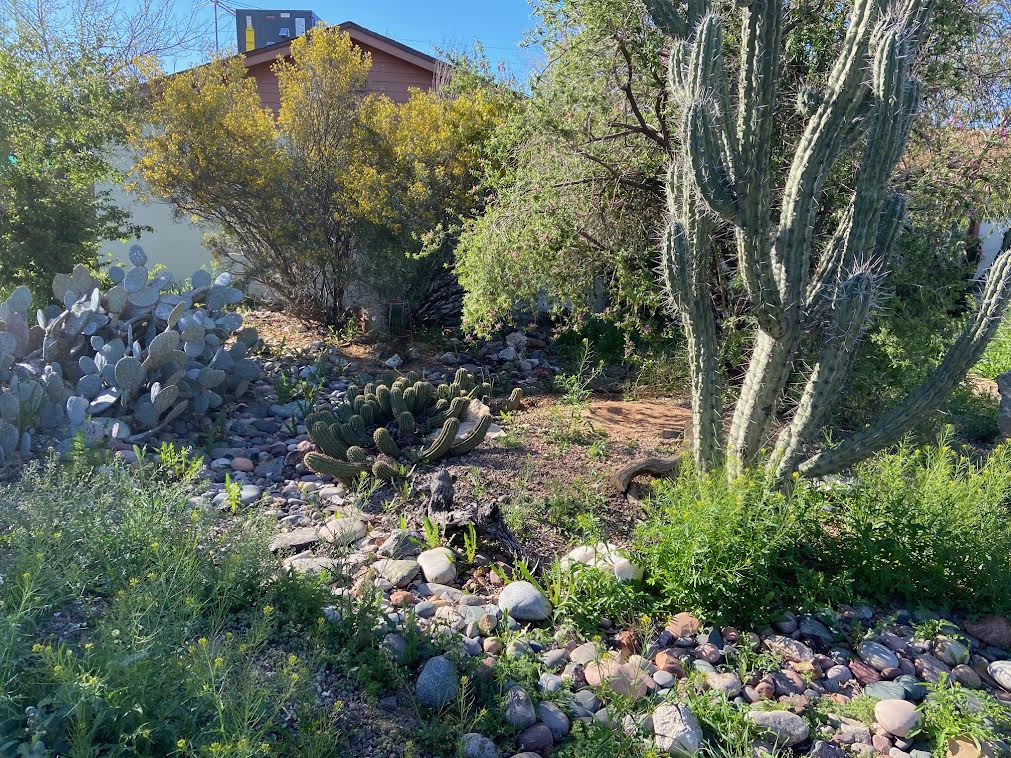
We’ve had an abundance of rain in my beautiful desert recently—a rarity in this part of the world—and it’s now wildflower season, something the local chamber of commerce pumps up every year to out-of-state visitors. Don’t get me wrong. Our wild flowers are lovely, especially following a wet winter, but let’s call those plants what they really are. Weeds!

There are various definitions of  weeds: plants that were not sewn in a particular location or plants that produce abundant seeds or simply plants that grow where you don’t want them to. But does that mean said plants are not worthwhile?

I remember as a child growing up in New Jersey the annual ritual that had me on my knees in the yard every spring pulling dandelions under my dad’s watchful eye. Apparently those small yellow flowers that turned into delightful, fluffy-white seed balls one could blow into the wind were the worst weed that could invade that lush greenness, a plant that I later learned can be eaten and used as a medicinal for arthritis and intestinal issues, heart and liver diseases, jaundice and gallstones, but that still became the bane of suburban yard owners everywhere.

Lo, the poor dandilion. So villified. So misunderstood.

But here’s the thing. A weed is actually no different from any other green, growing thing. It’s just how they’re perceived. Humans, for reasons I can’t quite ascertain, seem to feel the need to organize things into respectable little areas, designed to present order and uniformity. Having gone out and conquered the planet, we apparently feel compelled to eliminate anything considered remotely wild.

But I’m rebelling against that idea, and not just because my yard is currently a mass of weeds. You see, I have science on my side. I read that weeds help prevent soil erosion, act as fertilizer, and attract pollinators—bees, butterflies and hummingbirds—creatures without which our diverse diet of nuts, fruits, and vegetables would be severely diminished.

I think my weeds look quite lovely. Not sure what the neighbors think.

In the interest of unbiased journalism, I searched for the other side of the story, the real reason there are so many weed haters out there. I found data claiming weeds can carry diseases, alter the pH of the soil, and use more water than native plant species. But on closer inspection that information was often forwarded by those in the lawn-care industry, which made my old reporter’s brain twitch a bit.

Are my weeds unsightly? I don’t think so, but lawn purists might disagree. Still, I’ve decided to let my “flowers” grow and attract those all-important birds, bugs, and butterflies. Then, when they’ve served their pollinating purpose and our desert sun has scorched them to dust, I’ll thank them for their environmental service and pay someone to harvest what’s left. (Sorry, Dad. My weed-pulling days are long behind me.)

P.S.

Got a letter from the city. “It has been observed there is grass/weeds above six inches scattered in the front yard.” I was given ten days to rectify the situation. I expected a fight, so I put on my Eco Annie Superhero suit and explained that I let the weeds grow intentionally to help our environment thrive. And you know what? The kind man on the phone understood and gave me a few more weeks when I promised to cut everything down after the blooms were spent. Isn’t that nice? I feel better about the planet already!

Find Anne Montgomery’s novels wherever you buy books.

Goodreads

Amazon

A little piece of rainbow

My kitty Westin on the right with his brother Morgan.

Those of us who’ve had the great privilege of having pets in our families understand the joy these creatures give us. I have been incredibly fortunate over my life to have cared for myriad animals that delighted me—even when they misbehaved—and which comforted me when I was sad.

The problem, of course, is that their lifespans are so much shorter than ours, which necessitates tough decisions for those of us who love them. I should be used to that special room at the vet by now, but it never gets easier.

I just said goodbye to my dear cat Westin, one of the most endearing animals I’ve ever met. Westin’s life was difficult. He was deaf and had severe allergies that necessitated monthly shots and daily medication. Whenever I was asked if I’d like a receipt from the vet, I always said I didn’t want to know the price of his medical care. I’m pretty sure Westin cost more than the 50 or so animals I’ve tended to over the years put together. But he was such a joy, that I always smiled when I handed over my credit card.

The vet made it clear that Westin would not live a normal kitty lifespan as eventually the medications would take their toll. Westin was eight and he died peacefully surrounded by those who loved him.

In his honor, I thought I’d share the story I wrote about the day we brought Westin home.

A cat, a boy, a bond

There was nothing extraordinary about the cat that stared at me from the pages of my local newspaper. He was black. Gold eyes. His name was Westin. He’d been at the Humane Society way too long. His $20 price tag a clear indication that if he did not find a home soon, well…

I called my son Troy to come look at the picture. I told him about Westin. “Should we go get him?” I asked. His eyes lit up.

Within the hour we bounded through the door at the shelter, waving the newspaper article. “We’re here for Westin.” We grinned at the receptionist. A woman standing nearby frowned. I pointed at the picture again, wondering at her odd reaction.

“The story did not tell you everything,” she said, leading us toward a glassed-in enclosure, a place called the Campus for Compassion, where hard-to-adopt animals are placed for one last push to find them a forever home.

My son and I glimpsed Westin briefly through a large window as the woman ushered us through a doorway, around a corner, and through another door.  We somehow missed the sign that would have tipped us off that Westin was no ordinary kitty. The woman escorted us into the tidy room scattered with cat toys and shelves ascending one wall, where Westin quickly displayed his climbing skills. I sat on a small couch. Westin stared at me, then bounded into my lap.

“You get acquainted. I’ll get Westin’s records.” She left, closing the door behind her.

A short time later, a young volunteer appeared, bearing a thick folder.

“Where did he come from?” I asked as Westin head-butted my hand for the rub.

“He was one of thirty cats found abandoned in a hotel room,” she said. “We named them all after hotels.”

The thought that there were kitties nearby named Radisson, Hilton, Sheraton, and Howard Johnson made me want to laugh. Perhaps she read my mind.

“They’re all gone. They’ve been adopted. Westin is the only one left.”

I stared at the cat, now happily ensconced in my son’s lap. “Why?”

“Westin is sick.”

Troy and and I simultaneously stared at the cat, who appeared quite healthy and happy.

“When he came to us, he had lost a lot of his hair. We almost put him down. The vets here did a lot of testing and, well, Westin is deaf and has horrible allergies. He’s on daily medication and will be for the rest of his life. He has to be fed special food that’s about $60 a bag. I’ll leave you two to think about it,” she said, a hint of sadness in her voice. “He’s been here a long time.”

“It’s a lot of money,” I said when my son and I were alone. “And a lot of responsibility.” We already had four cats and a cattle dog.

When the volunteer came back, I asked if anyone else had ever wanted to adopt Westin.

“Oh, yes,” she said. “Until they found out about his problems.”

The boy with the blue eyes stroked Westin’s head. “He’s just like me, Mom. No one wanted me either.”

I stared at the ground. Troy is my third son. All of my boys spent time in the foster care system, before entering my life when they were teenagers, having been shuttled between group facilities and foster homes too many times to count, clearly understanding that there didn’t seem to be any families that wanted them.

Of course, we took Westin home. I can’t say it hasn’t been a struggle. Westin suffered a ruptured ear drum and only wants to eat food that he’s allergic to. Still, he gets along fine with the other animals and is under the watchful eye of our vet. We are hoping that, someday, he can go without the daily doses of medication and the special expensive food. In the meantime, Troy takes care of Westin. They seem to have an understanding.

Today, I’m sad, which I know from experience is to be expected. There’s a small hole in my heart that hurts. But I know eventually that space will fill in. Joy will take its place. Joy that I had the pleasure of knowing Westin. And perhaps a small piece of rainbow will lodge in my heart, color and light left behind from the moment Westin mounted the storied Rainbow Bridge.

Five years ago, Westin was featured on the Arizona Humane Society’s Pets on Parade.

You can watch the video here.

Find Anne Montgomery’s novels wherever you buy books.

Goodreads

Amazon

If you suffer from wrap rage, listen up!

Easy open? One wonders if anyone at the factory ever tried to get into one of these packages.

All I wanted was a cracker: a Triscuit to be precise.

But  I…couldn’t…open…the… package! Which had me saying all kinds of impolite things as I wrestled with the plastic bag inside the hermetically sealed cardboard box that had already tried my patience.

But it’s not just crackers that have me irritated. There’s the pet food bags that come with a string one just needs to pull and voilà the kibble bag is opened. But the thing rarely works, which has me reaching for a bone-handled camping knife I now keep on hand so I might stab those bags open. Then there are the drink containers which require me to fiddle with tiny plastic tabs that periodically break off leaving the cap useless. And let’s not forget those seals inside the peanut butter jar where one must attempt to grasp a miniscule flap and pull. I suppose the manufacturers intend for the lid to come off in one pretty, round piece, but more often than not the cover just rips and I’m off to find that camping knife and the stabbing begins anew.

My frustration no doubt stems from the fact that I’m old enough to remember when opening packages was simple. Today, however, just about everything we buy is encased in practically indestructible plastic clamshells and blister packs, shrink wrap and cling film. And though manufacturers insist their products are easy to open, we know they’re not.

I blame it all on the Tylenol Killer, a still unknown person who thought it would be just fine to lace acetaminophen capsules with cyanide back in 1982. Seven people died. And just like that, food and drug packaging changed. While I don’t generally believe in the death penalty, in this case I’d volunteer to push that plunger filled with potassium chloride, if only we could find the perp.

My go-to implement when attacking difficult packaging is my bone-handled camping knife.

So you know, I’m not the only one complaining. There’s actually a name for this “syndrome.” It’s called wrap rage, which is defined as “the common name for heightened levels of anger and frustration resulting from the inability to open packaging, particularly some heat-sealed plastic blister packs and clamshells.”

The thing is, it’s not like all this iron-clad packaging has made us safer. In fact, a British study revealed about 60,000 people suffer injuries annually that require hospital treatment—6,000 in the U.S. alone—because of their herculean attempts to open packages. The reason for these wounds is because, as I’ve already mentioned, we get frustrated and resort to dangerous implements—razors, box cutters, scissors, ice picks, and even bone-handled camping knives— in our efforts to open containers.

I looked for tips on how to deal with wrap rage, but I didn’t find much except that you should “never hold the item between your legs to stabilize it.” One wonders why that particular situation stands out, but I don’t want to think about it.

How can we avoid wrap rage? Next time you’re hungry try a banana or an apple. But since we can’t completely dodge impenetrable packaging, always have your bone-handled camping knife nearby.

Find Anne Montgomery’s novels wherever you buy books.

Goodreads

Amazon

Don’t let age differences get in the way

That I’d anchored SportsCenter in my youth did nothing to prevent one of my former students from saying I was too old to teach sports reporting.

Most of us understand that people should not be discriminated against because of who they are. In fact, there are hate laws protecting people against bigotry based on race, color, religion, national origin, sexual orientation, gender, gender identity, and disability.

But there is one big category missing. How about discrimination based on age? (There is, of course, a law banning ageism in the workplace, but here I’m talking about the social implications of the issue.)

Ageism is generally understood to be a dislike that focuses on older adults. But why? Shouldn’t mature people be respected for the wisdom they’ve acquired over their long lives, knowledge that if shared can help younger folks be happier and more successful?

Asian, Native American, and Indian cultures, among others, respect their elders and, in fact, celebrate older adults. But venerating the elderly seems almost nonexistent in the U.S. The question is why. Some of this attitude—as is the case with most prejudice—is based on stereotypes. Older people are considered slow workers, poor drivers, hard of hearing, unable to embrace new technologies, and generally weak and unattractive. Ugh!

Alice was my dear friend, despite the decades that separated us in age.

Now I’m not saying older people don’t also harbor ageist attitudes against the young. As a Baby Boomer, I’m embarrassed when my peers mumble derisively about the “younger generation.” I want to yell, “Don’t you remember when our parents said the same things about us? How they didn’t like our clothes and hair and music and political views?” Still, while agism can go both ways, today it generally tilts toward the denigration of the elderly.

I ran into this problem after teaching a course in sports reporting at Arizona State University. At the end of the semester, students are encouraged to rate their instructors and one comment hit me hard. “Next time ASU hires someone to teach sports reporting, they should hire someone younger!” I was 67. That I’d worked as a sports reporter and anchor at five TV stations both locally and nationally, including a stint at ESPN where I anchored SportsCenter, and had been a print reporter for three magazines and three newspapers, did nothing to up my stock. It was only my age that mattered. (It might have been my gender, too, but that’s for another time.)

I thought about that critique for a while and then recalled something I did back in my forties. I’d been sent to interview a woman who was a competitive swimmer. She was 64 and I remember gushing about how amazing it was that she was still swimming “at her age.” She was kind and polite, but there was a look on her face, bemusement perhaps, that I didn’t understand at the time. Later, when I turned 64 and was still swimming laps, I finally understood. She didn’t feel old or act old, and yet I’d labeled her that way.

I know we can do better, and I think a good way to do that would be more social mixing of the generations. I was fortunate in my youth to have several older friends. One in particular stands out. Alice was my rocking buddy. We met when she was in her seventies and I was in my thirties. I would head out into the Arizona desert with Alice where we wandered along wild washes, hiked up and down mountains, and frequently got lost in our quest for mineral specimens. We were still at it when Alice was approaching 90. I never thought of her as old. Ever!

Getting to know one another is the key, I think.  So, let’s not allow stereotypes to get in the way of what might become a beautiful friendship.

Find Anne Montgomery’s novels wherever you buy books.

Goodreads

Amazon