Authors! Learn to love that microphone

Writers write. That is abundantly clear. But is that enough in today’s whirlwind of book marketing? It is not!

Authors especially are sometimes categorized as introverts. Some of the all-time greats— Edgar Allan Poe, George R.R. Martin, J.K. Rowling, C.S. Lewis, and Agatha Christie are among the many that have admitted to being shy. Which makes me wonder how they would fair in today’s marketplace if they were just starting out. My initial thought is they would fail—despite their brilliant prose—because today authors must speak if they want to get the word out.

Here’s where I’ll point out that authors aren’t the only ones afraid of public speaking. It turns out that getting up in front of a crowd tops the list of American phobias. Over 25% of those polled say they would rather face drowning, bugs and snakes, heights, and claustrophobia among other perceived scary situations than get sweaty palms at a podium.

So, what’s an author to do?

Get better at public speaking! Get better the way we improve at anything. Practice! Practice! Practice!

Note here that in another life I spent a great deal of time in front of a microphone when I was a TV sportscaster. And over a 20-year period in the classroom I taught communications skills. So let me pause for a moment to put on my teacher’s cap…Okay. Good!

Admittedly, I’m a bit of a ringer since I spent a lot of years holding a microphone when I was a sportscaster, still I believe anyone can master public speaking skills.

Now, the first thing to remember is that you have a whole lot to say. You would not write books if you weren’t bursting with ideas, which means there’s plenty of material to mine for interesting things to talk about. So banish the terror of standing speechless before a mic.

With that in mind, you bravely agree to speak to a local book club, so the first thing to do is ask about expectations and the venue.  Where and when will you be speaking? How long will you be speaking? Is there specific information the host would like you to touch on? Will you be taking questions? Will you be at a podium? (For those feeling skittish, a podium can be helpful in hiding shaky knees and gives one a spot to place notes, as well as something to hold on to. While a podium might not always be available, it never hurts to ask.)

And now it’s time to decide what you want to say.

“Oh, gosh!” you’re probably thinking. “How do I begin?”

Glad you asked! Simply, in a few sentences, introduce yourself. While the host will no doubt give you a brief introduction, have your own prepared. And make sure to say how happy you are to have been invited, even if it’s a complete lie because your gut is churning and all you want to do is run away. Calm your nerves by remembering the folks at the book club are not mean high school kids who are waiting for you to fail so they can laugh at you. They want you to be great. So tamp down the terror and smile!

As for the talking points, take into account what the host suggested. Did she ask you to discuss your new book? Marketing tips? Why a weekly blog is important? The everchanging world of publishing? Take that assignment seriously. Do some research, but you don’t have to be an expert. Just share your personal experiences.

If the host didn’t specify a particular subject, talk about what inspired you to write your book, describe the main characters, briefly outline the plot without giving away any spoilers, describe the setting and explain why it’s important to the story, and talk about the road to publication.

It’s important that your talk is conversationl in style and that you make eye-contact with those in the audience.

Once you’ve got all the ingredients assmbled, practice your speech in the mirror. And if you’re concerned that you might lose your train of thought, feel free to keep some notes, but never type out your speech and try to memorize it. Go for the conversational approach and remember to make frequent eye contact with the members of your audience. It’s also nice if you can inject some humor at your own expense. Don’t shy away from the times when things went horribly wrong. I’m betting your audience will be able to relate to your disappointments more than your successes.

Later, after you’ve collapsed in your car, taken a few calming breaths, and checked your watch to see if it’s even remotely close to cocktail time, think about your performance. Note what went well, what went wrong, and how you can improve the next time, because there must be a next time. Remember earlier when I said “Practice! Practice! Practice!”? Well, I meant it.

Because public speaking opportunities are not all that common for most of us, I have a secret weapon in regard to practicing. It’s called podcasts. Because I’m way too lazy to do my own, I offer myself as a guest on other people’s programs. I subscribe to a service for $15 a month. (I use podcastguests.com, but there are probably others.) Twice a week, I get a list of podcasters looking for guests. Here’s where I’ll recommend that you don’t limit yourselves to literary podcasts, instead be willing to talk about anything you feel comfortable speaking about, because almost always the podcaster will get down to your books and a link to your website, which even happened when I was a guest on a program about caring for stray cat populations. There are podcasts on thousands of subjects, so don’t be shy. And be happy to be appear on any podcast. I’ve been interviewed by a 14-year old and had a blast. I’ve been on podcasts that have aired hundreds of shows and others that have only done ten. Every one is an opportunity.

And here’s the thing. If you don’t like how you did on a podcast, you don’t have to share it. Like the book talk, ask yourself, “What could I have done better?” Then make adjustments and put yourself out there again.

I promise you’ll catch on. And then don’t be surprised if, eventually, you find yourself loving that microphone.

You can check out my podcast page here.

Your Forgotten Sons

Inspired by a true story

Anne Montgomery

Bud Richardville is inducted into the Army as the United States prepares for the invasion of Europe in 1943. A chance comment has Bud assigned to a Graves Registration Company, where his unit is tasked with locating, identifying, and burying the dead. Bud ships out, leaving behind his new wife, Lorraine, a mysterious woman who has stolen his heart but whose secretive nature and shadowy past leave many unanswered questions. When Bud and his men hit the beach at Normandy, they are immediately thrust into the horrors of what working in a graves unit entails. Bud is beaten down by the gruesome demands of his job and losses in his personal life, but then he meets Eva, an optimistic soul who despite the war can see a positive future. Will Eva’s love be enough to save him?

Release Date: June 6, 2024

Universal Buy Link

Amazon

Apple Books

Barnes & Nobel

Google Books

Kobo

Bookstores, libraries, and other booksellers can order copies directly from the Ingram Catalog.

Anne Montgomery’s novels can be found wherever books are sold.

Goodreads

Amazon

.

Life after sports: Athletes need to have a plan

Like a lot of sports fans, I’ve been thinking about Miami Dolphins quarterback Tua Tagovailoa who suffered his third NFL concussion in a recent game against the Buffalo Bills. Understandably, the question now is whether the 26-year-old should continue donning a helmet.

Dec 27, 2021; New Orleans, Louisiana, USA; Miami Dolphins quarterback Tua Tagovailoa (1) calls for the ball from center Michael Deiter (63) against New Orleans Saints during the first half at Caesars Superdome. Mandatory Credit: Stephen Lew-USA TODAY Sports

In recent years, the medical community has shined a light on the devastating effects concussions can have on a person’s quality of life. The links between Chronic Traumatic Encephalopathy (CTE), Amyotrophic Lateral Sclerosis (ALS), Alzheimer’s, and dementia are frightening clear. Note that in the case of CTE, the degenerative brain disease has been confirmed through autopsies in 345 out of 376 former NFL players.

Logic would dictate that Tua—who has guaranteed compensation to the tune of $167 million dollars, though exactly how much he would retain is not yet clear—should retire, especially considering that he has a wife and two young children. And yet, Tua says he wants to play again.

Dr. Myron Rolle, an American neurosurgeon and Rhodes Scholar who is currently doing a Pediatric Neurosurgery Fellowship at John’s Hopkins, shared the following on Instagram. “I would hate to see him fall down this pathway of wanting to play this sport, wanting to be tough for your teammates, wanting to be on the field, wanting to not disappoint people…I hope we can get to him…to speak life into him and protect him from himself. For him, it’s time to step away. It’s time to rest and recover and to put away any ideas of retuning to play.”

Note that Rolle understands Tua’s world more than you might expect. The former safety played football at Florida State, then spent three seasons in the NFL with the Tennessee Titans and the Pittsburg Steelers, before he retired and turned to medicine. I heard him speak in a CNN interview recently where he admitted that he also had a difficult time hanging up his cleats, even though he had another career waiting for him.

It was that last part that caught my attention. That Rolle had a plan for the years after football. Which made me wonder how many young athletes have the foresight to see beyond the game to a time when their skills and bodies decline and they are no longer competitive, but when they have many more years to live.

Dr. Myron Rolle, a former NFL player turned neurosurgeon, understands Tua Tagovailoa’s desire to stay in the game, but is hoping the quarterback will retire.

As a former high school teacher, I can’t count the number of times teenage boys insisted that their only goal was to play professional football, basketball, or baseball. I would then gently point out that those few who make it to the pros rarely play more than four years. “What do you want to do after that?” I’d say. Blank stares were all I got in return.

I looked into Rolle’s background to see what made him different. I smiled when I read that on top of participating in high school football, basketball, and track, he sang in a school theater production, played saxophone in the band, and was the sports editor for the student newspaper.

Why is this important? It shows that Rolle had interests outside of playing sports, something I always recommended to my students. Participating in extracurricular activities can help young people move toward careers they might enjoy, an especially important idea for young athletes, since the vast majority of them will never play a team sport after high school.

Now consider college athletes who often spend up to 40 hours a week practicing, working out, playing, and traveling. When that commitment ends—as it will for 98% of them—what happens next? Are schools encouraging them to branch out and consider life after sports?

I will now share two personal examples, both of which took place when I was teaching sports reporting at Arizona State’s Walter Cronkite School of Journalism. I’d expected to see some football players in my class, or at least some walking around the department, but I did not. My boss eventually told me that the coach forbade his players from taking any of our courses for fear they would fail a class and lose their eligibility. Similarly, one of my students explained that her lacrosse coach recommended she forgo my class for the same reason, but she wanted to be a sports reporter, so she took it anyway. I doubt ASU is any different from most universities that seem to value the athlete more than the student.

One wonders if the NFL, which teaches rookies about player agents, finances, education, drugs and steroids, alcohol and HIV prevention, might also prepare them for life after football. Somehow, I doubt it. But wouldn’t it be nice if they did?

So perhaps it’s left up to high school teachers—and lets not forget parents—to encourage young athletes to diversify their interests, so that when the end of their sports lives eventually comes, they will be prepared to meet a fulfilling future.

Your Forgotten Sons

Inspired by a true story

Anne Montgomery

Bud Richardville is inducted into the Army as the United States prepares for the invasion of Europe in 1943. A chance comment has Bud assigned to a Graves Registration Company, where his unit is tasked with locating, identifying, and burying the dead. Bud ships out, leaving behind his new wife, Lorraine, a mysterious woman who has stolen his heart but whose secretive nature and shadowy past leave many unanswered questions. When Bud and his men hit the beach at Normandy, they are immediately thrust into the horrors of what working in a graves unit entails. Bud is beaten down by the gruesome demands of his job and losses in his personal life, but then he meets Eva, an optimistic soul who despite the war can see a positive future. Will Eva’s love be enough to save him?

Release Date: June 6, 2024

Universal Buy Link

Amazon

Apple Books

Barnes & Nobel

Google Books

Kobo

Bookstores, libraries, and other booksellers can order copies directly from the Ingram Catalog.

Anne Montgomery’s novels can be found wherever books are sold.

Goodreads

Amazon

.

A PBS Tribute to Sergeant Joseph “Bud” Richardville

Five years ago, my dear friend Regina Liparoto and I began a journey, one dedicated to telling the story of her uncle, Sergeant Joseph “Bud” Richardville, a man who served in the Graves Registration Service during World War II. Bud’s job—no doubt one of the least appreciated and most harrowing in the military—required that he locate, identify, and bury the dead.

I learned Bud’s story through a packet of 75-year-old letters and family oral history, stories Regina collected throughout her life. The result was Your Forgotten Sons, a novel inspired by Bud and those with whom he served in the GRS that was released this past June 6th in honor of the 80th anniversary of D-Day.

Recently, I traveled to Indiana where I met with Regina and members of the Richardville family, descendants who gathered to remember the soldier they never knew, but one they wanted to welcome back home.

And here is where I’d like to thank the people at Vincennes PBS for being there as we honored Bud.  You can find that story here.

Your Forgotten Sons

Inspired by a true story

Anne Montgomery

Bud Richardville is inducted into the Army as the United States prepares for the invasion of Europe in 1943. A chance comment has Bud assigned to a Graves Registration Company, where his unit is tasked with locating, identifying, and burying the dead. Bud ships out, leaving behind his new wife, Lorraine, a mysterious woman who has stolen his heart but whose secretive nature and shadowy past leave many unanswered questions. When Bud and his men hit the beach at Normandy, they are immediately thrust into the horrors of what working in a graves unit entails. Bud is beaten down by the gruesome demands of his job and losses in his personal life, but then he meets Eva, an optimistic soul who despite the war can see a positive future. Will Eva’s love be enough to save him?

Release Date: June 6, 2024

Universal Buy Link

Amazon

Apple Books

Barnes & Nobel

Google Books

Kobo

Bookstores, libraries, and other booksellers can order copies directly from the Ingram Catalog.

Anne Montgomery’s novels can be found wherever books are sold.

Goodreads

Amazon

.

Me and Calamity Jane

There’s something I haven’t mentioned.

But first…when I was just a toddler, my mother began calling me Calamity Jane. Why, you ask? Because I was her child most likely to come home with dark bruises, or a splinter the size of a two-by-four, or a broken bone, or shards of glass in my feet.

This Marquis de Sade-esque, Chinese finger-puzzle device was not as fun as it looks.

I was constantly charging through streams and woods and climbing trees. I started ice skating at five. Skiing at eight. So perhaps many of my injuries were easily explained. Still the Calamity Jane moniker carried with it more than a hint of clumsiness on my part, which I noted each time my mother rolled her eyes after I’d had some sort of misadventure.

And now I’ve done it again. This coming after the last few years where I’ve met more surgeons and physical therapists and chiropractors and massage therapists than I care to mention. Note that while most of my surgical adventures have been to shore up long-ago sports injuries that have disintegrated with age, this was not one of those times.

Simply put, I tripped in a pothole while out on my morning walk. And to make matters worse, I cried! Something I didn’t do when I fractured my spine while officiating a football game or breaking my leg while umpiring baseball. Nor did I weep after two rotator cuff surgeries or cervical spinal fusion. Yet, there I sat, butt on the ground, clutching my arm, screaming like a five-year old with her hair on fire.

In my defense, the injury was pretty gruesome. My wrist was going in a decidedly wrong direction. When it became apparent that I was in shock and couldn’t walk, my sweetie pie placed me off the road and charged up the hill like Superman to get the car. Then Ryan returned and whisked me off to the hospital.

After the emergency room folks took a good look, it was announced that I had broken three bones, and—because I never do anything halfway—I’d dislocated it as well. “We call that a skateboarder’s injury,” a nurse commented later, which was a much better story than taking a header while walking, but one I doubted anyone would believe.

After a quick examination, a pleasant doctor asked to have a specific device retrieved, then turned to me and said, “I think this will be more humane.” My doped-up brain hung onto that last word, but it wouldn’t be until later that I understood.

Considering that Calamity Jane was a crack shot and a trick rider, I’m guessing she wasn’t the least bit clumsy.

After suspending my arm in a Marquis de Sade-esque, Chinese finger-puzzle device for 30 minutes, she squinted at my hanging appendage. “I’d hoped that might straighten it out,” she said. Then the doctor placed one hand around my black-and-blue wrist, gently traced one finger down the inside of my arm, and yanked.

I screamed.

Unperturbed, she put her palm on the dislocated spot and pushed.

I screamed again.

I screamed so loud, the entire, bustling ER came to a halt. A nurse stuck her head in and enquired if everything was alright.

The doctor nodded, then turned to me. “I’m sorry,” she said.

I faded a bit after that. But later I awoke to a kindly man with a big smile staring down at me. “We’re going to have to fix your arm.”

The next day that nice surgeon pinned my broken parts back together. I guess he straightened my wrist out too. I didn’t ask how, since I don’t really want to think about it. I haven’t yet seen the results, as I’m still in a cast.

And here’s where I want an “Atta girl!”, since I’m still a bit embarrassed by all that crying and screaming. Three-and-a-half days after surgery, I boarded a plane—one of five on my schedule—so I could get to a book tour in Indiana. I got through five live events and several TV interviews, but only because Ryan did everything for me. I needed a wheelchair to traverse the airports. I couldn’t dress myself and was barely able to even brush my teeth. I can still see him lugging all our stuff around like a pack mule.

 So, yeah! I’m a trooper! And I want a T-shirt that says so.

And, of course, Ryan deserves one too.

As for Calamity Jane, the woman was a renowned trick rider and a crack shot, evidence that she was clearly no klutz. So, from here on out, I will proudly wear her name.

Your Forgotten Sons

Inspired by a true story

Anne Montgomery

Bud Richardville is inducted into the Army as the United States prepares for the invasion of Europe in 1943. A chance comment has Bud assigned to a Graves Registration Company, where his unit is tasked with locating, identifying, and burying the dead. Bud ships out, leaving behind his new wife, Lorraine, a mysterious woman who has stolen his heart but whose secretive nature and shadowy past leave many unanswered questions. When Bud and his men hit the beach at Normandy, they are immediately thrust into the horrors of what working in a graves unit entails. Bud is beaten down by the gruesome demands of his job and losses in his personal life, but then he meets Eva, an optimistic soul who despite the war can see a positive future. Will Eva’s love be enough to save him?

Release Date: June 6, 2024

Universal Buy Link

Amazon

Apple Books

Barnes & Nobel

Google Books

Kobo

Bookstores, libraries, and other booksellers can order copies directly from the Ingram Catalog.

Anne Montgomery’s novels can be found wherever books are sold.

Goodreads

Amazon

.

A little smile can go a long way

I while back, I was ensconced in a neck brace, the result of a surgery that had me unable to drive. So, my sweetie pie dropped me off at the health club for a nice soak in the whirlpool, a dip in the cold plunge, and a steam. I was feeling pretty good, as I made my way to a round metal table topped with an umbrella, where I sat and waited for Ryan to retrieve me.

As the health club is in the middle of a swanky mall, people were coming and going on what was a lovely, blue-sky-puffy-white-clouds kind of day. However, despite the ambiance, no one appeared the least bit happy. I watched people from behind my sunglasses. Maybe 30 folks walked by, not one of whom even attempted to make eye contact.

Note that in my neck brace I probably appeared slightly feeble, and at my age I could have been a grandmother to any one of them, so I couldn’t have appeared the least bit threatening. And still, there was a reluctance to communicate.

A young man strutted past talking importantly to himself.

A women pushed a baby carriage trailed by two small children. One little boy stared at me, perhaps intrigued by my neck brace. I smiled, but his mother moved on.

A couple marched by, heads down, grimly absorbed in their phones.

A dozen more people went by without looking at me or anyone else, at which point I started to worry about humanity.

Then, a thirtyish woman stared at me briefly and almost smiled. But she seemed embarrassed by the gesture, pressed her lips into a tight line, and turned away.

In the Psychology Today article, “Smiling at Strangers” Dr. Alex Lickerman explains that often strangers don’t smile at one another because they are so busy thinking about other aspects of their lives, that they are everywhere expect where they actually are.

But smiling, even at strangers, is good for us. It can trigger positive feelings that release hormones that help decrease stress levels. And, as Lickerman says, smiling at a stranger can be a kindness.

“To smile at a stranger in a meaningful way, then, requires we muster some kind of real feeling for them—that we care about someone we don’t know, if only in a small way. Thus, for me, smiling at strangers is a small exercise in compassion.” 

I will admit here that I didn’t always smile at strangers. But when I became a teacher, a peer sat me down and explained that it would be benificial if I could perhaps be a bit nicer. Eventually I started saying hello to anyone who walked by when I was on campus.

Today, I continue the practice when Ryan and I are out on our morning walk with the dogs. We say “Good morning!” to everyone we pass, and often the change in that stranger’s demeanor is shocking, a bright smile replacing what had been a dour countenance.

As I waited for my ride, I had pretty much given hope, but then a young man gave me a nod and a small smile. At which point, a fortyish women in black stopped, graced me with a beautiful smile, and called out, “Feel better!”

And I did!

Your Forgotten Sons

Inspired by a true story

Anne Montgomery

Bud Richardville is inducted into the Army as the United States prepares for the invasion of Europe in 1943. A chance comment has Bud assigned to a Graves Registration Company, where his unit is tasked with locating, identifying, and burying the dead. Bud ships out, leaving behind his new wife, Lorraine, a mysterious woman who has stolen his heart but whose secretive nature and shadowy past leave many unanswered questions. When Bud and his men hit the beach at Normandy, they are immediately thrust into the horrors of what working in a graves unit entails. Bud is beaten down by the gruesome demands of his job and losses in his personal life, but then he meets Eva, an optimistic soul who despite the war can see a positive future. Will Eva’s love be enough to save him?

Release Date: June 6, 2024

Universal Buy Link

Amazon

Apple Books

Barnes & Nobel

Google Books

Kobo

Bookstores, libraries, and other booksellers can order copies directly from the Ingram Catalog.

Anne Montgomery’s novels can be found wherever books are sold.

Goodreads

Amazon

A soldier finally comes home

Five years ago, my friend Regina gave me a mission. “Tell Bud’s story,” she said after handing me a bag of 75-year old letters. “Then we’ll bring him home.”

Bud was her uncle, her mother’s older brother, a man who like millions of others was drafted into the American military as the Allies prepared for the invasion of Europe during World War II.

Sergeant Joseph “Bud” Richardville was the son of sharecroppers and he lived in poverty in Vincennes, Indiana in a tiny home hard by the railroad tracks. As a boy, he was caught stealing food and coal, which landed him in what was then a home for wayward boys. At the Gibault School, Bud grew up, developed leadership skills, and discovered a love of baseball.

When Bud shipped out he did so as a member of the 606 Graves Registration Service, where he and his fellow soldiers performed probably the most difficult job in the military. Their task? Locate, identify, and bury the dead.

I followed Bud’s trail through the post marks on his letters home, dates and locations that placed Bud at Normandy on D-Day, in the frozen forests of the Battle of the Bulge, with General George Patton in Czechoslovakia, and at numerous other locations throughout Europe. But when the war ended, Bud did not come home. He was buried by his GRS brothers in a cemetery in Épinal, France.

Though Bud Richardville’s remains lie in an American cemetary in Épinal, France, on August 30, 2024, he was welcomed home to Vincennes, Indiana.

It was Regina’s hope that Bud could be repatriated and laid to rest alongside his family members in Vincennes, but those interred in the graceful American cemeteries that dot the globe must, generally, stay where they are.

So the book that tells Bud’s story and those of the others with whom he served is his homecoming. Your Forgotten Sons shines a light on the mostly ignored work of the men of the Graves Registration Service, those who toiled in the most difficult of circumstances to give the fallen the honor and reverence they deserved.

But there was more. On August 30th, 2024 a quiet group assembled outside the Indiana Military Museum in Bud’s hometown. Family members, friends, local dignitaries, veterans, and members of the press gathered to honor Bud. A plaque commemorating his service and that of the others in the GRS was laid. There was an honor guard and a 21-gun salute. A bugler played Taps.

And…there was a proclamation.

Proclamation

Sergeant Joseph “Bud” Richardville

Indiana Military Museum

August 30, 2024

WHEREAS, more than 80 years ago Sergeant Joseph “Bud” Richardville—a son of Vincennes—was summoned to serve the United States of America in World War II; and

WHEREAS, Sergeant Joseph “Bud” Richardville served with Hodges’s First Army as a member of the 606th Graves Registration Company, action that took him to Normandy on D-Day, through France and on to Luxembourg, Belgium, Czechoslovakia and Germany; and

WHEREAS, Sergeant Joseph “Bud” Richardville served in one of the most difficult of military capacities, where his job was to locate, identify, and bury the dead, the evidence of which remains with us today in the elegant cemeteries he and his men left behind; and

WHEREAS, we salute and pay tribute to the dedication and bravery of Sergeant Joseph “Bud” Richardville in the face of the heartrending duties he performed;

NOW therefore I, Joe Yochum, Mayor of the city of Vincennes, do hereby proclaim August 30th, 2024, as;

Sergeant Joseph “Bud” Richardville Day”

in the City of Vincennes. And I urge our residents to observe this day in honor of Bud and his distinguished service to our country.

And so…Sergeant Joseph “Bud” Richardville had finally come home.

Your Forgotten Sons

Inspired by a true story

Anne Montgomery

Bud Richardville is inducted into the Army as the United States prepares for the invasion of Europe in 1943. A chance comment has Bud assigned to a Graves Registration Company, where his unit is tasked with locating, identifying, and burying the dead. Bud ships out, leaving behind his new wife, Lorraine, a mysterious woman who has stolen his heart but whose secretive nature and shadowy past leave many unanswered questions. When Bud and his men hit the beach at Normandy, they are immediately thrust into the horrors of what working in a graves unit entails. Bud is beaten down by the gruesome demands of his job and losses in his personal life, but then he meets Eva, an optimistic soul who despite the war can see a positive future. Will Eva’s love be enough to save him?

Release Date: June 6, 2024

Universal Buy Link

Amazon

Apple Books

Barnes & Nobel

Google Books

Kobo

Bookstores, libraries, and other booksellers can order copies directly from the Ingram Catalog.

Anne Montgomery’s novels can be found wherever books are sold.

Goodreads

Amazon

The crabby conundrum: Part deux

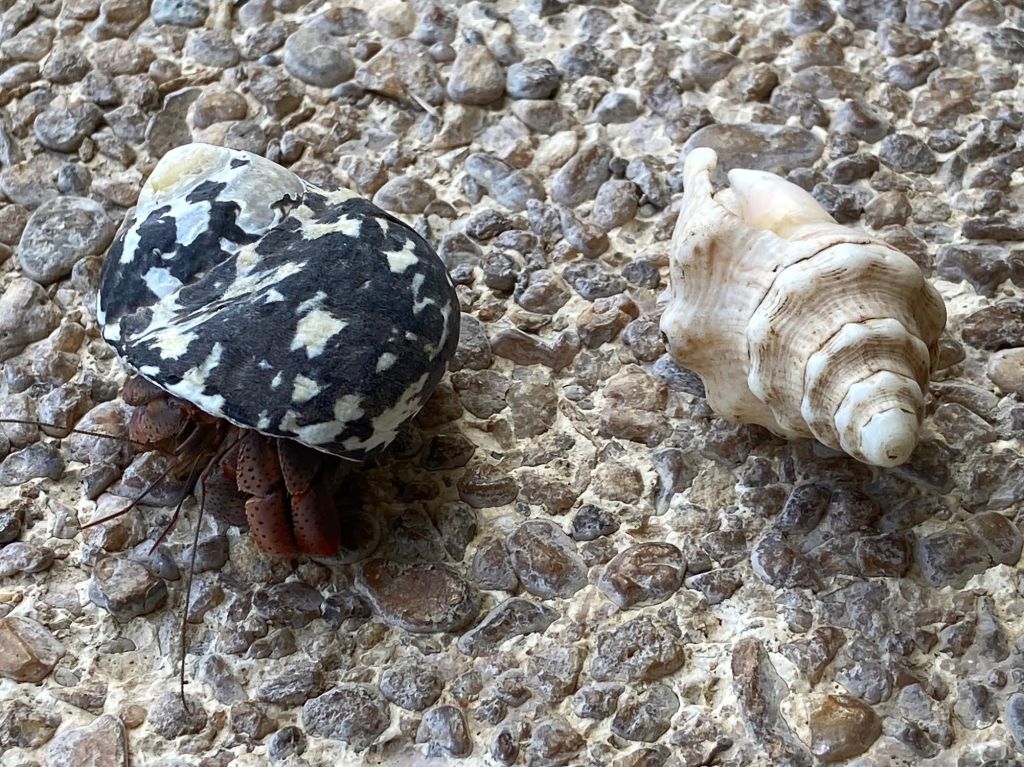
Hermit crabs routinely need larger shells as they grow. They then take a new one and leave their old home behind.

And now that the flooding has receded and the lights are back on after Tropical Storm Ernesto…

Not too long ago, I posted a blog about the hermit crabs that periodically wander through my home on St. Croix in the U.S. Virgin islands. At first, the little guys startled me, especially the one that was almost as big as my fist. But eventually, we got used to them. Now, my sweetie pie and I just pick them up and gently place them back outside.

Then we discovered the crabs were looking for something: crabby real estate. It seems they grow out of their shells and often congregate to switch out, a situation where hopefully everyone crawls away with the perfect place to live, until it’s time again to upsize. Since we live above a rocky beach, Ry and I headed out to gather some shells, which we placed in a corner of the patio, so we periodically get to watch the crabby get-together and find joy when they all wander off in their new digs.

Sargassum seaweed can pile up on beaches in great heaps, a result of climate change. (Photo by Mark Yokoyama)

Then something changed. There weren’t enough shells that fit, so we had crabs wandering around looking quite ill at ease in poorly-fitting homes, which prompted us to head back to the beach. But when we got there we discovered that huge swaths of sargassum had swept in. For the uninformed, sargassum is a red seaweed that in moderate amounts is a good thing. It’s a habitat for small fish and tiny sea turtles, is a wonderful fertilizer, and is, so I’ve heard, quite eatable. But with climate change the blooms have become massive, and when they come to shore the piles can become several feet thick, a red blanket that covers everything on the beach, so any suitable shells were impossible to reach.

Then I did what many of us do when we’re in need of something. I went to Amazon. And you wouldn’t believe how many hermit-crab shells were for sale. Great big bags of them. But whenever I went to buy some, I was told they were “currently unavailable.”

In a never-give-up moment, I called what I thought was a local pet store, but instead I reached a women on the mainland who told me tales of all the hermit crabs she’d provided homes for over the years, even explaining how she’d paint dates on their shells so she could recognize them whenever they returned. At first, I was delighted to meet a kindred spirit, but then I realized that perhaps we both sounded a bit deranged.

She explained that while she had no shells, I could call the Virgin Islands Fish & Wildlife people for some help, which I did. The woman who answered the phone paused for a very long time after I explained my predicament.

I dumped all my shells into a container on the patio, so the hermit crabs could find new homes.

“I don’t know anything about that!” She sounded as if I might be a danger to myself or others.

“Do you know of anyone else I can ask?” I said sweetly.

“No!”

The next morning, a large crab in a small shell pulled himself slowly across the patio. He was clearly depressed. (Don’t ask me how I knew. I just did.) Now I realize I’m not talking about a basket of kittens here, still I felt for the little guy and the rest of his poorly-housed freinds.

So I went back on line and eventually I found a women who specializes in all things hermit crab. In Tennessee. Amy at the Naples Seashell Company assured me she could ship shells to my little island, but her website encouraged me to measure the shell openings for each crab who required a new home and order an appropriately sized shell for them to move into. Note that some of the shells are the size of a pencil eraser and they get progressively bigger, up to the size of the previously mentioned fist-sized behemouth. While I did grab the tape measure, I realized I had no idea where the crabs live when they’re not sauntering through my home, so I picked out a whole bunch of shells in different sizes—note they range from an eighth of an inch to several inches—and placed my order.

My formerly depressed hermit crab got a new home and an instanat change in attitude.

When they arrived, I spilled the shells into a shallow pan, put them in the corner of the patio, and waited for the games to begin. At which point I noticed the depressed crab huddled in the corner. In a matter of seconds, he zeroed in on a shell and—with no quibbling about price or closing costs—hoisted himself into his new home, and then trundled off. I’m guessing he’ll tell the others some new dwellings are on the market.

I’ll let you know how it goes.

Your Forgotten Sons

Inspired by a true story

Anne Montgomery

Bud Richardville is inducted into the Army as the United States prepares for the invasion of Europe in 1943. A chance comment has Bud assigned to a Graves Registration Company, where his unit is tasked with locating, identifying, and burying the dead. Bud ships out, leaving behind his new wife, Loryane, a mysterious woman who has stolen his heart but whose secretive nature and shadowy past leave many unanswered questions. When Bud and his men hit the beach at Normandy, they are immediately thrust into the horrors of what working in a graves unit entails. Bud is beaten down by the gruesome demands of his job and losses in his personal life, but then he meets Eva, an optimistic soul who despite the war can see a positive future. Will Eva’s love be enough to save him?

Release Date: June 6, 2024

Amazon

Apple Books

Barnes & Nobel

Google Books

Kobo

Universal Buy Link

Bookstores, libraries, and other booksellers can order copies directly from the Ingram Catalog.

Find Anne Montgomery’s novels wherever you buy books.

Goodreads

Amazon

Authors, watch what your characters say!

I just finished reading a novel that was based in Ireland. As a women of Irish descent, I loved the descriptions of the rural town where the story was located, all wild green countryside and soft rain and colorful characters. And the story was dramatic and engaging with a missing teenager and mysterious events.

It seems lots of people like the book as it’s a New Your Times best seller with several pages of glowing reviews. Still, I’m hesitant to give you the title, since—as an author myself—I feel badly about denigrating others in the field.

Still, there are things I must point out. The protagonist is a former Chicago detective who spent 25 years as a cop in that gritty city. He moves to Ireland, burned out by his career and a messy divorce, looking for peace. When we meet up with him, he’s fixing up a rundown cottage, where he’s only been for a month or two.

So, what’s my beef? It’s the things Jim says. (Note his real name is not Jim, since I’m doing my best not to reveal the book’s title.) The words coming out of his mouth kept throwing me off.

“People are fierce talkers around here.”

“Well, I’m not rightly sure.”

“Much obliged for the meal.”

Ugh!

Like many of you, I’ve spent way too much time watching American crime shows and reading mystery novels filled with police personnel and detectives, and I’ve never heard one of them speak this way.

“That suits me down to the ground.”

“Looks kind’a loco to me.”

“Got a mess of perch.”

The author points out once or twice that Jim grew up in North Carolina, still that doesn’t explain his choice of words, or that he seems to magically understand terms the local Irish people use. When he’s told that someone “gave grinds,” Jim instantly knew the person in question was tutoring students. Jim also uses the word “townland” repeatedly, when an American would simply say “town.” It’s ironic that at one point the author explains, “One of the reasons he picked Ireland is so he wouldn’t have to learn a new language,” and yet, clearly, Jim has done just that.

“I was just tidying up this thicket of mine.”

“Sang like a little birdie.”

“This dinner’s down to you.”

And now I bet you’re thinking, “Well, gosh, Anne, why do you care about this?”

The answer? Putting this type of language in a hardened Chicago cop’s mouth is distracting. It makes the reader momentarily pause and pulls one out of the story.

Adding to the dialogue issue, is the fact that authors need to understand that people do things differently in different parts of the world. For example, remember the World War II movies where the Germans could pick out an American spy simply by the way they smoked a cigarette? Europeans would hold it between the thumb and forefinger, while Americans held a cigarette between the index and middle fingers. Similarly Jim says with much certainty, “Etiquette is stuff you gotta do just cause that’s how everyone does it. Like holding your fork in your left hand.” And while Europeans eat that way, Americans primarily use their fork in their right hand, with the exception of the times they’re cutting meat when they shift from left to right.

I will admit here that I have also been guilty of errors like this. In the early drafts of my recently published World War II historical fiction novel Your Forgotten Sons, I had soldiers in the 1940s starting Jeeps with keys and adjusting rear-view mirrors. Oops! They used push starters back then and the vehicles had no mirrors. So, I admit, we can all make mistakes. The point is readers want to immerse themselves into the novels they’re reading, into the landscape and characters and plot, but when authors are sloppy, the book loses its magic, something we should all try to avoid.

YOUR FORGOTTEN SONS

INSPIRED BY A TRUE STORY

ANNE MONTGOMERY

Bud Richardville is inducted into the Army as the United States prepares for the invasion of Europe in 1943. A chance comment has Bud assigned to a Graves Registration Company, where his unit is tasked with locating, identifying, and burying the dead. Bud ships out, leaving behind his new wife, Lorraine, a mysterious woman who has stolen his heart but whose secretive nature and shadowy past leave many unanswered questions. When Bud and his men hit the beach at Normandy, they are immediately thrust into the horrors of what working in a graves unit entails. Bud is beaten down by the gruesome demands of his job and losses in his personal life, but then he meets Eva, an optimistic soul who despite the war can see a positive future. Will Eva’s love be enough to save him?

Order your copy today

Amazon

Apple Books

Barnes & Nobel

Google Books

Kobo

Universal Book Link

Find Anne Montgomery’s novels wherever you buy books.

Goodreads

Amazon

Novels Alive gives Your Forgotten Sons 5-Stars!

My thanks to reviewer Amy Wilson of Novels Alive for her review of my World War II historical fiction novel Your Forgotten Sons. Find the review here.

YOUR FORGOTTEN SONS

INSPIRED BY A TRUE STORY

ANNE MONTGOMERY

Bud Richardville is inducted into the Army as the United States prepares for the invasion of Europe in 1943. A chance comment has Bud assigned to a Graves Registration Company, where his unit is tasked with locating, identifying, and burying the dead. Bud ships out, leaving behind his new wife, Lorraine, a mysterious woman who has stolen his heart but whose secretive nature and shadowy past leave many unanswered questions. When Bud and his men hit the beach at Normandy, they are immediately thrust into the horrors of what working in a graves unit entails. Bud is beaten down by the gruesome demands of his job and losses in his personal life, but then he meets Eva, an optimistic soul who despite the war can see a positive future. Will Eva’s love be enough to save him?

Order your copy today

Amazon

Apple Books

Barnes & Nobel

Google Books

Kobo

Universal Book Link

Find Anne Montgomery’s novels wherever you buy books.

Goodreads

Amazon

The power of physical labor

When the men arrived to build us a new shed, I caught Ryan at the back door staring at them like he wanted to go out and play.

A while back, my sweetie pie was going through a rather tough time. He was still caring for his mother who had dementia. Early one morning she was rushed to the hospital. Though Mary was okay in the end, the stress on Ryan was palpable. A short time later, he got a kidney stone. The doctors sent him home and said, “It’ll pass in a few days.” As soon as the little beast moved on, Ryan got Covid. He’d managed to avoid the bug for years, but when it hit him, he was miserable. Then, his father died unexpectedly. About six weeks later, Ryan managed to get his mom into a nursing facility, a bitter-sweet moment. Mary had been running away and biting the home caregiver, and Ryan didn’t have the medical skills to take care of her anymore. I thought moving her to a home would be a relief, and while it was I sensed a tinge of guilt remained behind.

It was at that point that Ryan started cleaning. As he wanted to sell his house, he began sorting through his mother’s closets and boxes and drawers, an endeavor that took weeks, since Mary was a bit of a hoarder.

According to the Forbes article, “The Mental Health Benefits of a Clean Home,” cleaning is good for your health. “(It) might sound like something your parents may have told you to get you to tidy up your toys as a kid, but turns out, there’s some truth to it. Our environment plays an important role in our mental wellness, and keeping a clean home, whether that’s your bedroom, apartment or house, has a variety of benefits you won’t want to ignore.”

What are the advantages of cleaning? It can provide a sense of order and control, which can give us a better handle on our emotions. Cleaning also releases endorphins, hormones that can tamp down stress and act as a pain reliver. Tidying up can improve our focus, which allows our brains to concentrate on one task at a time. And cleaning can regulate our emotions because it “requires us to slow down, which can offer a calming effect during overwhelming situations…”

So perhaps I should not have been surprised when Ry announced that we should get a new shed. The one in my backyard had been a jumbled mess for years. No matter how many times I marched everyone out to clean up the shed, it would quickly return to an impassable room, random stuff tossed in and piled to the ceiling.

I couldn’t really argue about getting a new shed. A sprawling mesquite tree had grown over the top of the building and was slowly crushing the roof, so the contents were removed. Then, after numerous trips to Goodwill and the dump, the guys from Tough Shed appeared to build us a new one.

Ry loves to work with his hands and I caught him staring from the back door as the men put the new shed together. I couldn’t help but think that he looked like a little kid who wanted to go out and play with the other boys. Then I wondered if building things might also be benificial to one’s health and it turns out it is. According to Psychology Today, working with your hands promotes mindfulness and provides a sense of personal accomplishment, which reduces stress and anxiety.

When the shed was finished, Ryan began organizing the little room, building shelves, and finding perfect spots for the belongings we’d kept. The process is ongoing, but he’s getting there. In the meantime, I think I’ll let him be, since the shed seems to be a man-cave of sorts.

I think he’s earned it, don’t you?

YOUR FORGOTTEN SONS

INSPIRED BY A TRUE STORY

ANNE MONTGOMERY

Bud Richardville is inducted into the Army as the United States prepares for the invasion of Europe in 1943. A chance comment has Bud assigned to a Graves Registration Company, where his unit is tasked with locating, identifying, and burying the dead. Bud ships out, leaving behind his new wife, Lorraine, a mysterious woman who has stolen his heart but whose secretive nature and shadowy past leave many unanswered questions. When Bud and his men hit the beach at Normandy, they are immediately thrust into the horrors of what working in a graves unit entails. Bud is beaten down by the gruesome demands of his job and losses in his personal life, but then he meets Eva, an optimistic soul who despite the war can see a positive future. Will Eva’s love be enough to save him?

RELEASE DATE: JUNE 6, 2024

Order your copy today

Universal Buy Link

Amazon

Apple Books

Barnes & Nobel

Google Books

Kobo

Find Anne Montgomery’s novels wherever you buy books.

Goodreads

Amazon