Inspired by a true story: What’s that mean?

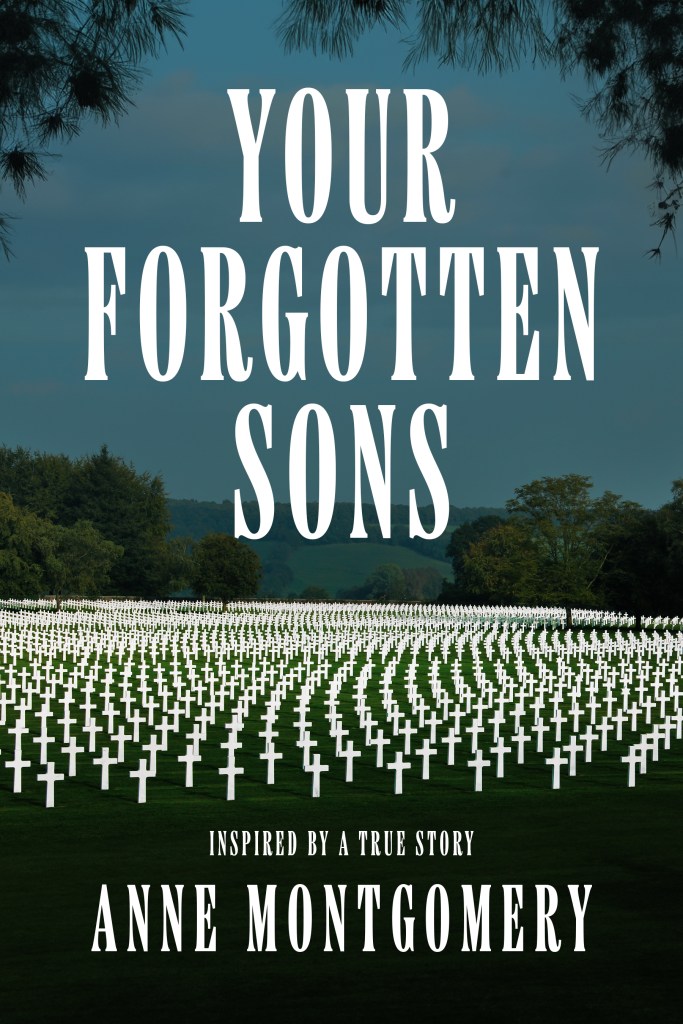
My new historical fiction novel Your Forgotten Sons, which will be released June 6th, 2024 in honor of the 80th anniversary of D-Day, tells the story of Sergeant Bud Richardville, a man who served in the Army’s Graves Registration Services in Europe during World War II. Right on the cover you’ll see the words “Inspired by a true story.” But what does that mean?

First let’s talk about what the book isn’t. Your Forgotten Sons is not based on a true story, because by definition “the expectations are that the characters, storylines, and a majority of the scenes that you present within the script are primarily based on actual occurrences.”

But that doesn’t mean Bud’s story is made up. The phrase inspired by a true story indicates that “it’s based on a real-life event, but that a lot of the characters and scenes surrounding it are fictionalized.”

In Bud’s case, the facts of his story are true. I utilized letters he wrote to family members, oral histories, interviews, and correspondences from the military to determine who Bud was and what happened to him. Sadly, his military records were not available, because in 1973 a massive fire raged through the National Personnel Records Center in St. Louis, destroying approximately 17 million official military personnel files. The records for servicemen and women who had been discharged between 1912 and 1960 were wiped away, the flames consuming 80% of the Army’s archives, Bud’s among them.

I did my best to tell Sergeant Bud Richardville’s story, even though I didn’t always have the facts.

However, I was able to follow Bud’s path through Europe by utilizing the postmarks on his letters home, stamps that gave me dates and locations. Those postmarks, along with his letters, led me to believe that Bud was stationed in England just before D-Day, was part of the invasion at Normandy, was at the Battle of the Bulge, and was in Czechoslovakia when General George Patton’s Third Army liberated that country from the Nazis.

It was only when the book was going to press that I recieved a copy of Bud’s obituary which read, “He landed in France on D-Day and was with Hodge’s First Army as a member of the 606 Graves Registration Company. Action took him from France to Luxembourg, Belgium, Czechoslovakia, and Germany.” So there it was. Proof that the postmarks had confirmed where and when Bud served.

When you read Your Forgotten Sons you will meet other soldiers in the GRS. They are entirely fictitious. Bud did not directly name the men he worked with, so I used my imagination. Nor is the woman Eva real. Though quiet family whispers suggested that Bud may have fallen in love with a woman while in Europe, nothing is known about her, so I created what I hope is a realistic character to serve in her stead. Note that all of Bud’s family members mentioned in the book were real people, as was Bud’s wife Lorraine, though she was shrouded in mystery even when Bud married her. While there is some historical information based on the real Lorraine, she remains an enigma.

I’ll admit that following Bud’s footprints was difficult, still I believe readers will understand my need to create scenes and dialogue that best represent the truth of Bud’s story. In the end, my hope was to remember a man who served his country well, a man who never came home, a man whose remains lie buried in the American Cemetery in Épinal, France, interred there by the soldiers who worked by his side.

Your Forgotten Sons

Inspired by a true story

Anne Montgomery

Bud Richardville is inducted into the Army as the United States prepares for the invasion of Europe in 1943. A chance comment has Bud assigned to a Graves Registration Company, where his unit is tasked with locating, identifying, and burying the dead. Bud ships out, leaving behind his new wife, Lorraine, a mysterious woman who has stolen his heart but whose secretive nature and shadowy past leave many unanswered questions. When Bud and his men hit the beach at Normandy, they are immediately thrust into the horrors of what working in a graves unit entails. Bud is beaten down by the gruesome demands of his job and losses in his personal life, but then he meets Eva, an optimistic soul who despite the war can see a positive future. Will Eva’s love be enough to save him?

Join us at Changing Hands Bookstore in Phoenix on June 6, 2024, for the lanuch of Your Forgotten Sons. Find out more about the event here.

Pre-Order your copy today

Amazon

Apple Books

Barnes & Nobel

Google Books

Kobo

Review a copy early by going to NetGalley. Sign in here.

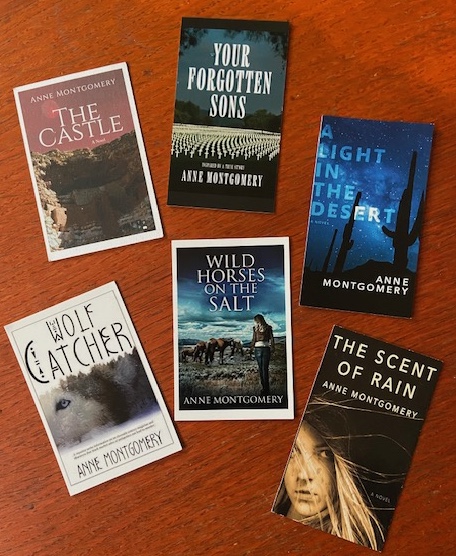
Anne Montgomery’s novels can be found wherever books are sold.

Goodreads

Amazon

Writing historical fiction can be tricky

I almost got tripped up a few times, when writing about World War II Jeeps.

My new book, Your Forgotten Sons, is a work of historical fiction, a story inspired by Sergeant Joseph “Bud” Richardville who worked in the Graves Registration Service in Europe during World War II.

As many authors know, writing about the past can be tricky. One reason is we tend to look at history through our own modern-day lens. For example, when I was writing about Bud, I often had him riding in a Jeep. Today, Jeeps are ubiquitous on civilian roadways, but the origins of the vehicle are steeped in war.

Scripps Howard WWII reporter Ernie Pyle once said of the Jeep, “It did everything. It went everywhere. Was as faithful as a dog, as strong as a mule, and as agile as a goat. It constantly carried twice what it was designed for and still kept going.”

No doubt current Jeep owners prize the vehicle for many of the same attributes. The problem comes when one sees a Jeep and misses the evolution that led to today’s version. When I first wrote Your Forgotten Sons, I had Bud starting a Jeep with keys and adjusting the rearview mirror. Oops! Jeeps back then started with a pushbutton and the vehicles had no review mirrors.

I also had Bud and his fellow soldiers eating K-rations, but I would learn that he and his peers actually consumed C-rations. What’s the difference? K-rations were heavy, having been designed for static warfare, like the trench battles of World War I. But World War II was a different type of war, with fast-moving trucks and tanks and parachute troops who needed lighter combat rations, because soldiers were constantly on the move.

When I first envisioned Bud, I saw him in a green T-shirt, the iconic color of the Army. Today, Army personnel wear undershirts defined as Tan 499 which has a slight green tint to it, a shade referred to as “coyote”. But in Bud’s time, the plain, white cotton T-shirt was what all male service members sported.

When writing about the World War II era, I had to pay close attention to the facts. Luckily, the time is well documented with videos, and photographs, and eye-witness accounts. But consider writing about periods that go way back in history. My novel Wolf Catcher takes place in both modern times and the 11th century in what would become Arizona. I once wrote a scene where Native people used honey to sweeten their food, which could never have happened, because it was not until the early 1600s that European settlers first brought honey bees to the Americas.

It’s clear, then, that when authors choose to write stories based on history, they need to be meticulous in their research.

I’m working on it.

Your Forgotten Sons

Inspired by a true story

Anne Montgomery

Bud Richardville is inducted into the Army as the United States prepares for the invasion of Europe in 1943. A chance comment has Bud assigned to a Graves Registration Company, where his unit is tasked with locating, identifying, and burying the dead. Bud ships out, leaving behind his new wife, Loryane, a mysterious woman who has stolen his heart but whose secretive nature and shadowy past leave many unanswered questions. When Bud and his men hit the beach at Normandy, they are immediately thrust into the horrors of what working in a graves unit entails. Bud is beaten down by the gruesome demands of his job and losses in his personal life, but then he meets Eva, an optimistic soul who despite the war can see a positive future. Will Eva’s love be enough to save him?

Release Date: June 6, 2024

Pre-Order your copy today

Amazon

Apple Books

Barnes & Nobel

Google Books

Kobo

Review a copy early by going to NetGalley. Sign in here.

Find Anne Montgomery’s novels wherever you buy books.

Goodreads

Amazon

A surgery turns into a search for the truth

My dear friend Gina Liparato told me about her Uncle Bud who served in World War II and never came home; a man who worked in the Graves Registration Service in Europe and whose strange death puzzled her for decades.

Baltimore, 2019

I’d traveled to Baltimore at the request of a dear friend. She was facing a delicate, possibly life-changing surgery at Johns Hopkins Hospital and asked that I stand in as her healthcare power of attorney.

The night before the operation, Gina, handed me a Ziplock bag. Inside I found a packet of yellowed letters. We’d spoken of Gina’s elusive uncle—her mother’s handsome, rakish brother—on occasion over the years, and of the odd circumstances surrounding his death near the end of World War II.

“No matter what happens to me, I want you to tell Bud’s story,” she said.

I nodded and promised that I would.

The next day, my friend of over three decades tried to comfort me and her soldier husband: three tours, two in Afghanistan, one in Iraq, a navy-blue sweatshirt boasting an Airborne patch, a bracelet saying Remember The Fallen encircling his wrist. Gina’s husband would soon disappear, leaving her in my care, because the hospital and its patients gnawed at his belly, a reminder of dead and dying soldiers he’d been unable to help in another hospital in Iraq.

I kissed Gina goodbye, told her I loved her, and left her alone with her husband.

Hours later, I sat bedside, staring at my friend who looked small and fragile beneath a thin hospital blanket.

“I want to bring him home.” Her eyes were still glassy from the anesthesia.

“Who?” I gazed at Gina, her face etched with pain. The drugs weren’t helping.

“And I want to know what happened?” She winced and closed her eyes.

“Do you want me to call the nurse?”

“No. Bud…” her voice trailed off.

“It’s been a long time, Gina. And we don’t have much to go on.”  I recalled the night before when she’d extracted those fragile letters with almost religious reverence. The epistles were small squares, etched with tight, black script. I’d made the promise in haste, hoping to make Gina feel better, and now wondered if I could keep my word.

She opened her eyes and squirmed, trying to find a comfortable position, but was under doctor’s orders not to move.

“Stay still! Water?” I reached for a plastic cup with a bent white straw, in an effort to do something.

Gina shook her head and stared out the window. I followed her gaze and focused on the clear blue sky and showy fall foliage, brilliant orange and yellow leaves basking in bright sunshine. I searched for something to say. I’d always been the one who, faced with a problem, could tackle a job and get it done, a hangover perhaps from my previous life as a reporter. But how was I to determine what happened to a man who died mysteriously all those years ago?

“I will have some water.”

I reached for the cup and guided the straw between Gina’s chapped lips. When she was done, I placed it back on the stainless-steel tray next to the bed. Then, she closed her eyes and let out a ragged breath.

I hated feeling helpless. Without thinking, I blurted out, “Let’s go get Bud!”

“Really?” She brightened instantly, a glimpse of the Gina I knew before the surgery.

I nodded. “When you’re better.”

And so, we agreed to travel to France, to the graveyard in Épinal where Sergeant Joseph “Bud” Richardville had lain since his death in 1945. Even if Gina spent the rest of her life in a wheelchair, we’d go to France and find out what happened.

But then Covid hit and our plans were derailed. Still, as Gina healed, we invesitgated Bud’s story, utilizing the resources we had. And, when we were done, we finally knew what happened to Bud Richardville. Your Forgotten Sons, which will be realesed on June 6, 2024 in honor of the 80th anniversary of D-Day, tells his story.

Your Forgotten Sons

Inspired by a true story

Anne Montgomery

Bud Richardville is inducted into the Army as the United States prepares for the invasion of Europe in 1943. A chance comment has Bud assigned to a Graves Registration Company, where his unit is tasked with locating, identifying, and burying the dead. Bud ships out, leaving behind his new wife, Lorraine, a mysterious woman who has stolen his heart but whose secretive nature and shadowy past leave many unanswered questions. When Bud and his men hit the beach at Normandy, they are immediately thrust into the horrors of what working in a graves unit entails. Bud is beaten down by the gruesome demands of his job and losses in his personal life, but then he meets Eva, an optimistic soul who despite the war can see a positive future. Will Eva’s love be enough to save him?

Release Date: June 6, 2024

Pre-Order your copy today

Amazon

Apple Books

Barnes & Nobel

Google Books

Kobo

Review a copy early by going to NetGalley. Sign in here.

Find Anne Montgomery’s novels wherever you buy books.

Goodreads

Amazon

5 Stars for Your Forgotten Sons

To those of you who are NetGalley fans, I’m happy to announce that my new World War II historical fiction novel, Your Forgotten Sons, is now available on the site. And I’m thrilled that the first 5-Star review has posted. Find excerpts below.

“This was a riveting, quick read that focuses on the true experiences of one man, Bud Richardville of Indiana…Bud’s unit is mobile, following the advances of the front-line troops. They land in Normandy only 8 hours after the first assault, to begin their grim duty of collecting, identifying, and burying the dead…This book is well worth reading, not only because it highlights areas of WW II not usually covered but also because it shines a spotlight on the need for mental healthcare for veterans of all wars. I highly recommend this book to all historical fiction lovers.”

You can read the rest of the review here. My thanks to NetGalley’s Lisa Gentry for being the first to review Your Forgotten Sons. If you’d like to become a NetGalley reviewer, go to https://www.netgalley.com/catalog/book/327844.

Coming soon!

Your Forgotten Sons

Inspired by a true story

Anne Montgomery

Bud Richardville is inducted into the Army as the United States prepares for the invasion of Europe in 1943. A chance comment has Bud assigned to a Graves Registration Company, where his unit is tasked with locating, identifying, and burying the dead. Bud ships out, leaving behind his new wife, Lorraine, a mysterious woman who has stolen his heart but whose secretive nature and shadowy past leave many unanswered questions. When Bud and his men hit the beach at Normandy, they are immediately thrust into the horrors of what working in a graves unit entails. Bud is beaten down by the gruesome demands of his job and losses in his personal life, but then he meets Eva, an optimistic soul who despite the war can see a positive future. Will Eva’s love be enough to save him?

Release Date: June 6, 2024

Pre-Order your copy today

Amazon

Apple Books

Barnes & Nobel

Google Books

Kobo

Anne Montgomery’s novels can be found wherever books are sold.

Goodreads

Amazon

On being a biohazard

When I got Covid and subsequently broke my leg a few years back, I was labled a biohazard.

Covid hit me hard in 2021. Hallucinations haunted me, especially the one where I was being attacked by words, which, à la Serena Williams, I batted away. But the more I repelled those words, the faster they came at me. The experience was akin to being inside a video game.

Later, I passed out and awoke with a severely broken leg, one that had to be surgically repaired and which kept me hobbling around for about eight months. I mention this because when I was hospitalized the fact that I still had Covid was problematic. The sign outside my room said Biohazard in big letters, underneath of which was my name, as well as those of the other Covid patients on the floor.

As a former sports official, an avocation I practiced for forty years, I’d been called a lot of unpleasant things, still Biohazard was a something new and rather sinister sounding. The medical staff coming in and out of my room in coveralls, hoods, and goggles lent an ominous tone, so as you can imagine I was happy when they released me to recover from the virus and wait for surgery at home.

Recently, I dealt with a similar issue. I have what is disturbingly called a degenerative spine, the result of too many falls and hits and lots of repetitive motion. So, my surgeon sent me off to the imaging people, where a nice lady stuck a needle in my arm and deposited a bit of radioactive material into my bloodstream. If the idea is making you squeamish, note that I was a bit queasy about the idea as well.

“Will I glow?” I asked the technician.

 She smiled. “Maybe some sparkles.”

I waited several hours for the radioactive stuff to do its job, then I had to stay completely still for about a half an hour. The scanning machines hummed quietly, as they rolled over and around me. It wasn’t unpleasant, though my nose itched and I wasn’t allowed to scratch it. Still, in the grand scheme it was pretty painless.

When it was over, I asked if I could see the results and what I saw was strangely beautiful. My spine was lit up in purple and turquoise and a bright yellow patch burst from my cervical spine.

“That’s the bad part,” I said pointing at the stary spot.

“I can see that,” she said.

The scans will go to the neurosurgeon, who will decipher all that light and decided how to fix me. I tried to understand what he might see, but like many body scans there was a Rorschach-test quality to the pictures that I couldn’t decode.

I thanked the woman for her help, and before I left she said, “Don’t hold any babies for a few hours. And don’t sit next to any pregnant women.”

I squinted.

“And you probably shouldn’t go to the airport. TSA might stop you.”

“I’m leaking radiation?”

She smiled.

Biohazard indeed.

Your Forgotten Sons

Inspired by a true story

Anne Montgomery

Bud Richardville is inducted into the Army as the United States prepares for the invasion of Europe in 1943. A chance comment has Bud assigned to a Graves Registration Company, where his unit is tasked with locating, identifying, and burying the dead. Bud ships out, leaving behind his new wife, Lorraine, a mysterious woman who has stolen his heart but whose secretive nature and shadowy past leave many unanswered questions. When Bud and his men hit the beach at Normandy, they are immediately thrust into the horrors of what working in a graves unit entails. Bud is beaten down by the gruesome demands of his job and losses in his personal life, but then he meets Eva, an optimistic soul who despite the war can see a positive future. Will Eva’s love be enough to save him?

Release Date: June 6, 2024

Pre-Order your copy today

Amazon

Apple Books

Barnes & Nobel

Google Books

Kobo

Anne Montgomery’s novels can be found wherever books are sold.

Goodreads

Amazon

AI Editor: Part deux

I named my AI editor Hal Jr. and I think he did a pretty good job.

A while back, I wrote about an experiment I agree to. My publisher asked if I’d like to try a new kind of editor. I have a book coming out in June—a historical fiction, World War II novel inspired by a true story called Your Forgotten Sons—and the idea was that I would work with an editor of the “artificial intelligence” variety.

I thought about that for a while, and when my publisher said I could switch to a human editor if I was unhappy with the results, in the interest of not being called old and technology averse, I agreed.

I recently sent the completed manuscript back, so here’s what I’ve learned about working with an AI editor, who I dubbed Hal Jr. First, since we authors have long been working remotely with our editors, the process didn’t feel all that strange. I received my document full of those red lines leading to comments I needed to consider. My job was to accept Hal Jr.’s fixes or not.

Almost universally, I said yes. He did a great job finding all those grammatical boo-boos I’ve made most of my life. You’d think that after writing nine books and having five published, not to mention my years working as a print reporter, that I would have figured out to spell compound words by now. But, no! Hal Jr. gently pointed out that corkscrew and curveball were single words, terms that have meant a great deal in my life and which one might think I would have no trouble spelling.

Then there were the homophones, which for those who don’t recall elementary school English are words that are pronounced alike but that differ in spelling and meaning. I have a serious issue with those, and Hal Jr. had his red pen out to illustrate my deficiencies: alter and altar, aisle and isle, and, rather embarrassingly, your and you’re.

I am also grateful that Hal Jr. sometimes identified words I misused, ones that were similar to what I wanted, but clearly wrong: resemble and reassemble, barley and barely, shuddered and shuttered, cheeks and checks.

And Hal Jr. did a damn good job at picking up those missing quotation marks and other errant punctuation, especially all those outdated commas. As a girl who grew up in a home where we debated comma use at the dinner table, I can tell you that the wee squiggle is no longer used as much as it once was. It’s all about clarity and flow, so I let Hal Jr. lead the way in the comma department.  

My AI editor and I then ran into one big argument. He kept correcting things that I thought were right. Turns out there was an issue with which English we were using. Hal Jr., it appears, is British and I’m American. Who knew there were so many disparate spellings between us: pummeled or pummelled, apologize or aplologise, humor or humour, ad nauseum. He and I agreed to disagree, and the American versions won out.

All in all, I think Hal Jr. did a great job, so much so that I wish he and I could maybe have a beer to celebrate the completion of the manuscript. I’m not sure if AIs drink beer, but if I had to guess, I’d say Hal Jr. would drink his warm, yet another difference between we Americans and Brits.

The manuscript is now out of my hands, so I hope it’s perfect, but I know that’s probably impossible. But should you find any errors please feel free to blame Hal Jr.

Anne Montgomery’s novels can be found wherever books are sold.

Goodreads

Amazon